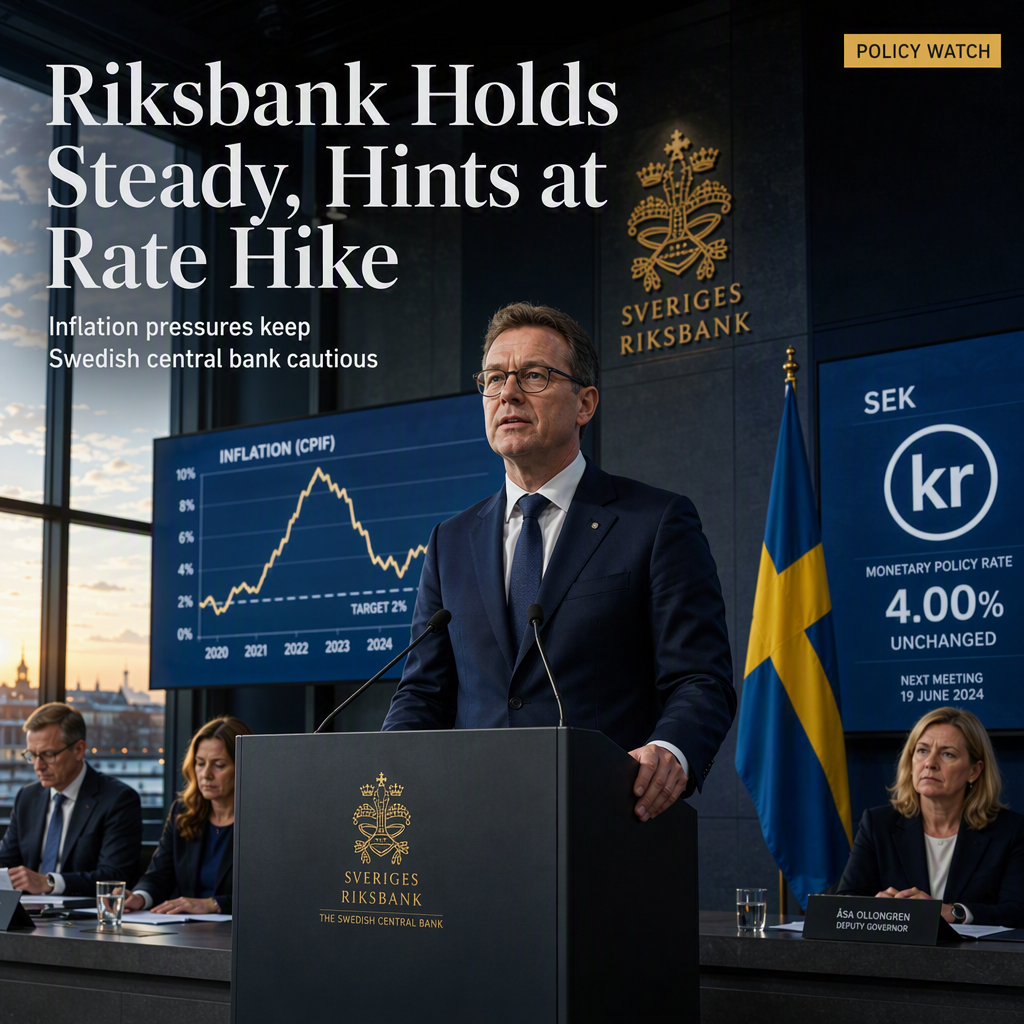
The Swedish Riksbank has decided to keep its policy rate steady at 1.75%, citing a balanced approach in light of mixed economic signals. According to BNY Mellon's Geoff Yu, the central bank's decision was influenced by stronger-than-expected growth and inflation, contrasted with a softer labor market and subdued company pricing plans [1]. Summer inflation readings exceeded the bank's June forecast, and underlying inflation is close to 2%, although measured inflation remains low due to temporary fiscal measures [1].
The Riksbank also acknowledged ongoing uncertainty stemming from the Middle East conflict, but noted that the economic impact has been smaller than initially feared [1]. Despite maintaining a broadly unchanged outlook, the central bank has left the door open for a potential rate increase later in the year if inflation persists [1].
No specific forward-looking analyst opinions were provided beyond the bank's own statement that a rate hike remains possible should inflation prove more persistent [1].
CONCLUSION
The Riksbank's decision to hold rates reflects a cautious stance amid mixed economic signals, with stronger inflation offset by a weaker labor market. While the outlook remains broadly unchanged, the possibility of a rate hike later this year could influence market expectations for the Swedish Krona. Investors should monitor inflation trends and central bank communications for further guidance.