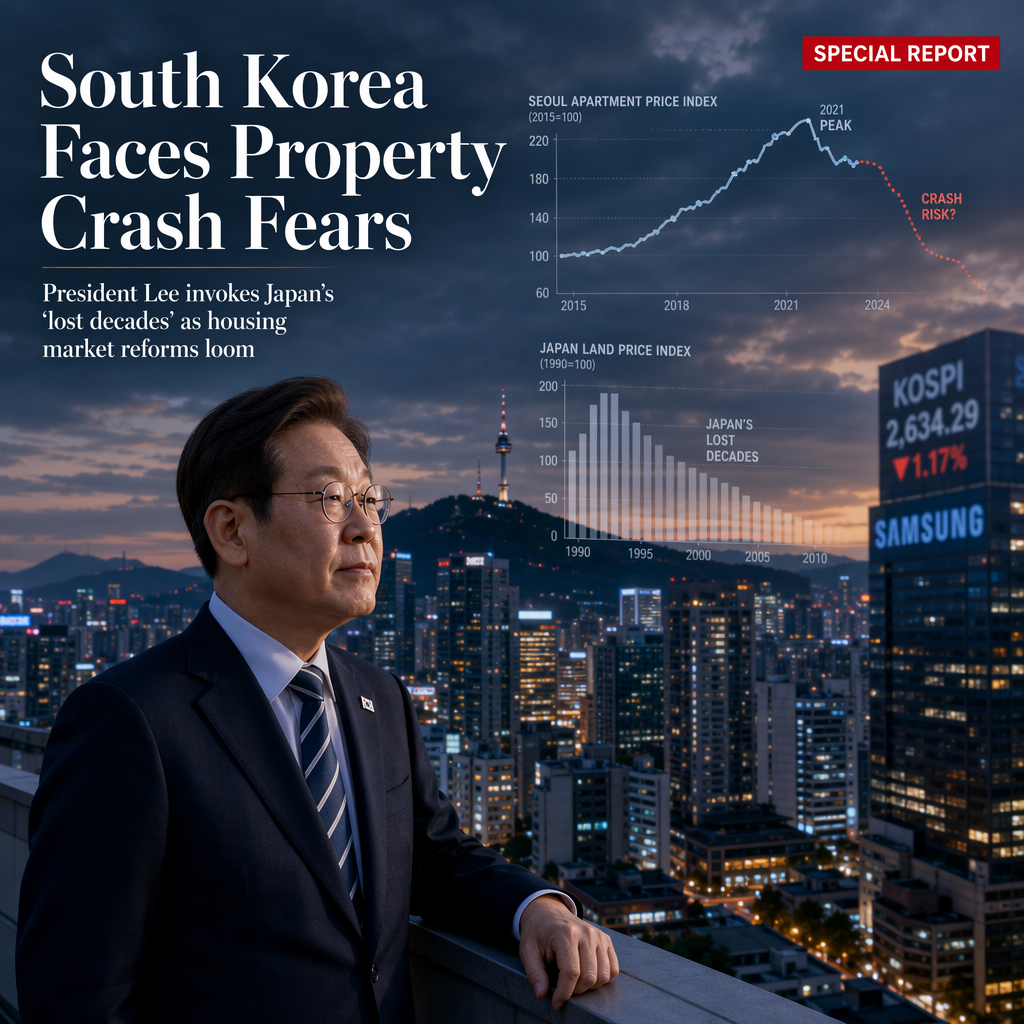
South Korean President Lee Jae Myung has invoked the specter of Japan's property crash in the early 1990s to highlight concerns over South Korea's overheated real estate market as he prepares to revise taxes aimed at stabilizing the housing sector [1]. In a public discussion on real estate policy, President Lee referenced Japan's 'lost decades,' warning that 'quite a few people' fear South Korea could face a similar prolonged period of stagnation if the housing market is not addressed [1].
Lee emphasized that real estate constitutes the largest share of South Korean household wealth, with data showing that as of end-March 2025, real assets made up 75.8% of Korean household assets, compared to 24.2% for financial assets [1]. The president's administration has attempted to redirect household wealth from the overheated housing sector into financial markets, a strategy that has seen mixed results. The benchmark Kospi index, which Lee previously targeted to reach 5,000 during his term, briefly crossed that mark in January 2026 amid an AI-powered chip boom, but now hovers around 6,700, experiencing volatility due to the dominance of Samsung Electronics and SK Hynix [1].
Despite President Lee's warnings, economists cited by CNBC believe the comparison to Japan may overstate the immediate risks. Kang Min Joo, senior economist at ING, stated that the probability of a real asset bubble burst in Korea is limited, noting that mortgage lending conditions have been tight for several years and authorities have maintained strict controls on loan-to-valuation and debt-to-income ratios. The LTV ratio, once as high as 80%, has fallen to below 40% in the Seoul area [1]. The household debt-to-GDP ratio stands at 90.14 as of 2024, down from a record high of 98.67 in 2021, but remains the second highest in Asia behind Australia [1].
Gareth Leather, senior economist for Asia at Capital Economics, echoed the sentiment that fears of a bubble are exaggerated, suggesting that the president's comments reflect concerns about the recent rise in housing prices rather than an imminent market collapse [1].
CONCLUSION
President Lee's invocation of Japan's property crash has heightened awareness of risks in South Korea's real estate market, but economists argue that current lending controls and debt levels mitigate the likelihood of a similar crisis. While concerns about rising housing prices persist, the consensus among experts is that fears of a bubble are overstated.