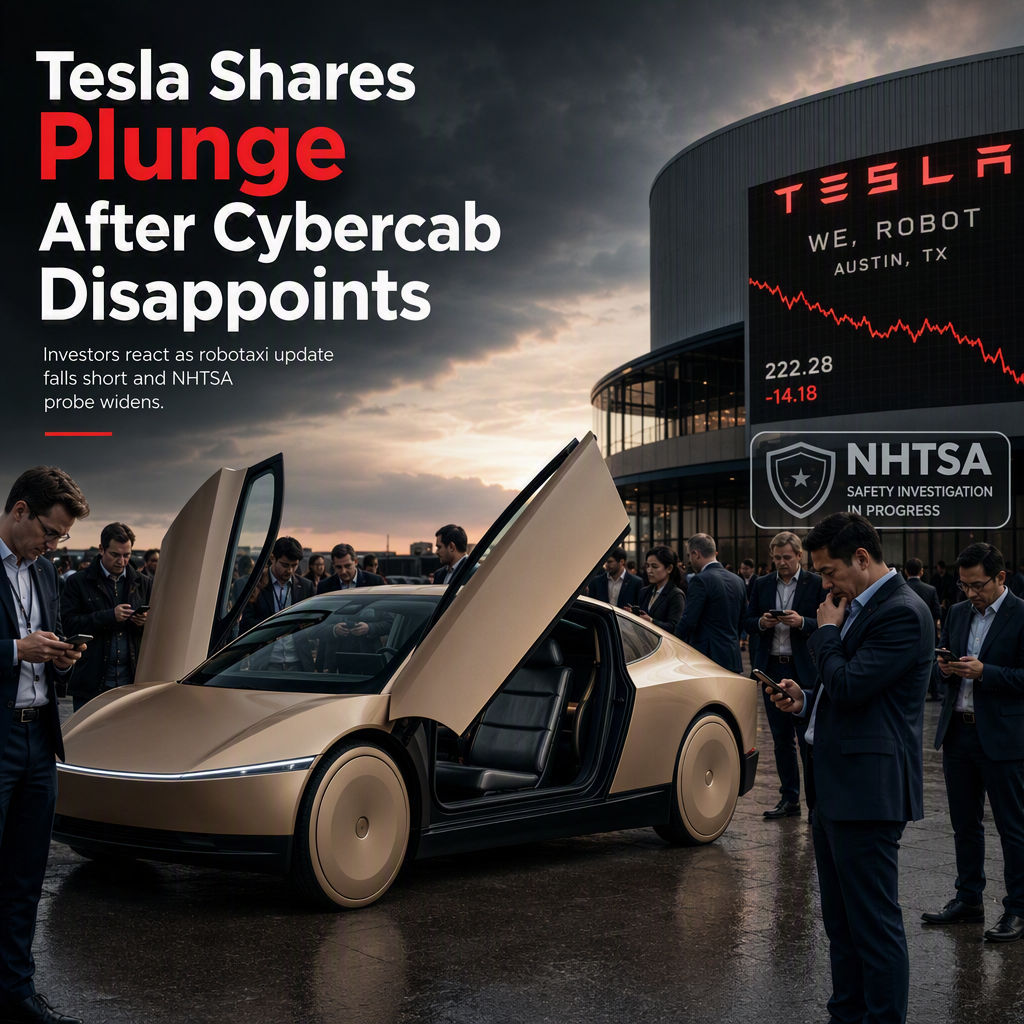
Tesla's stock declined by 6% on Friday following the company's highly anticipated Cybercab update, which failed to meet Wall Street's expectations and left investors unimpressed. The Cybercab, a bronze-colored two-seat robotaxi with scissor doors and no steering wheel or pedals, has been in production since April and was first revealed nearly two years ago. The update event, held in Austin, Texas, was invite-only, not livestreamed, and did not feature an appearance by CEO Elon Musk, marking a departure from Tesla's usual high-profile product launches. Tesla announced that users of its Robotaxi ride-hailing app can now book driverless trips in the Cybercab within a geofenced area around Austin [1].
Analysts at RBC Capital Markets noted that Tesla provided only limited new information compared to previous announcements, with significant questions remaining about pricing, production cadence, and regulatory approvals. Despite these concerns, RBC analysts maintained a buy recommendation on Tesla shares. Wells Fargo analysts echoed the sentiment of disappointment, titling their note 'TSLA Cybercab Launch Event Underwhelms' and highlighting early execution issues with the Austin robotaxi service, including user-reported routing errors, missed destinations, and excessive wait or drive times [1].
In addition to the lackluster event, the National Highway Traffic Safety Administration (NHTSA) launched an 'audit query' on Thursday to assess whether Tesla properly self-certified the Cybercab as compliant with U.S. federal safety standards for public road use. This regulatory scrutiny adds further uncertainty to the rollout of Tesla's robotaxi service [1].
The 6% stock drop on Friday followed a 5.4% gain on Thursday ahead of the event, indicating that investor optimism was quickly reversed by the perceived shortcomings of the update and the emergence of regulatory concerns [1].
CONCLUSION
Tesla's Cybercab update failed to deliver the clarity and excitement investors anticipated, resulting in a significant stock decline and heightened regulatory scrutiny. Key questions about the robotaxi's pricing, production, and safety compliance remain unresolved, contributing to market uncertainty. The event's underwhelming reception and early operational issues suggest that Tesla faces significant challenges in establishing itself in the U.S. robotaxi market.