
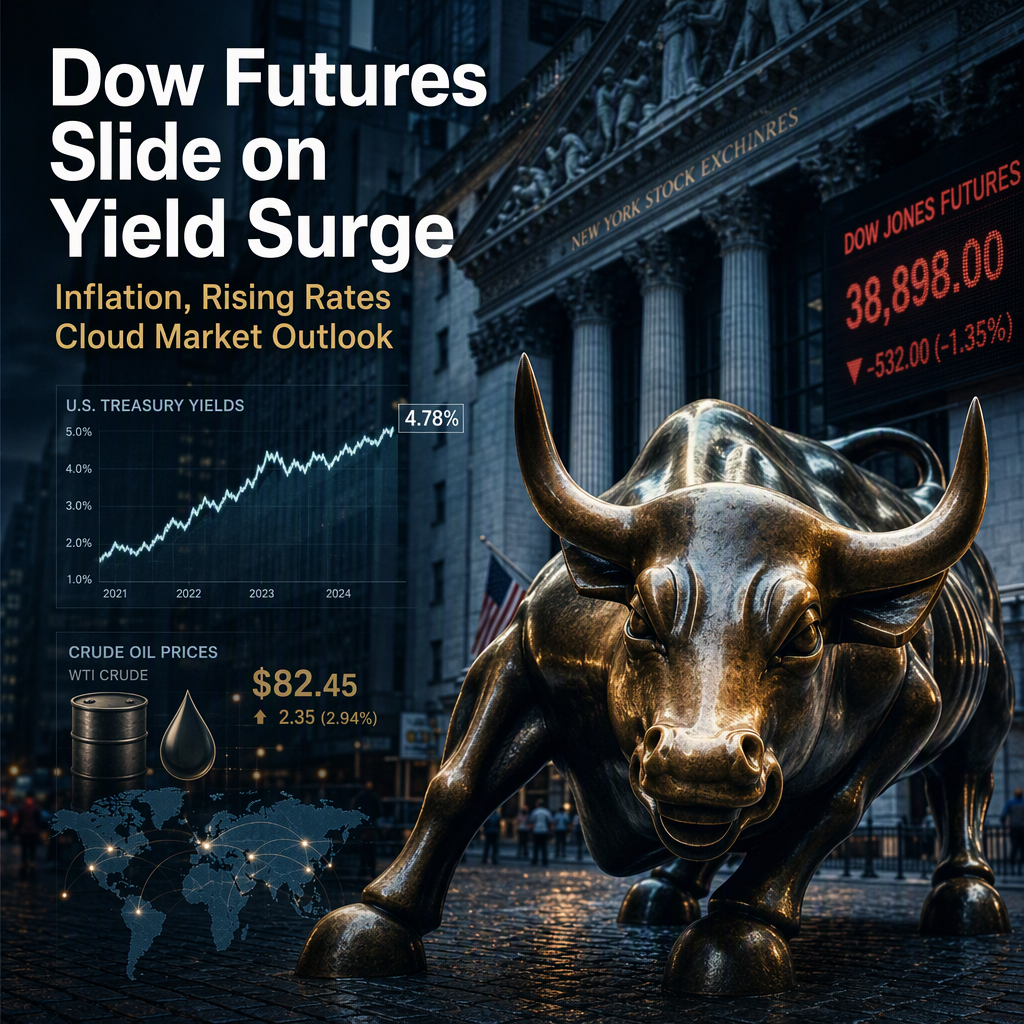
Dow Jones futures declined by 0.42% to trade near 51,060 during European hours on Thursday, reflecting investor caution amid rising US Treasury yields and persistent inflation concerns [1]. In contrast, S&P 500 futures edged up by 0.09% to around 7,720, and Nasdaq 100 futures rose 0.51% to near 30,850, highlighting mixed sentiment across major US indices [1].
The increase in Treasury yields was notable, with the 10-year yield climbing to 5.33% and the 30-year yield reaching 5.67%, both marking 24-year highs. These moves were driven by worries over energy-driven inflation and the potential for tighter monetary policy. Elevated oil prices, compounded by limited progress in US-Iran negotiations and only tentative signs of recovering Middle East supply flows, added to inflationary pressures [1].
During regular US trading on Wednesday, the Dow Jones and S&P 500 fell by 0.86% and 0.25%, respectively, while the Nasdaq Composite managed a 0.24% gain. Financial and industrial stocks were particularly weak, as higher yields weighed on market sentiment [1].
However, recent inflation data provided some relief. The August US Personal Consumption Expenditures (PCE) price index rose 0.3% month-over-month, below the 0.4% forecast, and core PCE increased 0.2%, under the 0.3% consensus estimate. On an annual basis, headline PCE inflation slowed to 3.4%, significantly below the projected 3.7% [1].
Looking ahead, market participants are focused on Friday’s US Nonfarm Payrolls report, with consensus estimates expecting 90,000 jobs added in September and the unemployment rate to remain at 4.1%. Investors are also monitoring upcoming corporate earnings from Nike, McCormick, and Acuity Brands [1].
CONCLUSION
Rising US Treasury yields and persistent inflation concerns have pressured Dow Jones futures, though softer-than-expected inflation data offered some relief. Market attention now turns to the upcoming US Nonfarm Payrolls report and key corporate earnings, which could provide further direction for equities.