
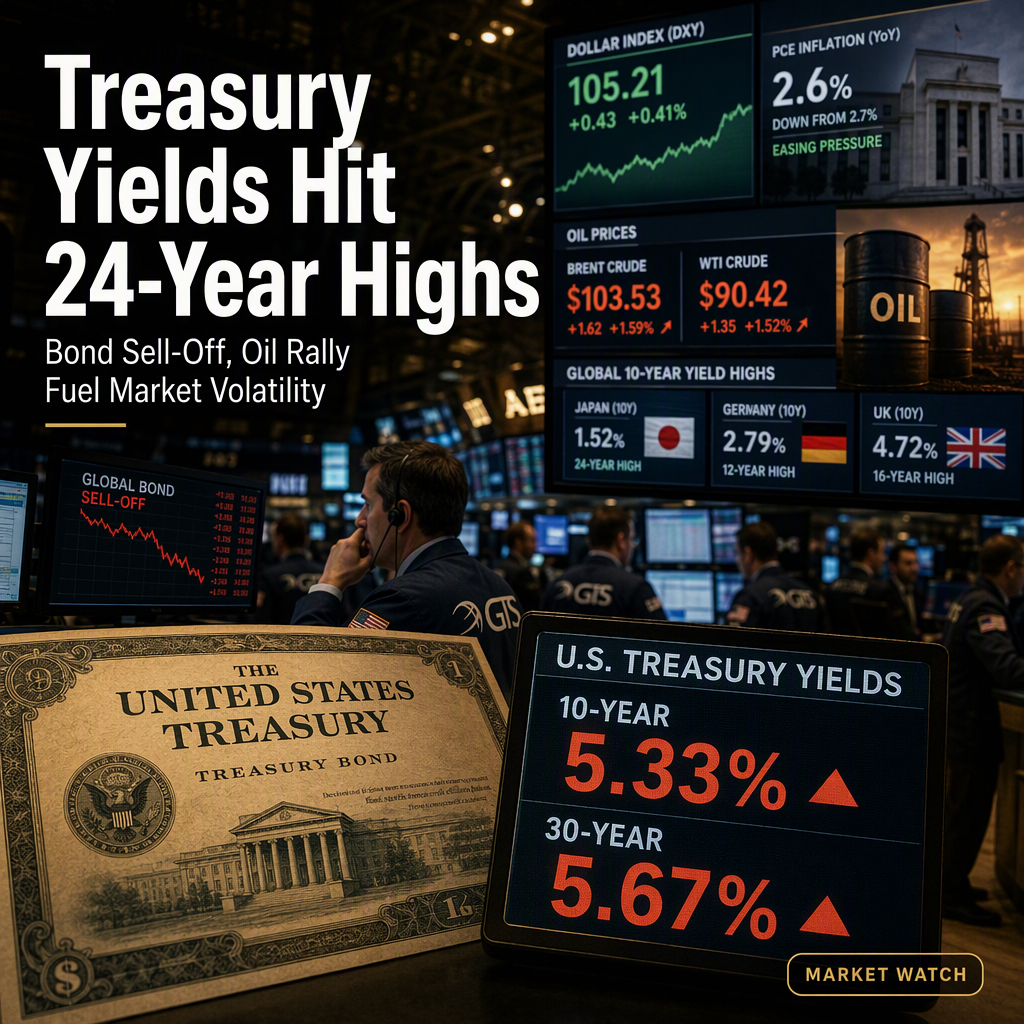
US Treasury yields soared to levels not seen since 2002, with the 10-year yield rising to 5.33% and the 30-year yield reaching 5.67% amid a global bond sell-off and persistent inflation concerns driven by elevated energy prices [2][5][6]. The 2-year yield also advanced, touching 4.92% [2][6]. This surge in yields was accompanied by a sharp rally in Brent crude oil, which climbed 42% from its June lows to $103.53 per barrel, and WTI rose to $90.42 per barrel, as the re-escalation of the US-Iran conflict fueled skepticism about a near-term resolution and reinforced inflationary pressures [2][3]. Deutsche Bank’s Jim Reid described the quarter as 'tricky,' noting that the bond rout was largely triggered by the oil price surge and geopolitical tensions [2][3].
Despite the upward pressure on yields, US inflation data surprised on the downside. The August Personal Consumption Expenditures (PCE) price index rose 0.3% month-over-month, below the 0.4% forecast, while core PCE grew 0.2%, under the 0.3% consensus. On an annual basis, headline PCE inflation decelerated to 3.4%, significantly below the projected 3.7% [2]. Revised core PCE figures showed a three-month annualized rate of 2.1% and a six-month rate of 2.7% in August, down from 3.3% in February, indicating a moderation in underlying price pressures [1][2]. The Bureau of Economic Analysis revisions lowered the annual rate of change for the core PCE deflator by 36 basis points, more than the expected 10-20 basis points [2].
Market expectations for aggressive Federal Reserve rate hikes eased following the softer inflation data. The CME FedWatch Tool showed a 39% chance of an October rate hike, down from nearly 51% before the inflation release [2]. New York Fed President Williams stated, 'there is no need for urgency' after the recent rate hike, suggesting the Fed will take its time to review additional data before tightening policy further [1]. MUFG’s Lee Hardman noted that the US Dollar Index reached a year-to-date high around 101.80, maintaining upward momentum despite the softer inflation data and less aggressive Fed hike expectations [1]. Short-term US yields and the Dollar initially fell after the inflation report but quickly recovered as markets looked past the surprise [2].
Global bond yields also rose, with Japan’s 10-year yield at 3.126%, its highest in three decades, and Germany’s 10-year bund at 3.6179%, the highest since 2008. French, Italian, and UK 10-year yields similarly reached multi-year highs, reflecting widespread investor concerns over fiscal deficits and sticky inflation [6]. Rabobank warned that another phase shift higher in US 30-year yields could push them into ranges seen during the late Cold War period, with Bill Gross advising caution on bonds and stocks [5].
Looking ahead, market focus shifts to the upcoming US Nonfarm Payrolls report, with consensus estimates anticipating 90,000 jobs added in September and the unemployment rate holding steady at 4.1% [2]. The Fed will also monitor the US CPI report for September as it continues to assess the timing of future rate hikes [1].
CONCLUSION
US Treasury yields have reached their highest levels in over two decades, driven by a global bond sell-off, surging oil prices, and persistent inflation concerns. Softer US inflation data has eased expectations for aggressive Fed rate hikes, but market volatility remains elevated as investors await key labor and inflation reports. The outlook for yields and risk assets will depend on upcoming economic data and central bank policy signals.