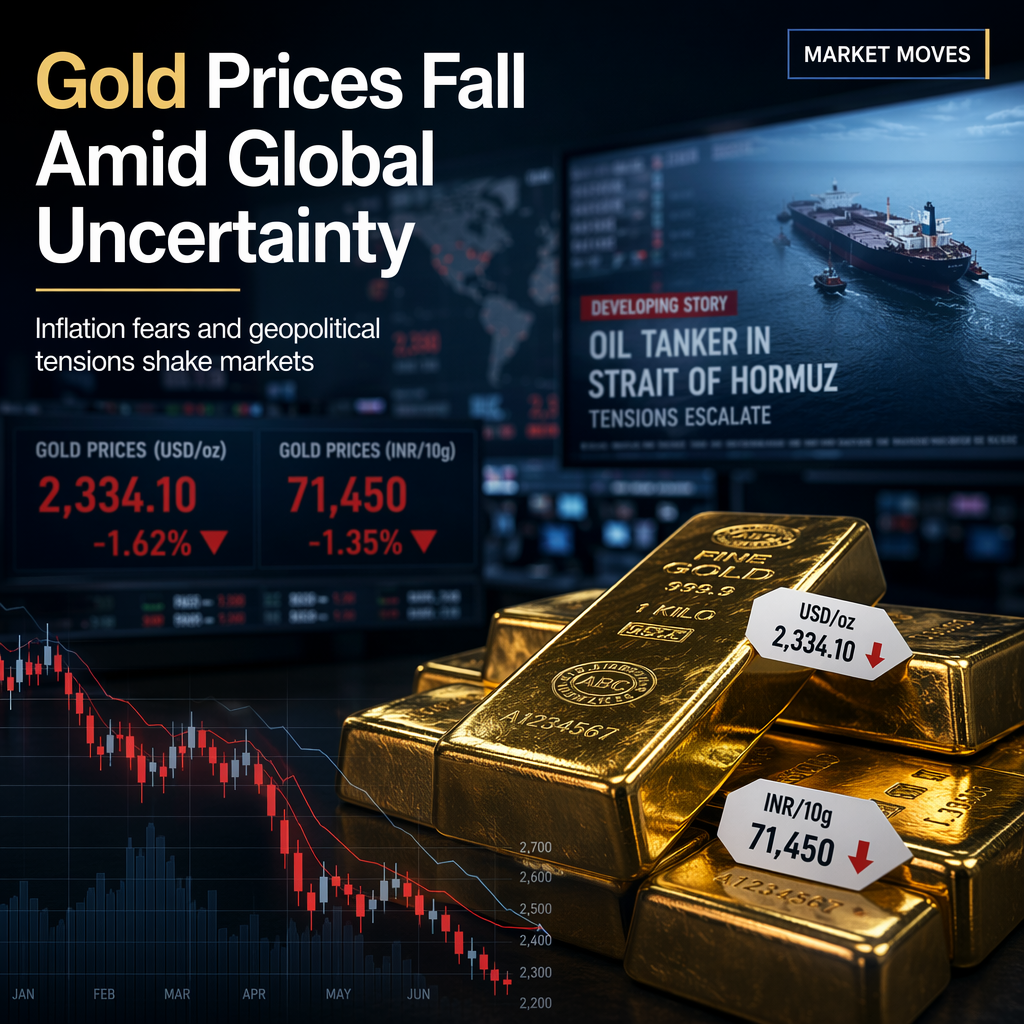
Gold prices experienced a decline for the second consecutive day, with the XAU/USD pair dropping to the $4,125-$4,124 region during the Asian session on Tuesday, according to FXStreet [1]. In India, gold prices also fell, with the price per gram decreasing to 12,665.01 Indian Rupees (INR) from 12,769.91 INR the previous day, and the price per tola dropping to 147,722.20 INR from 148,945.80 INR [2]. FXStreet notes that Indian gold prices are calculated by adapting international prices (USD/INR) to local currency and measurement units [2].
The decline in gold prices is attributed to reviving inflation fears, driven by rising crude oil prices amid renewed tensions in the Strait of Hormuz. These tensions are heightened by Tehran's efforts to assert strategic control and collect fees from ships, as well as a reported incident where an oil tanker was struck by an unidentified projectile while transiting the strait. These developments have supported crude oil prices and contributed to inflationary concerns, which in turn have acted as a tailwind for US Treasury bond yields and diverted flows away from gold [1].
Despite these pressures, receding US Federal Reserve rate hike bets and a lack of US Dollar (USD) buying have helped limit deeper losses for gold. The soft US Nonfarm Payrolls (NFP) report for June has led traders to shift expectations from one to two Fed rate increases in 2026 to between zero and one hike. The US ISM Services PMI eased to 54.0 in June from 54.5 in the previous month, matching consensus estimates and doing little to boost the USD [1].
Technical analysis shows that XAU/USD retains a bearish near-term bias, trading below the 200-day Simple Moving Average (SMA) at $4,489.97 and within a descending channel. However, the Moving Average Convergence Divergence (MACD) indicator has turned positive, suggesting some recovering bullish momentum, though not yet strong enough to challenge the dominant overhead structure. The Relative Strength Index (RSI) at 44.16 remains below the 50 line, indicating a neutral to mildly bearish tone [1].
Investors are reportedly hesitant to place aggressive bets and are awaiting further cues about the Federal Reserve's policy path, with attention turning to the upcoming release of the FOMC Minutes on Wednesday. Geopolitical developments are also expected to influence USD demand and gold prices in the near term [1].
CONCLUSION
Gold prices have declined both globally and in India, pressured by inflation concerns and geopolitical tensions, despite softer US economic data and receding Fed rate hike expectations. Market participants remain cautious, awaiting further signals from the Federal Reserve and ongoing geopolitical developments. The overall market sentiment for gold remains neutral to mildly bearish in the short term.