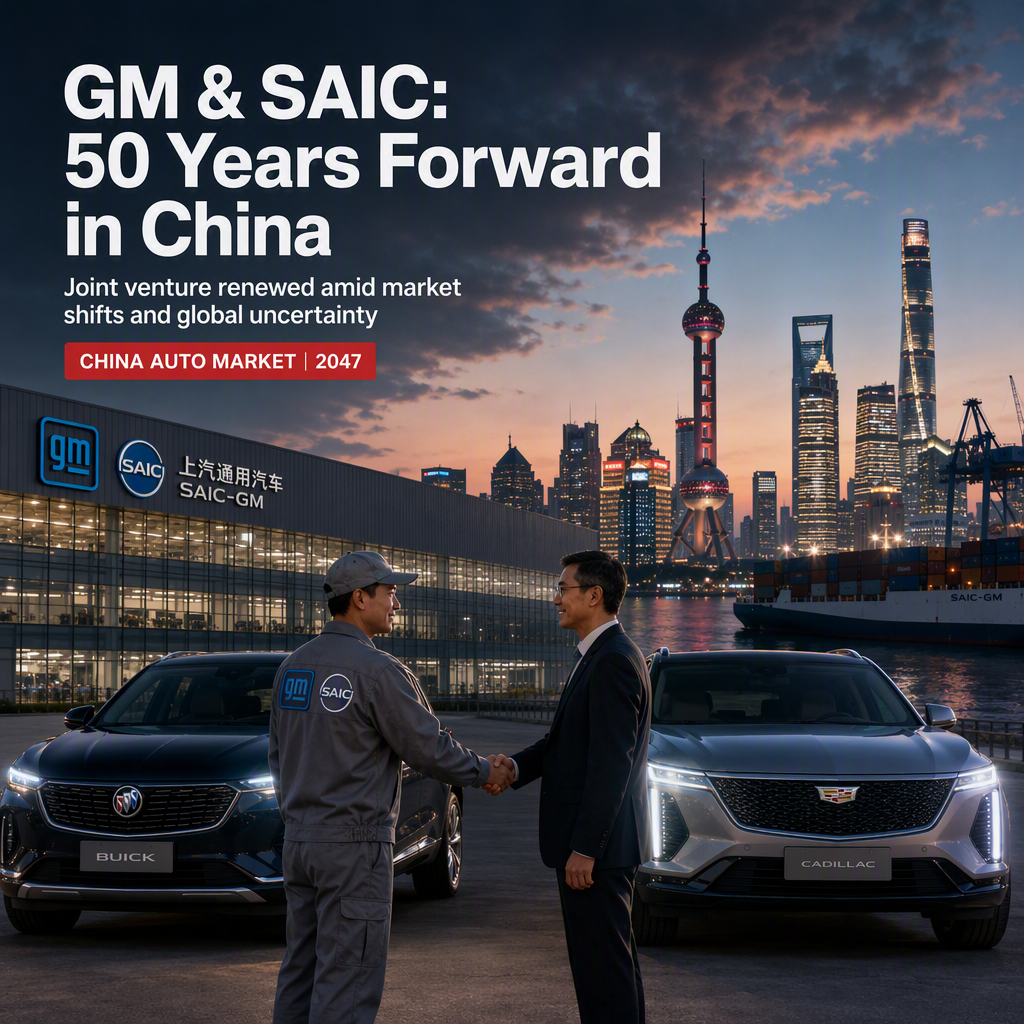
General Motors (GM) and China's SAIC Motor have agreed to extend their joint venture by 20 years, pushing its duration to 2047 and marking a total of 50 years since its inception in 1997. The renewed agreement maintains the 50-50 partnership structure and will focus on domestic sales of Buick and Cadillac models in China, as well as exporting Chevrolet vehicles manufactured in China to non-U.S. markets [1].
This extension comes at a time of heightened geopolitical tensions between the U.S. and China, including ongoing discussions about a potential ban on Chinese automotive brands and vehicles in the United States. Despite these challenges, GM expressed optimism about its prospects in China and select international markets, with GM China President John Roth stating, "We are committed to strong performance in the China market, and we see meaningful opportunities to compete in select international markets: the Middle East, Africa, South America, Mexico and Asia-Pacific" [1].
The Chinese auto industry is undergoing rapid transformation, with domestic automakers rising quickly and a shift away from traditional Western brands and legacy joint ventures. This has led to a slowing Chinese market and underutilization of manufacturing plants, prompting automakers like GM to pursue export opportunities. China has recently become the world's largest vehicle exporter, driven by government support and a culture of innovation [1].
Financially, GM's performance in China has faced challenges. After being GM's top sales market from 2010 to 2023, shifting market dynamics led to restructuring efforts. GM's earnings from China fell from approximately $2 billion annually in 2018 to two consecutive years of losses in 2024 and 2025. Following restructuring actions that cost $1.1 billion in special charges last year, GM reported $248 million in equity income from China in the first half of 2026 [1]. Since its establishment, the joint venture has produced and delivered over 20 million vehicles [1].
CONCLUSION
GM and SAIC's decision to extend their joint venture underscores a long-term commitment to the Chinese market despite recent financial setbacks and geopolitical uncertainty. The move signals GM's strategic pivot toward exports and restructuring in response to evolving market dynamics, with moderate optimism for future performance.