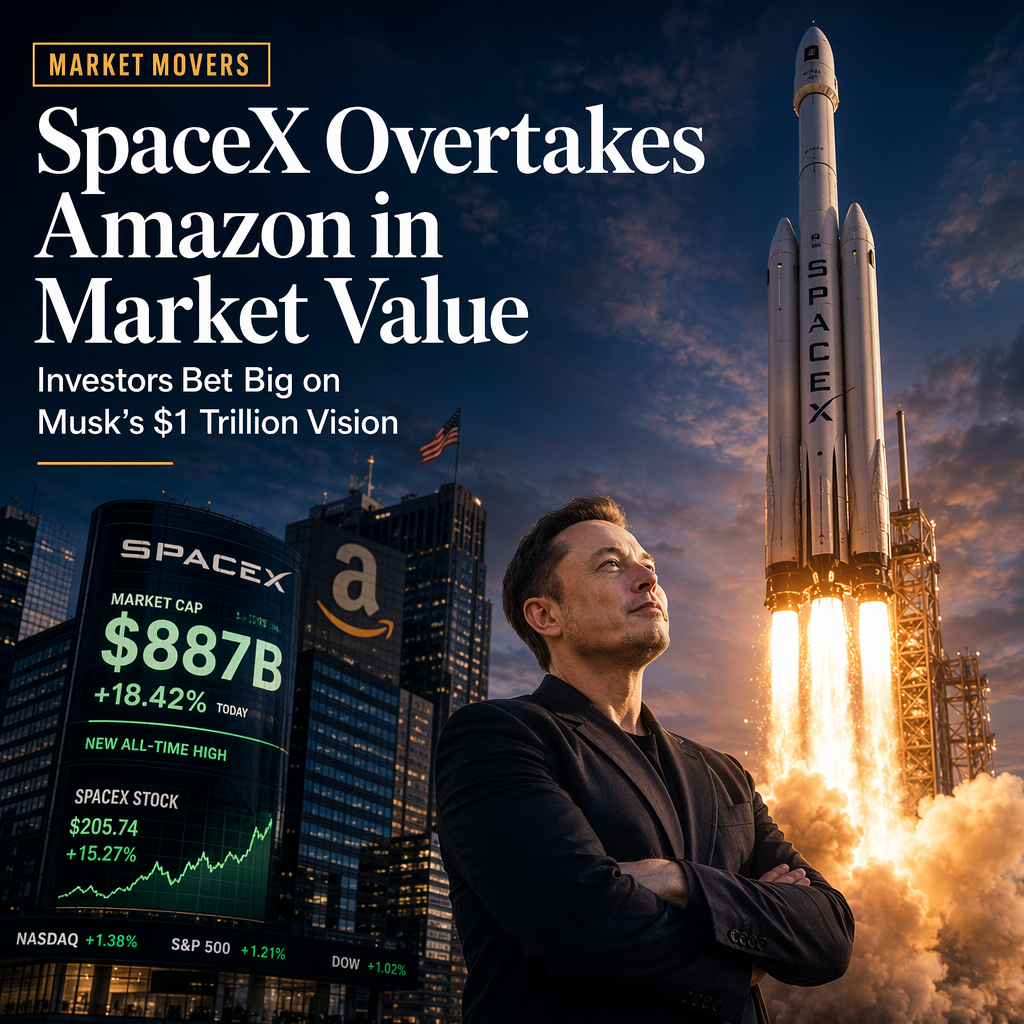
SpaceX shares climbed 3% in premarket trading on Wednesday, continuing a rally that has seen the stock surge approximately 62% since its IPO on Friday [1]. This sustained momentum propelled SpaceX's market capitalization to $2.65 trillion at the close on Tuesday, allowing it to surpass Amazon and briefly overtake Microsoft as the fourth-largest U.S. company by valuation [1].
The surge in SpaceX's valuation comes despite the company posting a $4.9 billion net loss in 2025 and a $4.28 billion loss in the first quarter of 2026 [1]. Investors appear to be betting on the long-term potential of founder and CEO Elon Musk, who stated on X that SpaceX "might be able to reach approximately" $1 trillion in revenue by 2030 [1].
The company's dominance in satellite technology through its Starlink service and reusable rockets has fueled optimism, but the lofty valuation has also raised questions about the sustainability of such rapid growth [1]. Peter Boockvar, chief investment officer at One Point BFG Wealth Partners, commented on CNBC that while the upside is significant if SpaceX can deliver, the current valuation demands substantial performance and could take at least a couple of years to justify [1].
Overall, the market's reaction reflects excitement and confidence in SpaceX's future, but analysts caution that the company must demonstrate strong fundamental growth to support its enormous valuation [1].
CONCLUSION
SpaceX's post-IPO rally has catapulted its market cap above Amazon, driven by investor enthusiasm for its growth prospects and Elon Musk's leadership. However, with significant recent losses and a sky-high valuation, analysts warn that SpaceX will need to deliver substantial results in the coming years to meet market expectations.