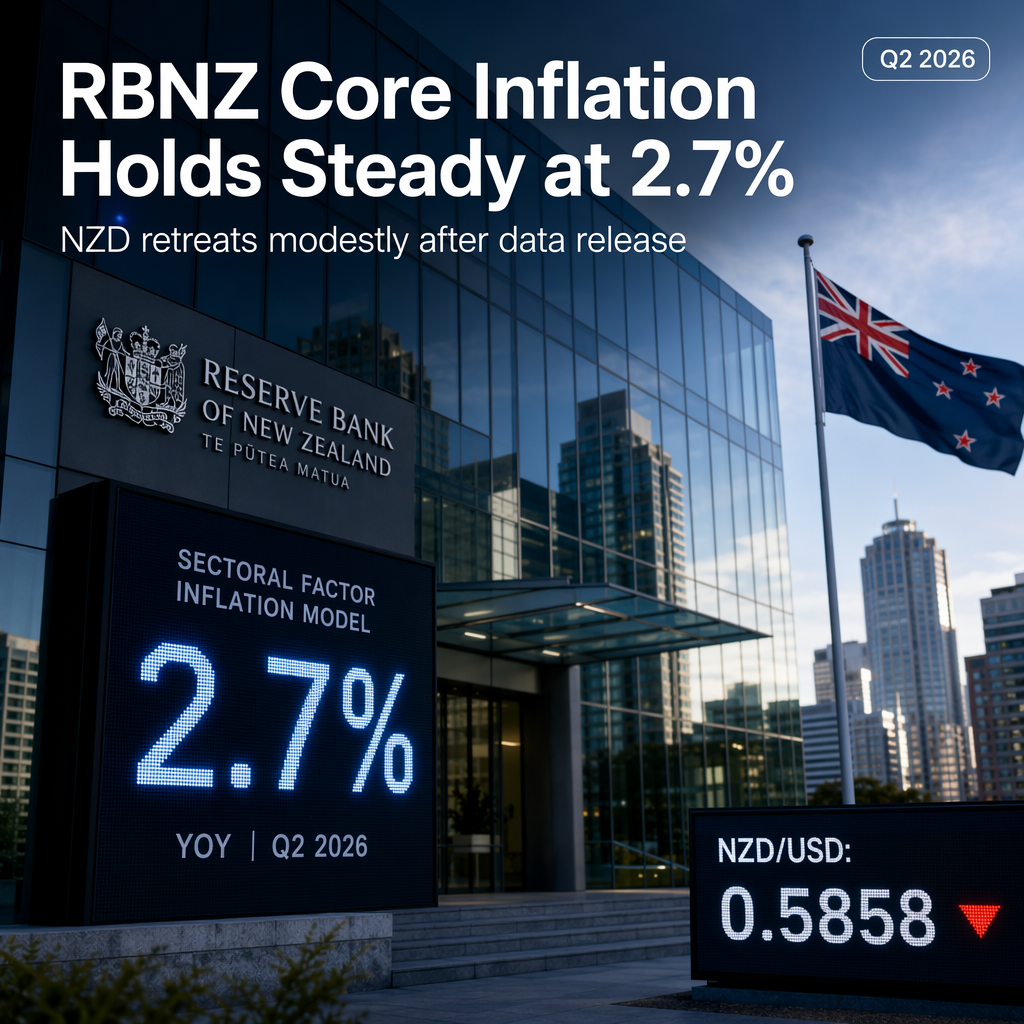
The Reserve Bank of New Zealand (RBNZ) released its Sectoral Factor Model Inflation gauge for the second quarter of 2026, reporting a year-over-year (YoY) rate of 2.7%. This figure is unchanged from the first quarter's reading of 2.7% YoY, indicating stability in the core inflation measure closely monitored by the RBNZ for monetary policy decisions. The RBNZ targets an inflation range of 1% to 3% as part of its policy mandate [1].
Following the release of the inflation data, the New Zealand Dollar (NZD) experienced some selling pressure. At the time of reporting, NZD/USD had retreated from its seven-week high of 0.5874, though it remained up 0.36% on the day at 0.5858 [1]. This market reaction suggests a modest cooling in bullish sentiment for the NZD, likely due to the lack of upward surprise in the inflation data.
The RBNZ's Sectoral Factor Model is a core inflation estimate based on co-movements in individual price series, distinguishing between tradable and non-tradable items. This measure is considered important for assessing underlying inflation trends, as it excludes more volatile components such as food and fuel [1].
No forward-looking statements or analyst opinions were provided in the article. The market implications discussed were limited to the immediate reaction in the NZD/USD currency pair following the data release [1].
CONCLUSION
The RBNZ's core inflation gauge held steady at 2.7% YoY in Q2 2026, remaining within the central bank's target range. The New Zealand Dollar saw a modest pullback from recent highs, reflecting a muted market response to the stable inflation data. No additional forward guidance or analyst commentary was included in the source.