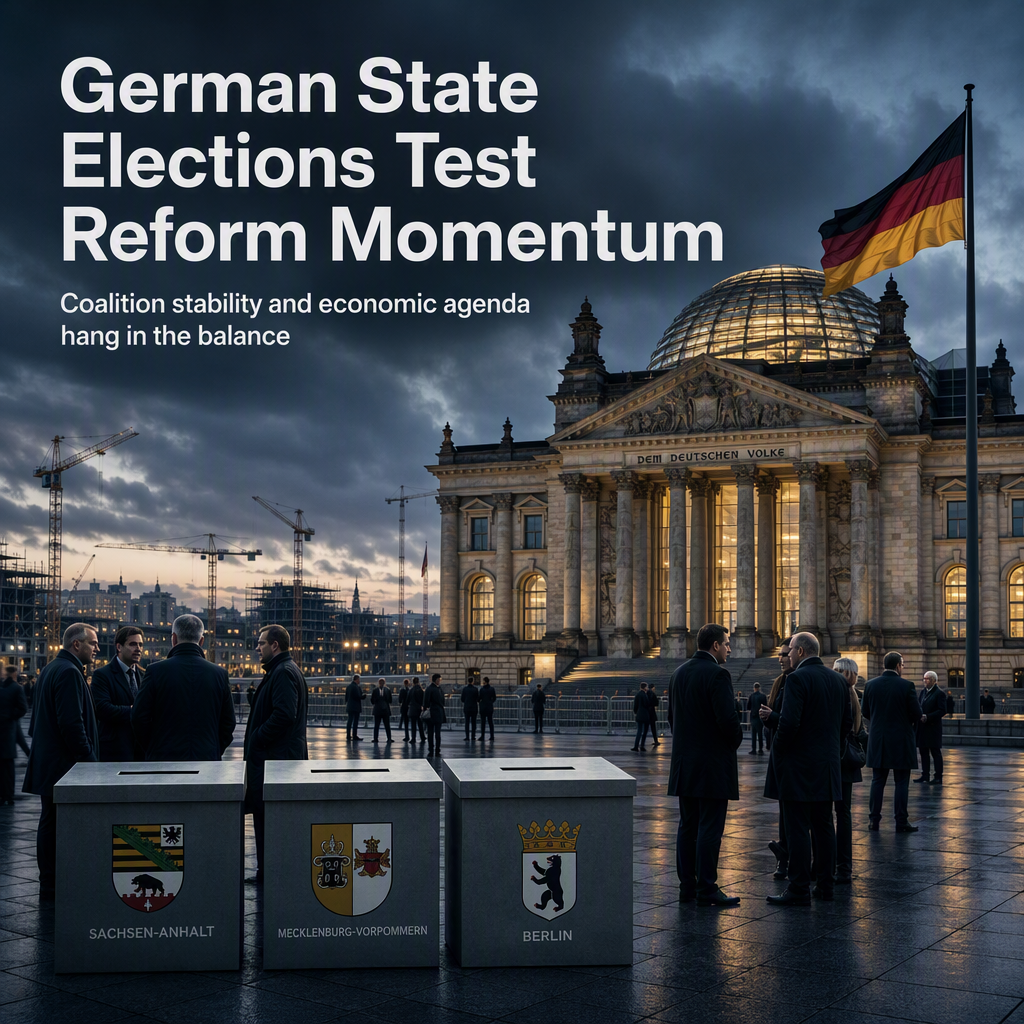
According to ING’s Carsten Brzeski, upcoming state elections in Saxony-Anhalt (6 September), Mecklenburg-Vorpommern, and Berlin (both on 20 September) could significantly influence the political landscape in Germany and indirectly affect the economy. Approximately 5.4 million people, representing about 8% of the German electorate, are eligible to vote in these elections. The outcomes are expected to set the political tone in Berlin for the remaining three years of the current legislature and could potentially end the CDU-SPD coalition before its official term concludes [1].
Brzeski highlights the strong polling of the AfD and the fragile position of Chancellor Merz’s CDU-SPD coalition. He notes that internal party reactions to the election results could slow or derail the implementation of a recently agreed reform package, which is aimed at addressing Germany’s prolonged economic stagnation, regaining competitiveness, and tackling structural challenges such as demographic change and China’s evolving role in the global economy. Although the CDU and SPD reached a reform agreement before the summer, not all party members support it, and its implementation has been described as cumbersome [1].
The direct economic impact of the September elections is expected to be very limited in the short term. However, new state governments could undermine support for the federal reform package, slow its implementation, or even derail it entirely. Brzeski also points out that a symbolic victory for the AfD could negatively affect foreign investor sentiment and trigger internal party reactions that might further impede reforms or bring down the federal government. He identifies three potential triggers to watch for in the aftermath of the elections [1].
While no immediate changes to the economy are anticipated in September, the elections could influence the cost and feasibility of future government initiatives, depending on the political fallout and the stability of the ruling coalition [1].
CONCLUSION
The upcoming German state elections are poised to test the stability of the CDU-SPD coalition and the momentum behind critical economic reforms. While immediate economic effects are expected to be limited, the political outcomes could have significant implications for investor sentiment and the government’s ability to implement its agenda.