
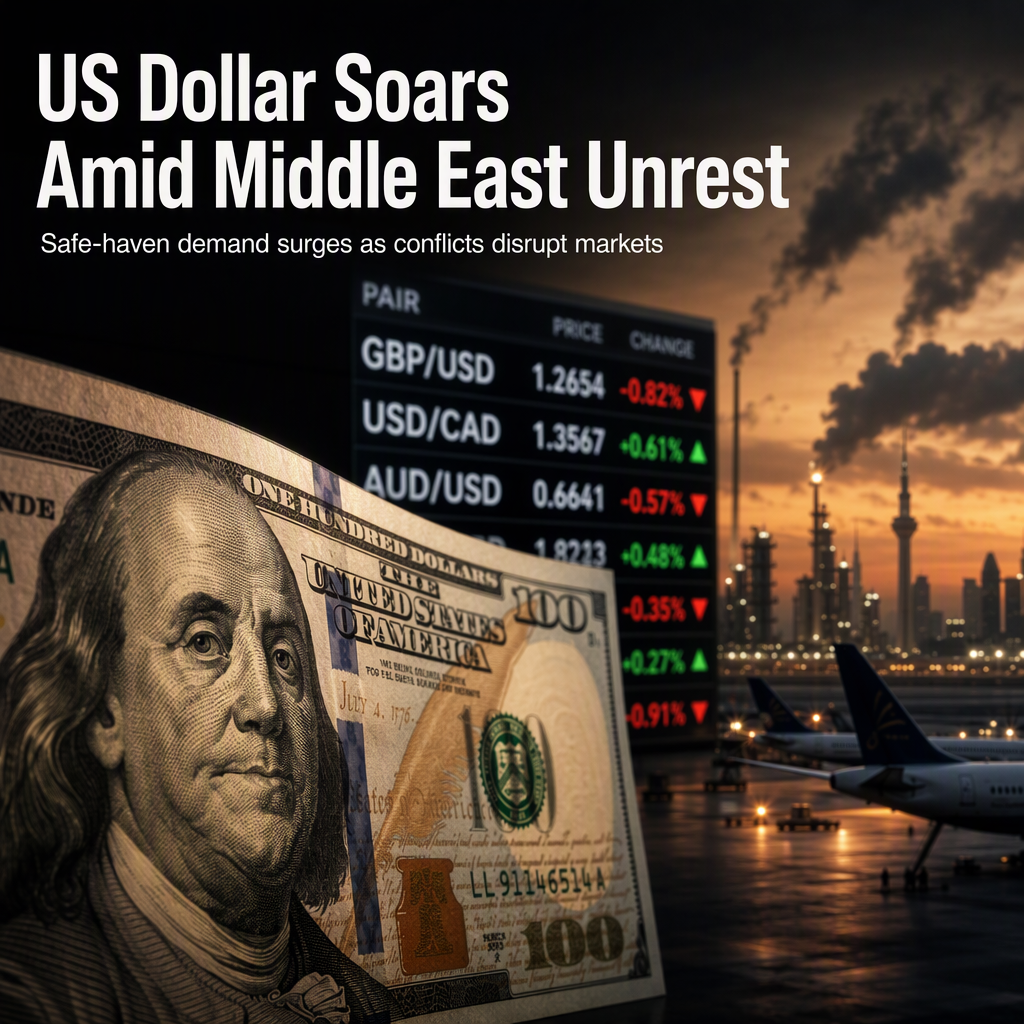
A series of coordinated military operations by Yemen's Houthi group against Saudi Arabian airports, an oil facility, and military sites on Monday has heightened geopolitical tensions in the Middle East, injecting volatility into global currency and commodity markets [1][2][3]. The Houthi attacks, which reportedly included ballistic and cruise missiles as well as drones, disrupted air traffic at King Khalid International Airport in Riyadh and have raised concerns about further escalation, with media reports suggesting Israel is preparing a potential attack against Iran, either in coordination with the US or independently [1][2][3].
These developments have reinforced the safe-haven appeal of the US Dollar (USD), which remains strong against major rivals. The USD recently hit its highest level since April 2025 before pausing for a breather, but persistent geopolitical uncertainties and elevated US bond yields continue to underpin its bullish undertone [1][3]. In the currency markets, the GBP/USD pair is consolidating above 1.3200, with upside capped by the strong USD and technical resistance at the 100-period SMA (1.3319) [1]. The USD/CAD pair is trading around 1.4265, near its highest level since April 2025, as weak oil prices and a dovish Bank of Canada policy stance weigh on the Canadian Dollar [3]. Meanwhile, the AUD/USD pair holds steady around 0.6970, supported by a retreat in oil prices due to expanded Middle Eastern crude exports and a G7 emergency stockpile release, which have eased inflation concerns [2].
Market participants are closely monitoring US monetary policy signals. Recent US data showed moderation in inflation and a weak Nonfarm Payrolls report, tempering expectations for a Federal Reserve rate hike in October [1][3]. However, traders are still pricing in over an 80% chance of a rate hike by year-end, maintaining a positive outlook for the USD [1][3]. The upcoming release of the FOMC Minutes and speeches from influential Fed members are expected to provide further direction for the USD and related currency pairs [1][3].
Analyst commentary highlights that while traditional cost pressures such as oil and computing costs are often cited as drivers of US inflation, HSBC strategists argue that recent inflation acceleration has been primarily profit-driven, as measured by the gross value-added deflator [2]. Technical analysis across the major pairs suggests that while the USD remains in a bullish phase, some pairs (such as USD/CAD) are showing overbought conditions, indicating potential for corrective consolidation [1][3].
CONCLUSION
Geopolitical flare-ups in the Middle East have reinforced safe-haven demand for the US Dollar, driving it to multi-year highs against major currencies and capping gains for rivals like the British Pound, Canadian Dollar, and Australian Dollar. Market focus now shifts to upcoming US Federal Reserve communications and further geopolitical developments, which are expected to dictate near-term currency market direction.