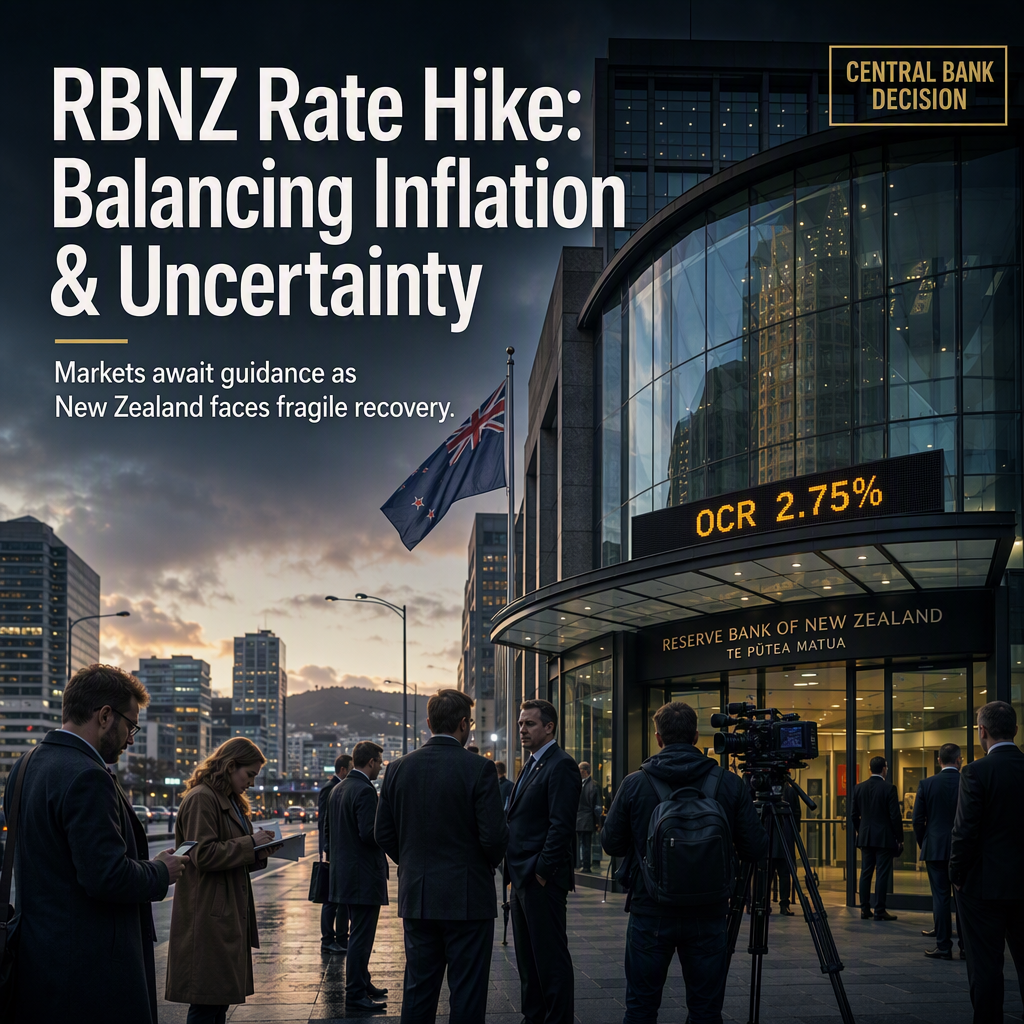
The Reserve Bank of New Zealand (RBNZ) is expected to raise its Official Cash Rate (OCR) by 25 basis points from 2.50% to 2.75% at its upcoming meeting, with the decision scheduled for 02:00 GMT, followed by Governor Anna Breman’s press conference at 03:00 GMT [1]. This move comes after a hawkish hike in July, and experts anticipate a consensus decision this time, in contrast to the divided outcome of the previous meeting [1].
The RBNZ’s decision is set against a backdrop of persistent inflation, with headline inflation at 4.1% year-on-year in the June quarter, surpassing the central bank’s forecast of 3.9% [1]. Despite easing inflation expectations in the third quarter and a soft labor market—evidenced by a rise in the unemployment rate to 5.6%—the central bank faces a challenging environment as it seeks to balance high inflation with fragile economic recovery [1]. The RBNZ’s updated projections, especially regarding the OCR, will be closely watched for indications about the timing and scope of further rate increases [1].
Market participants are particularly focused on the RBNZ’s forward guidance. If policymakers signal a higher likelihood of another rate hike in October or raise the projected terminal OCR from around 3.28%, the New Zealand Dollar (NZD) could strengthen against the US Dollar (USD) [1]. Westpac notes that such signals could lead markets to price in additional hikes in both October and December, potentially bringing the OCR to 3.25% by year-end [1]. Conversely, if the RBNZ adopts a wait-and-see approach, market expectations for further hikes may diminish, putting downward pressure on the NZD/USD pair [1].
With the 25 basis point hike largely anticipated by markets, the main surprise is expected to come from the RBNZ’s guidance on future policy moves, especially in light of ongoing global uncertainties such as the prolonged Middle East conflict [1].
CONCLUSION
The RBNZ is widely expected to raise its OCR to 2.75%, with market attention focused on signals regarding future tightening. The central bank’s guidance will be crucial for the NZD’s direction, as markets weigh the prospects of additional rate hikes against a backdrop of persistent inflation and a soft labor market.