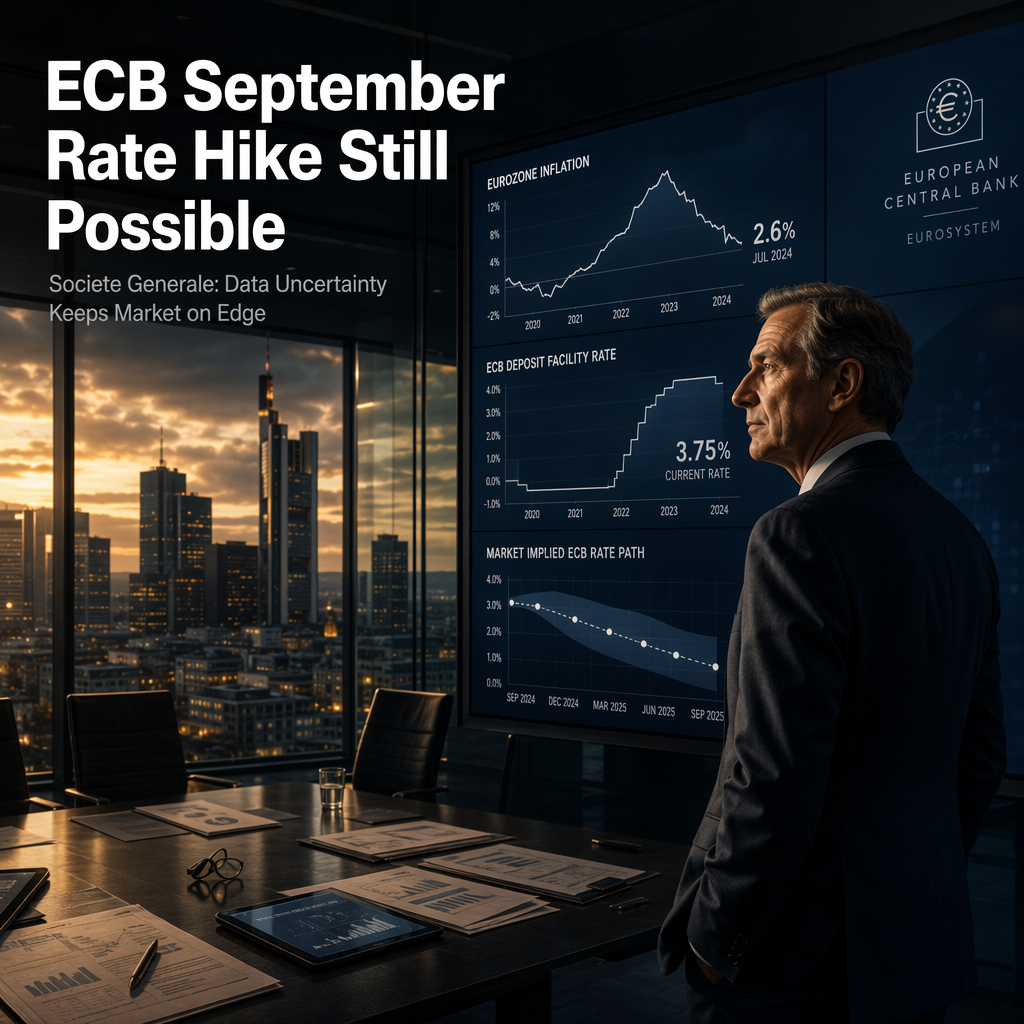
Societe Generale’s Anatoli Anenkov anticipates that the European Central Bank (ECB) will make no policy changes at its upcoming meeting, instead reiterating its data-dependent, meeting-by-meeting approach to monetary policy decisions [1]. Recent economic data from the Euro Area, including Germany and France, have not significantly shifted the outlook, and the risk of technical recessions in these countries is now assessed as lower than previously expected [1].
Anenkov notes that the possibility of a rate hike in September remains open and is currently fully priced in by the markets, though he expresses less conviction regarding further tightening beyond that point [1]. He describes a potential September hike as broadly neutral, suggesting it would maintain the current policy stance while allowing the ECB time to assess the extent of indirect and second-round wage effects later in the year [1].
The report highlights that, based on current data, the ECB may need to lower its headline inflation forecast for the year due to declining energy prices, while economic growth could also be weaker, partly due to volatile Irish data [1]. Although upside risks to inflation have moderated, uncertainty remains high, and the timing of indirect effects may complicate policy decisions [1]. Anenkov emphasizes that the trigger for any policy action will likely be found in forecasts and scenario analysis rather than realized data, given the lag in observable effects [1].
Overall, the assessment underscores the difficulty in judging the appropriateness of recent and potential future rate hikes, as the full impact of policy changes and indirect effects remains uncertain [1].
CONCLUSION
Societe Generale expects the ECB to hold rates steady at its next meeting, with a September hike still possible but further tightening less certain. Market pricing reflects this outlook, while the ECB remains focused on evolving data and forecasts amid ongoing uncertainty.