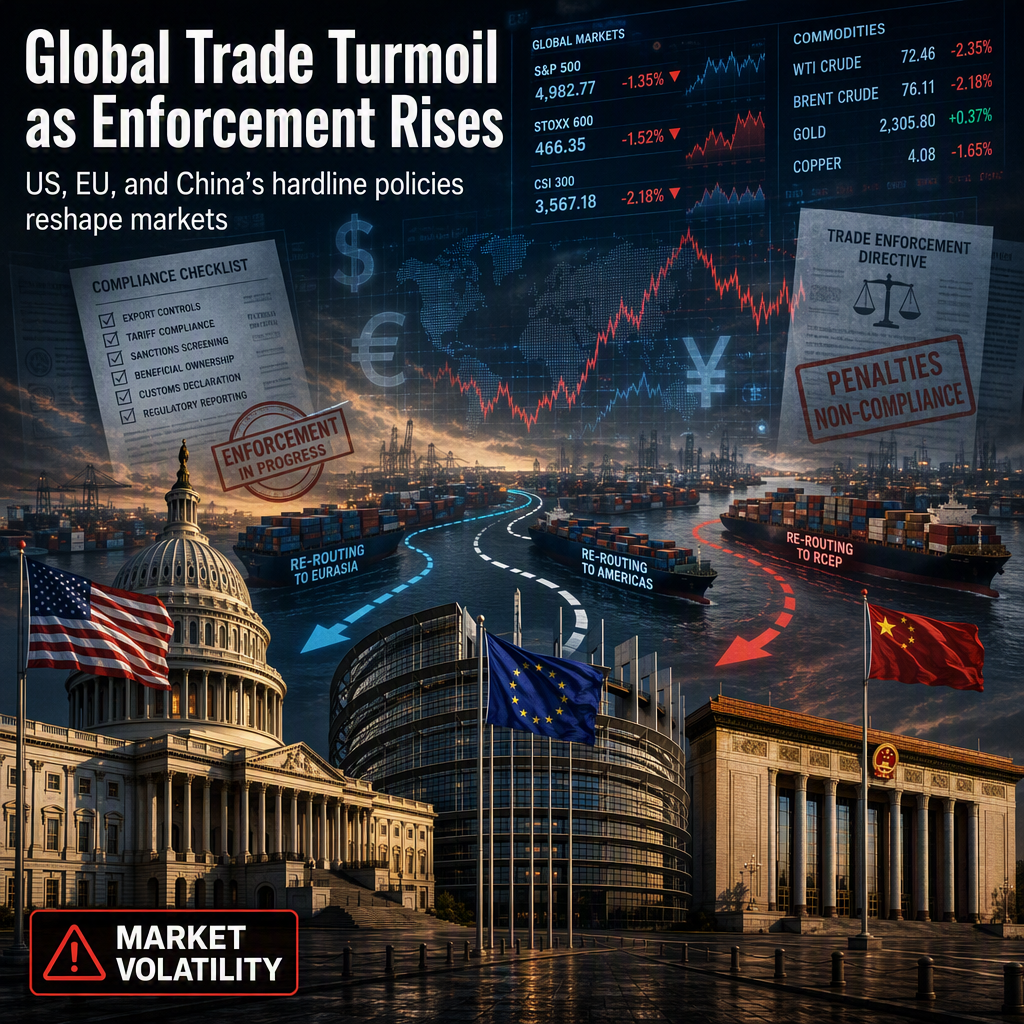
The United States, European Union, and China are moving away from negotiation-based trade relations toward stricter enforcement of their respective trade rules, fundamentally reshaping global trade dynamics [1]. This shift is characterized by an increase in tariffs, sanctions, and legal disputes at the World Trade Organization, with each bloc implementing new regulatory measures: the EU has rolled out the Carbon Border Adjustment Mechanism (CBAM), the US has expanded export controls and sanctions, and China has tightened its anti-foreign sanctions law [1].
These enforcement trends are having direct implications for global supply chains, investment flows, and the compliance strategies of multinational corporations. Legal departments are now central to due diligence, as companies face rising risks related to regulatory compliance. Industry leaders emphasize that anticipating legal risk is becoming as important as financial performance in investment strategies, with regulatory enforcement now a key driver of market sentiment [1].
Technical analysis of trade data reveals measurable shifts in trade flows between the US, EU, and China, including the re-routing of supply chains to avoid jurisdictions with heightened enforcement. This has resulted in new price levels for commodities and manufactured goods, with market reports indicating weakening support levels for US export sectors and increased resistance for EU imports subject to CBAM levies [1].
Financial markets are responding with heightened volatility, as investors adjust portfolio allocations to manage increased regulatory uncertainty. Sectors such as technology and energy are particularly exposed to these enforcement trends, prompting analysts to recommend defensive positions and close monitoring of policy announcements from Washington, Brussels, and Beijing as indicators of short-term market direction [1]. Market sentiment remains cautious, with risk management and country-specific exposure taking on greater importance [1].
CONCLUSION
The transition to enforcement-driven trade policies by the US, EU, and China is creating significant volatility and uncertainty in global markets. Investors and companies are prioritizing compliance and risk management, with defensive strategies prevailing until the regulatory environment stabilizes. Market participants are advised to closely monitor policy developments for further direction.