
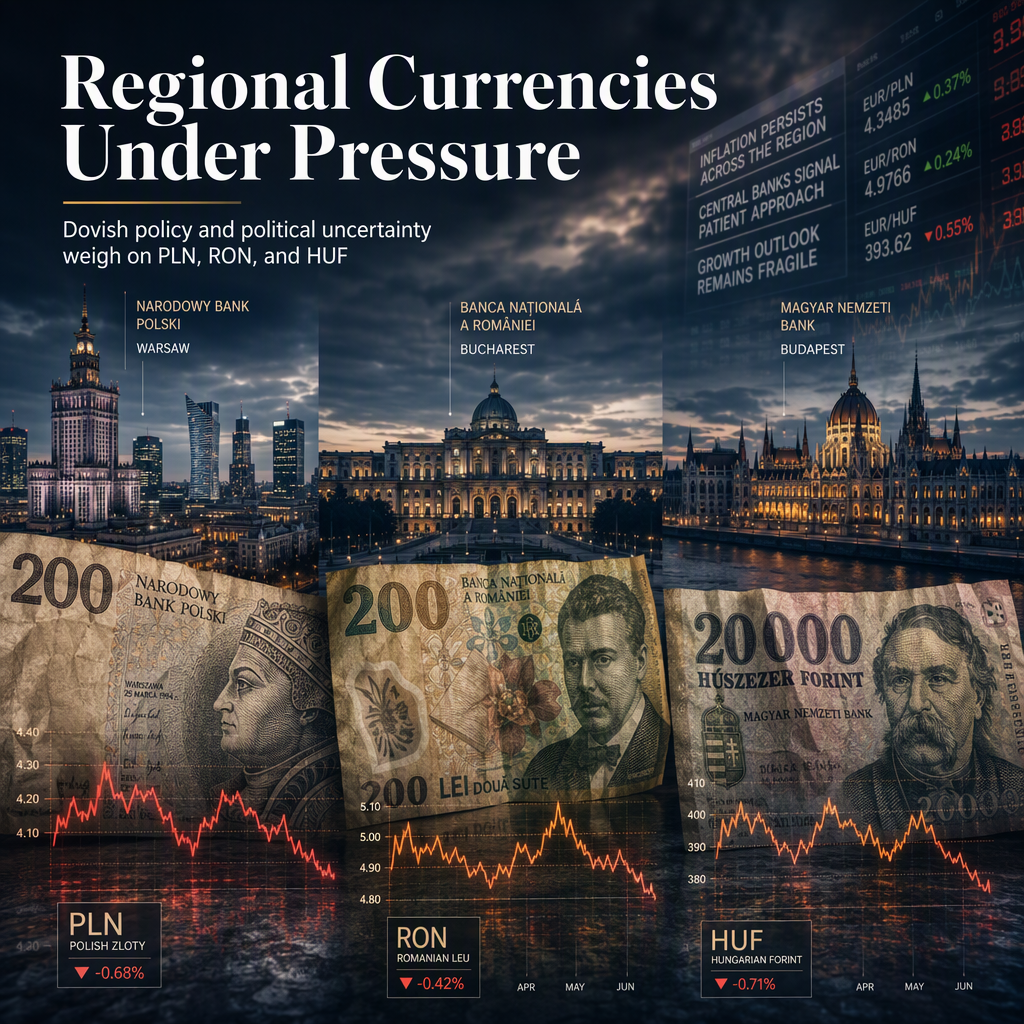
Central and Eastern European currencies, including the Polish Zloty (PLN), Romanian Leu (RON), and Hungarian Forint (HUF), are under pressure due to dovish monetary policy stances and political uncertainty, according to recent analyses from ING and Commerzbank. The National Bank of Poland (NBP) maintained its policy rate at 3.75% as expected, with a statement that offered little new information compared to September. ING notes that markets are currently pricing in just under two rate hikes by year-end and a total of 110 basis points of tightening, setting a high bar for any hawkish shift. The EUR/PLN exchange rate has stabilized around 4.360–4.380, but a combination of risk-off sentiment and the NBP's dovish message is expected to push the pair towards 4.380–4.400 [1].
In Romania, the National Bank of Romania is also expected to keep rates unchanged at 6.50%. The EUR/RON has experienced unusual volatility in the past two weeks, recently testing highs just below 5.355. This pressure is attributed to ongoing political uncertainty regarding the formation of a new government and speculation about a possible rating downgrade. ING suggests that unless a new parliamentary majority is secured, the EUR/RON is likely to remain elevated, with further upside risks if coalition talks collapse [1].
Meanwhile, the Hungarian Forint remains weak as the National Bank of Hungary (MNB) faces criticism for policy contradictions. Commerzbank's Tatha Ghose highlights that the MNB's September meeting minutes confirmed a unanimous decision to halt rate cuts, with no discussion of future hikes or cuts. Despite a recent uptick in September CPI inflation to 1.6% year-on-year, driven by fuel prices, and a sharp increase in the MNB's inflation forecast for 2027 to 3.1%, the central bank has reduced its medium-term inflation target from 3.0% to 2.5% effective January 2028. However, the MNB has not signaled any intention to tighten policy, even as other countries shift towards hawkishness. Ghose argues that the Forint will remain weak until the MNB adopts a much more hawkish stance and resolves its policy contradictions [2].
Both ING and Commerzbank emphasize that dovish central bank messaging and, in Romania's case, political instability, are key factors keeping regional currencies under pressure. Forward-looking statements from ING suggest stabilization at current levels for the EUR/RON unless the political crisis deepens, while Commerzbank warns that the Forint's recovery is unlikely without a significant policy shift from the MNB [1][2].
CONCLUSION
Central banks in Poland, Romania, and Hungary are maintaining dovish or ambiguous policy stances despite inflationary pressures and political uncertainty, leading to continued weakness in their respective currencies. Analysts from ING and Commerzbank highlight that without a shift towards more hawkish policies or resolution of political instability, the Zloty, Leu, and Forint are likely to remain under pressure. Market participants are advised to monitor upcoming central bank communications and political developments closely.