
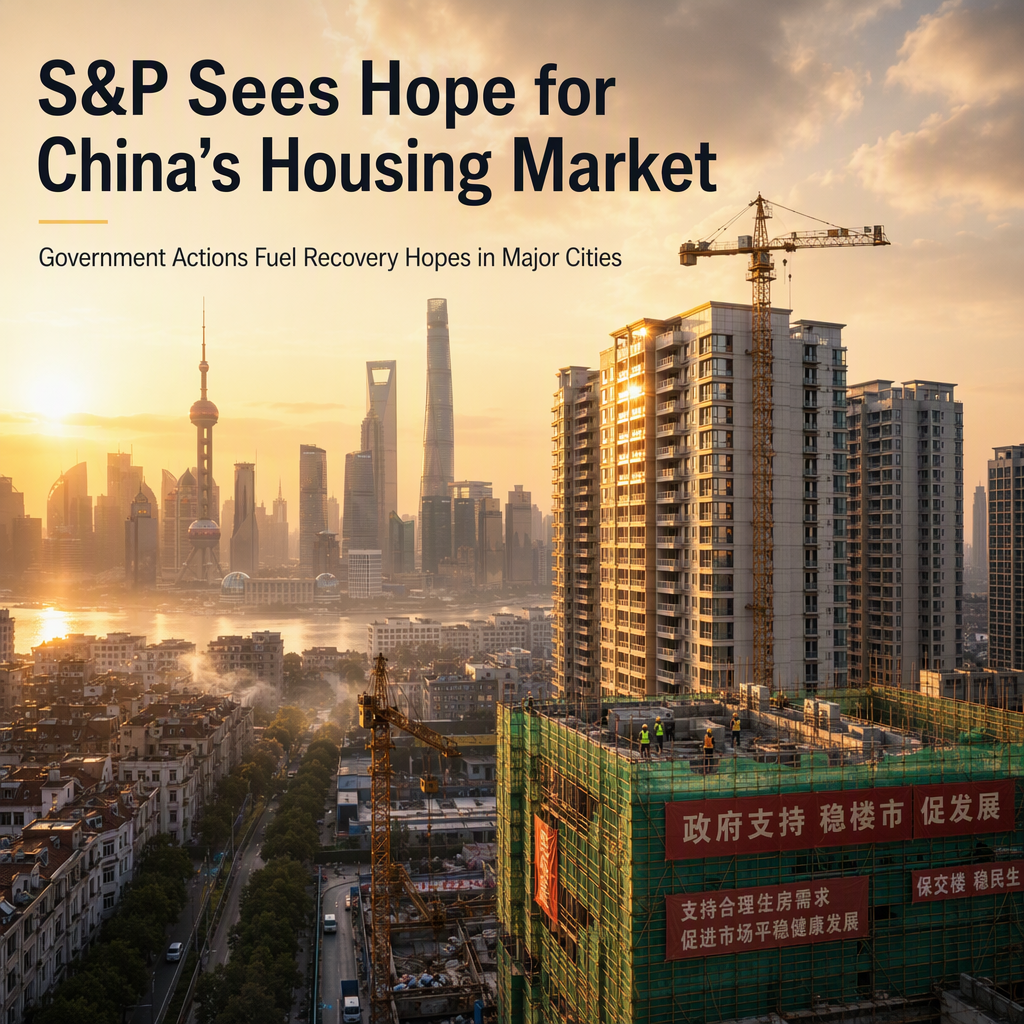
S&P Global Ratings has indicated that China's real estate market may be approaching a bottom after a prolonged slump, drawing parallels to previous housing crises in countries such as Japan, the U.S., and Spain [1]. According to a report distributed on Thursday, S&P analysts believe that residential real estate prices in China could reach their lowest point in the third quarter of 2028, with the largest cities like Beijing and Shanghai potentially seeing a recovery as early as next year [1]. This marks a significant shift from S&P's February outlook, which cited high levels of unsold housing as a barrier to recovery [1].
The improved outlook is attributed to two recent government interventions. In August, Beijing imposed new restrictions on developers' ability to sell unfinished properties, and in September, Premier Li Qiang announced additional policies aimed at stabilizing the sector [1]. Subsequently, a mortgage rate subsidy was introduced for first-time homebuyers purchasing units under 1.5 million yuan ($220,000) and smaller than 120 square meters [1]. S&P's Edward Chan noted that these measures are expected to make developers more cautious, leading to reduced land purchases and fewer new projects, which should help address the market's oversupply issue [1].
Guotai Junan International echoed the positive sentiment, suggesting that the largest Chinese cities could witness early signs of property market recovery as soon as this quarter [1]. Despite the multi-year downturn, 2026 is identified as the first year of real estate inventory destocking, a key factor in stabilizing home prices over the next one to two years [1]. The scale of unfinished, pre-sold homes remains significant, with Nomura estimating in 2023 that it was about 20 times the size of Country Garden, the largest non-state-owned developer by sales as of the end of 2022 [1].
Historically, Chinese developers such as Evergrande have relied on pre-sales to fuel growth, leading to a debt-driven expansion and instances where homebuyers waited years for completed units [1]. The current policy shift is expected to curb such practices and support a more sustainable market structure [1].
CONCLUSION
S&P Global Ratings and other analysts suggest that China's real estate market is nearing a turning point, supported by recent government interventions and a reduction in new supply. While challenges such as oversupply persist, the outlook for major cities is improving, with potential recovery signs expected as early as next year. The market is entering a phase of inventory destocking, which could help stabilize prices in the coming years.