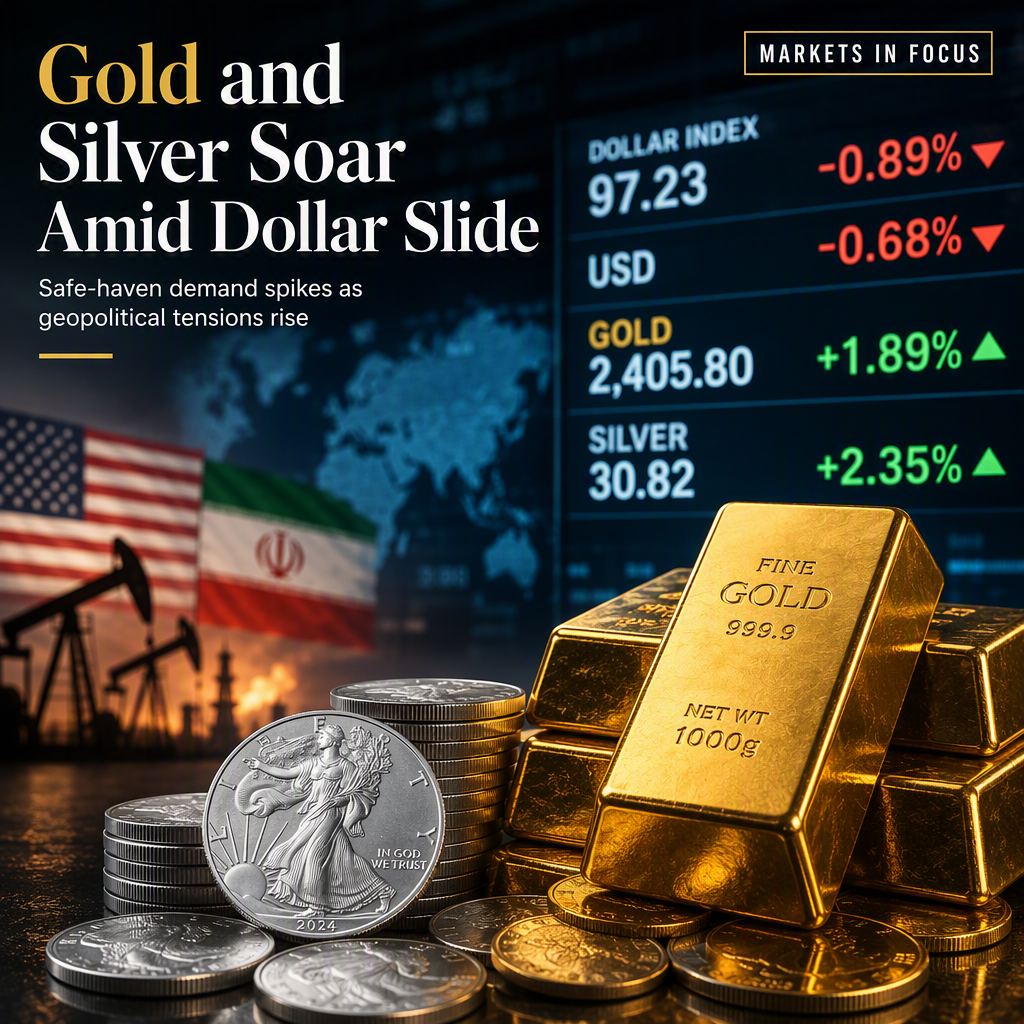
Gold (XAU/USD) and Silver (XAG/USD) both experienced significant gains on Monday, driven by a weakened US Dollar and heightened geopolitical uncertainty, particularly surrounding US-Iran relations [1][2]. Gold prices rose over 1%, trading at $4,422 after rebounding from daily lows of $4,367, while Silver surged nearly 1.80% to $65.85, having touched a low of $64.70 earlier in the session [1][2].
The US Dollar Index (DXY) fell 0.37% to 99.53, providing a tailwind for precious metals [1]. Despite a rise in the US 10-year Treasury yield by over 2.5 basis points to 4.718%, Gold continued its upward momentum, surpassing the 100-day Simple Moving Average (SMA) at $4,386 and eyeing the $4,500 resistance level [1]. Silver, meanwhile, is consolidating in the $64.70–$66.70 range, with technical resistance at the 100-day SMA of $68.72 and further upside targets at $70.00 and the 200-day SMA at $71.73 [2].
Investor sentiment was influenced by last week’s softer US inflation data, which reduced expectations of a hawkish Federal Reserve. The probability of the Fed holding rates unchanged stands at nearly 69%, while the odds for a 25-basis-point hike in December are at 66%, according to Prime Terminal [1]. Market participants are now awaiting the release of the Fed's July meeting minutes on Wednesday for further policy guidance [1].
Geopolitical factors also played a role, with ongoing uncertainty over US-Iran relations and mixed signals from Iranian officials contributing to the safe-haven demand for both Gold and Silver [1][2]. Additionally, crude oil prices surged over 2.30% to $84.35 per barrel, further reflecting market unease [1]. Technical indicators for both metals suggest bullish momentum in the short term, though key resistance levels must be cleared for further gains [1][2].
CONCLUSION
Both Gold and Silver rallied sharply as the US Dollar weakened and geopolitical tensions fueled safe-haven demand. Technical and fundamental factors point to continued investor interest in precious metals, with upcoming Fed communications and ongoing geopolitical developments likely to shape future price action.