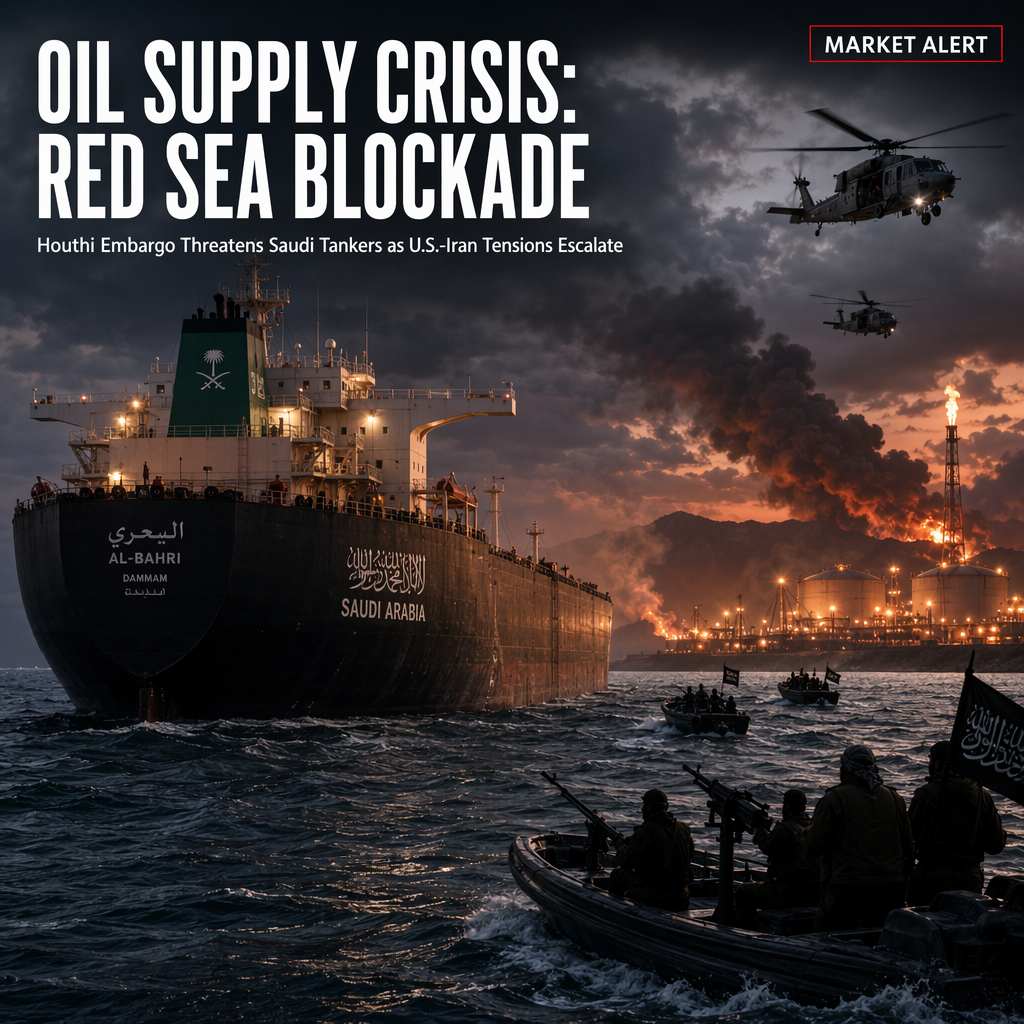
Houthi militants in Yemen have declared an immediate maritime embargo against Saudi Arabia, intensifying threats to global oil supply already strained by Iran's attacks on tankers in the Strait of Hormuz [1]. The Houthis, who have previously threatened to close the Bab el-Mandeb Strait—a critical passage connecting the Red Sea to the Gulf of Aden—accused Saudi Arabia of imposing an 'aggressive siege' following alleged bombings of Sanaa International Airport by Riyadh [1].
Saudi Arabia has been diverting millions of barrels of oil per day through a pipeline to a Red Sea export terminal, providing a vital alternative route for global oil markets during the ongoing U.S.-Iran war [1]. However, the closure of Bab el-Mandeb, as threatened by the Houthis, would block this relief valve and further exacerbate supply disruptions caused by Iran's attacks in Hormuz [1].
Brent crude oil prices initially surged nearly 4% overnight, breaking the $90 per barrel mark, driven by escalating violence and supply threats, including the deaths of at least three U.S. service members in recent fighting between the U.S. and Iran [1]. However, prices eased after Iran indicated a willingness to engage in talks with Washington [1]. Despite the volatility, traders remain focused on statements from Tehran and Riyadh, with analysts from Energy Aspects warning that further escalation could push oil prices into triple digits [1].
The U.S.-Iran war has intensified following the collapse of the interim deal signed on June 17 to reopen Hormuz, with Tehran launching repeated attacks on oil tankers, resulting in at least two deaths and more than a dozen injuries this month [1]. In response, the U.S. has bombed Iran for nine consecutive days and reinstated its naval blockade, while tanker traffic through Hormuz has declined amid the ongoing conflict [1]. The Trump administration maintains that the strait remains open, with millions of barrels of oil still being shipped daily under U.S. military protection [1].
CONCLUSION
The Houthi declaration of a maritime embargo against Saudi Arabia adds a new layer of risk to already volatile oil markets, with critical supply routes under threat and prices reacting sharply to developments. While Brent crude briefly surged above $90 per barrel, the market remains highly sensitive to further escalation or signs of de-escalation between the U.S., Iran, and regional actors. Continued instability could drive oil prices even higher, underscoring the fragility of global energy supply chains.