
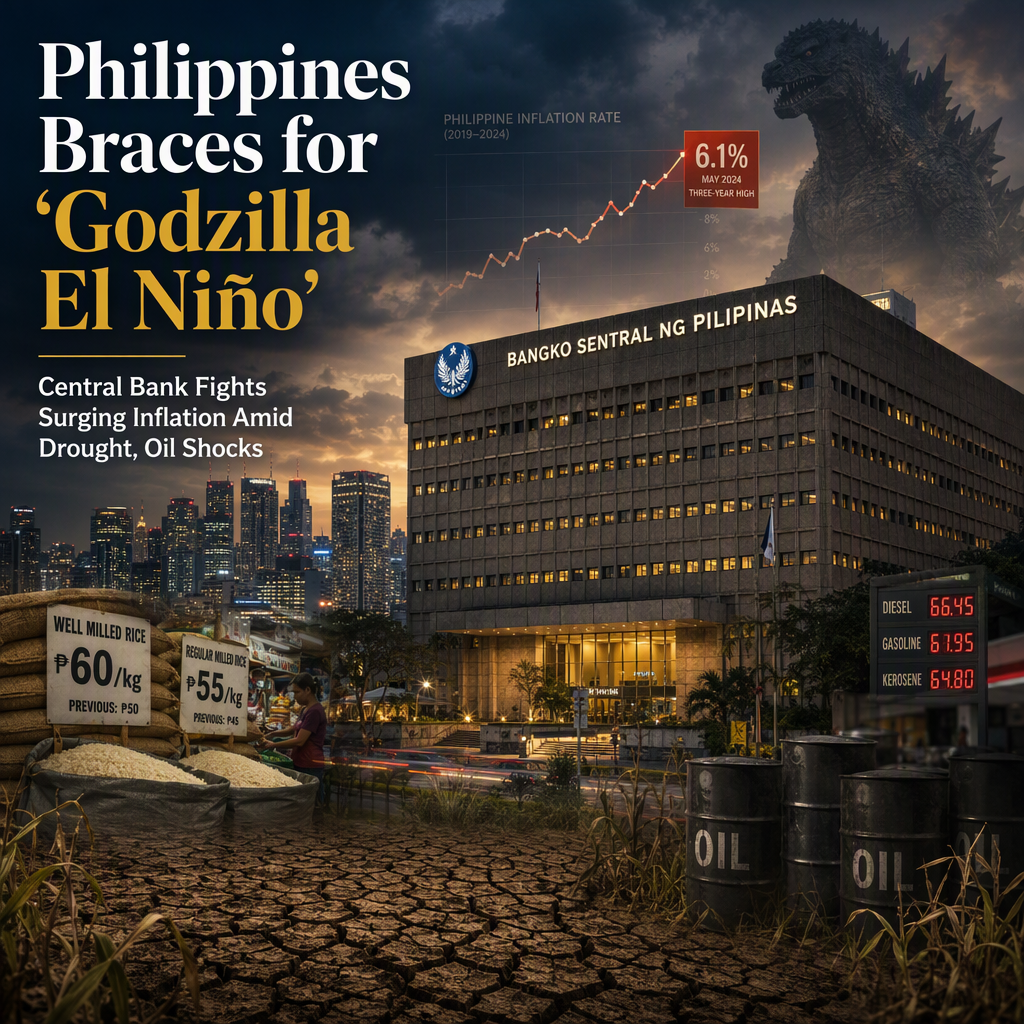
The Philippine central bank is preparing for the potential economic fallout from a 'Godzilla' El Niño event, compounding the effects of a prolonged oil shock on the country's inflation outlook [1]. Governor Eli Remolona stated that the Bangko Sentral ng Pilipinas (BSP) is modeling policy scenarios that account for both high and low oil prices, as well as two El Niño cases, including the severe 'Godzilla' variant [1]. The central bank expects the worst of El Niño's impact on prices to occur between November and February, at a time when inflation has already surged to a three-year high [1].
In September, Philippine inflation accelerated to 7.2%, up from 6.1% in August, with rice prices rising by 18%, according to the Philippine Statistics Authority [1]. The Philippines, as the world's largest rice importer, faces heightened food supply risks, especially as Agriculture Secretary Francisco Tiu Laurel warned that a fresh drought could further squeeze domestic supply [1]. Larger Philippine rice purchases could increase demand in a global market already affected by El Niño and export restrictions, with the UN Food and Agriculture Organization's rice price index climbing for six consecutive months to a 20-month high [1].
To address runaway inflation, the BSP raised its benchmark rate by 25 basis points to 5% in August [1]. Aris Dacanay, senior ASEAN economist at HSBC Bank, suggested that the BSP should implement another 25 basis point hike next week to 5.25%, followed by a similar increase in December [1]. Governor Remolona emphasized that maintaining price stability remains the central bank's top priority, stating, 'We're holding our breath, but we have to be prepared for the worst' [1].
CONCLUSION
The Philippine central bank is intensifying its efforts to combat inflation amid the dual threats of a severe El Niño event and ongoing oil shocks. With inflation at a three-year high and further price pressures expected, additional interest rate hikes are anticipated to stabilize the economy. The situation underscores the country's vulnerability to both climate and commodity risks.