
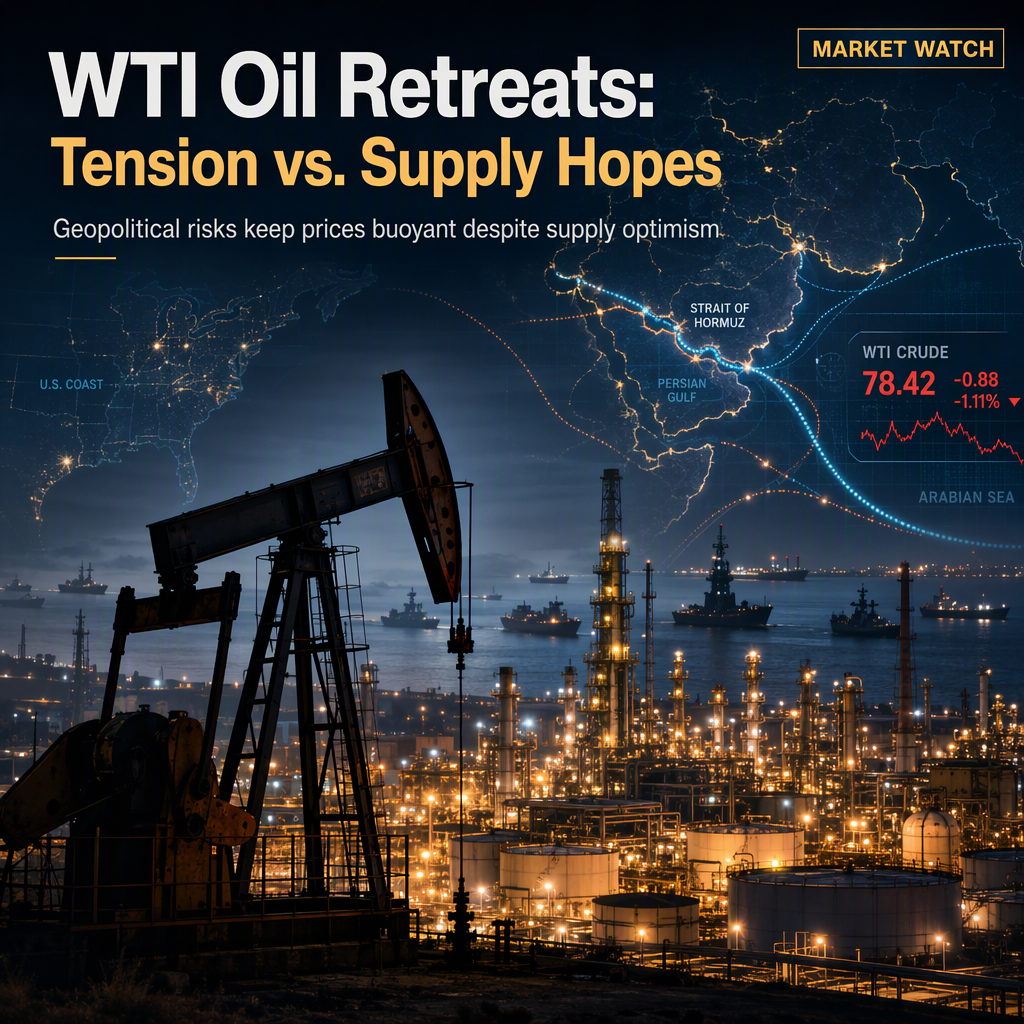
West Texas Intermediate (WTI), the benchmark US crude oil price, retreated from the mid-$94.00s after reaching an over two-week high during the Asian session on Wednesday, ending a four-day winning streak. Despite this pullback, WTI showed resilience, trading around the $93.75-$93.70 region, down less than 0.20% for the day, and lacking significant follow-through selling pressure [1].
Market sentiment was influenced by hopes that a US-Russia diesel agreement could increase supply and help cap crude oil prices. However, downside risks were limited due to escalating tensions between Saudi Arabia and Iran-backed Houthi rebels in Yemen, as well as the ongoing US-Iran standoff over the Strait of Hormuz, which maintained a geopolitical risk premium for oil [1].
From a technical perspective, WTI retains a bullish near-term tone. The Relative Strength Index (RSI) is around 64, indicating firm but not overbought buying pressure, while the Moving Average Convergence Divergence (MACD) remains modestly positive, suggesting sustained upside bias. A sustained move above the 50% Fibonacci retracement level at $94.24 could see prices extend to the 61.8% retracement at $96.13 and the 78.6% retracement at $98.83, with a potential test of the cycle high near $102.26. On the downside, notable support levels are at $92.35 (38.2% retracement), $90.01 (23.6% retracement), and $86.22 [1].
No specific analyst opinions or forward-looking statements beyond technical analysis were provided in the article [1].
CONCLUSION
WTI oil prices have eased slightly from recent highs but remain supported by geopolitical tensions and technical momentum. While hopes for increased supply from a US-Russia diesel agreement may cap prices, the overall market structure remains bullish in the near term. Key technical levels will likely guide the next moves in WTI prices.