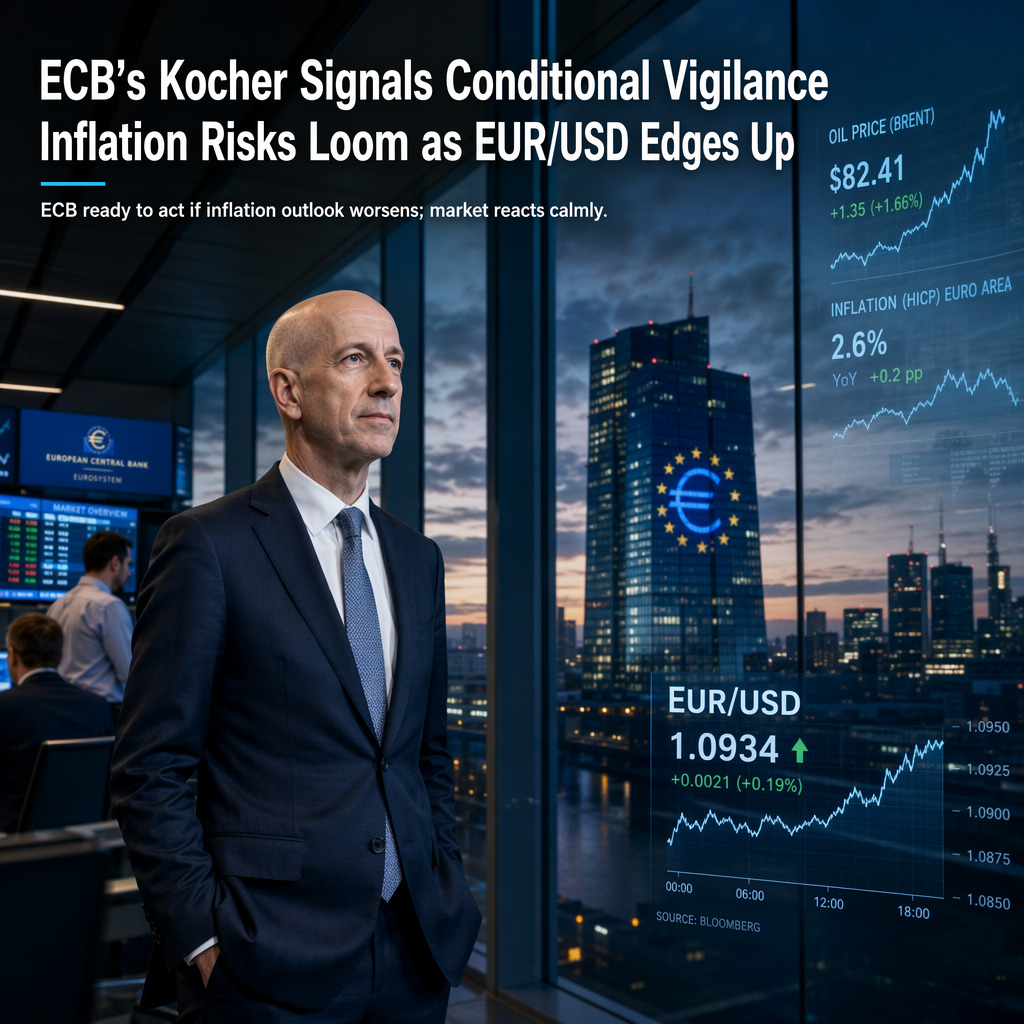
European Central Bank (ECB) Governing Council member Martin Kocher stated that there is currently no hard evidence of second-round effects in inflation, but emphasized that the ECB will act if the inflation outlook deteriorates [1]. Kocher highlighted recent developments in oil markets as concerning and noted that the ECB is prepared to remain vigilant over the coming weeks [1]. He also commented that while the growth forecast is not strong, he does not foresee a recession at this time [1].
Slovenian central bank chief Primož Dolenc added that risks remain high, particularly due to developments related to the war in Iran, which reinforce adverse risk scenarios [1]. Kocher's remarks, which scored 6.2/10 on the FXS Speechtracker, reflect a mildly hawkish tilt compared to recent ECB communications, especially with the conditional pledge to act if inflation expectations worsen [1]. However, his acknowledgment of weak growth and the absence of clear second-round effects tempers the hawkishness, indicating no immediate rush to tighten policy unless a significant shock occurs [1].
In terms of market reaction, the EUR/USD pair rose by 0.11% to trade at 1.1385 following Kocher's comments [1]. Analysts suggest that this combination of vigilance and patience could support the Euro on upside inflation surprises or oil-driven repricing, but does not provide a strong catalyst for a sustained shift in the ECB's policy path in the near term [1].
CONCLUSION
The ECB is maintaining a vigilant but patient stance, ready to act if inflation risks intensify, but not signaling imminent policy tightening. Market reaction was modestly positive for the Euro, reflecting a balance between inflation vigilance and caution over weak growth. The outlook remains data-dependent, with oil market developments and inflation data likely to influence future ECB actions.