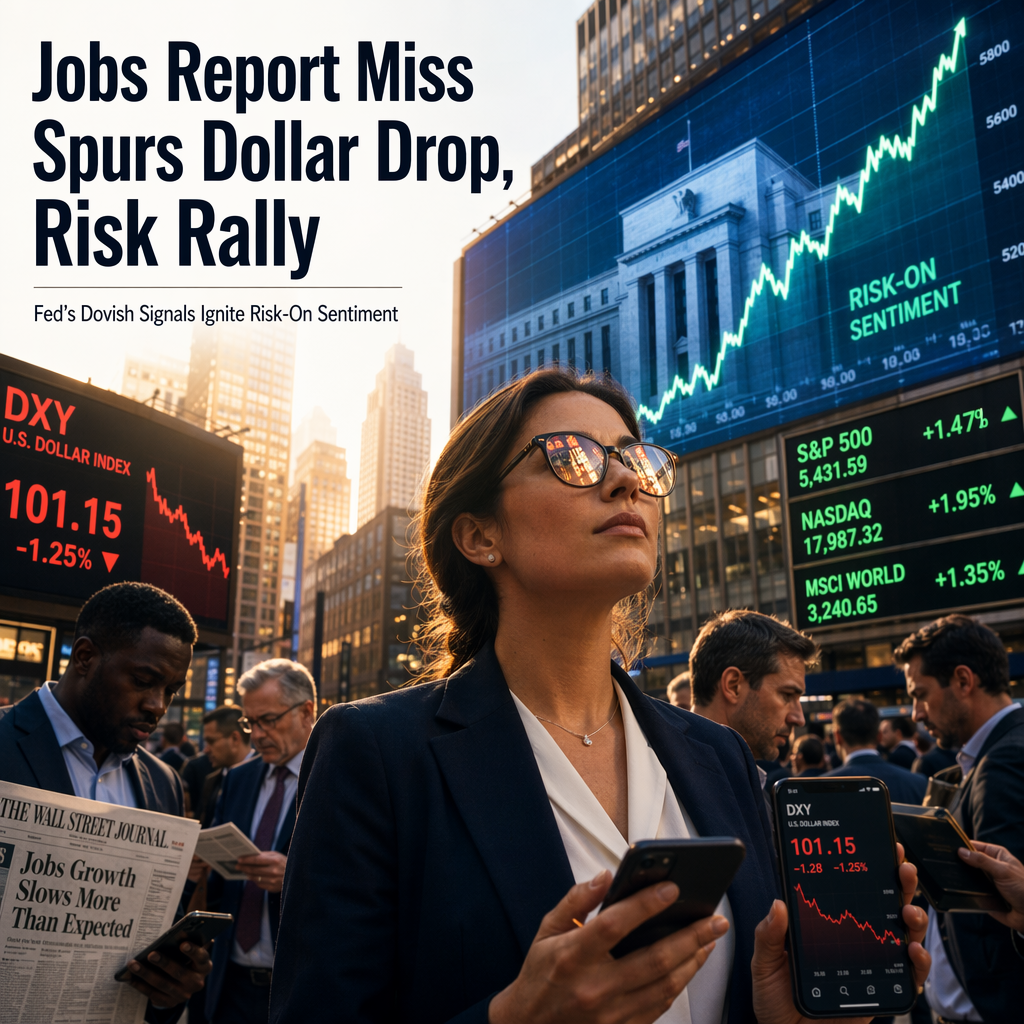
The week of June 29 to July 3, 2026, was marked by a significant market-moving event: the US jobs report released on Thursday, which showed payrolls badly undershooting expectations. This disappointing labor data acted as the primary catalyst for a broad decline in the US dollar across all G10 currency pairs and sparked a recovery in equities and other risk assets [1]. The market's reaction was further primed by dovish remarks from Fed Chair Warsh on Wednesday, which signaled a higher probability of interest rate cuts should labor market weakness persist [1].
Scenario C, described as 'Risk-On,' became the dominant market narrative, with its probability rising from 22% to 30% earlier in the week as traders anticipated the jobs report and interpreted the Fed's tone as more accommodative [1]. The result was a decisive shift in sentiment: US and global stock indices rebounded, reversing previous risk-off flows, while bond yields fell as traders priced in a more dovish path for Federal Reserve policy [1].
The article emphasizes that correctly identifying the scheduled jobs report as the key catalyst was crucial for market participants, as both the direction of the move and its underlying cause matched the projected scenario. The week reinforced the importance of anchoring trading scenarios to major scheduled events and dynamically adjusting probabilities as new information, such as Fed commentary, becomes available [1].
No explicit price levels or ticker symbols were mentioned, but the narrative confirms broad USD weakness and equity strength following the event. The overall market sentiment shifted decisively risk-on, with traders reassessing the near-term outlook for US monetary policy [1].
CONCLUSION
The US jobs report miss, combined with dovish signals from Fed Chair Warsh, drove a broad decline in the dollar and a rally in risk assets. Market sentiment turned decisively risk-on as traders anticipated a more accommodative Fed stance. The event underscored the importance of scenario planning around scheduled catalysts for short-term trading.