
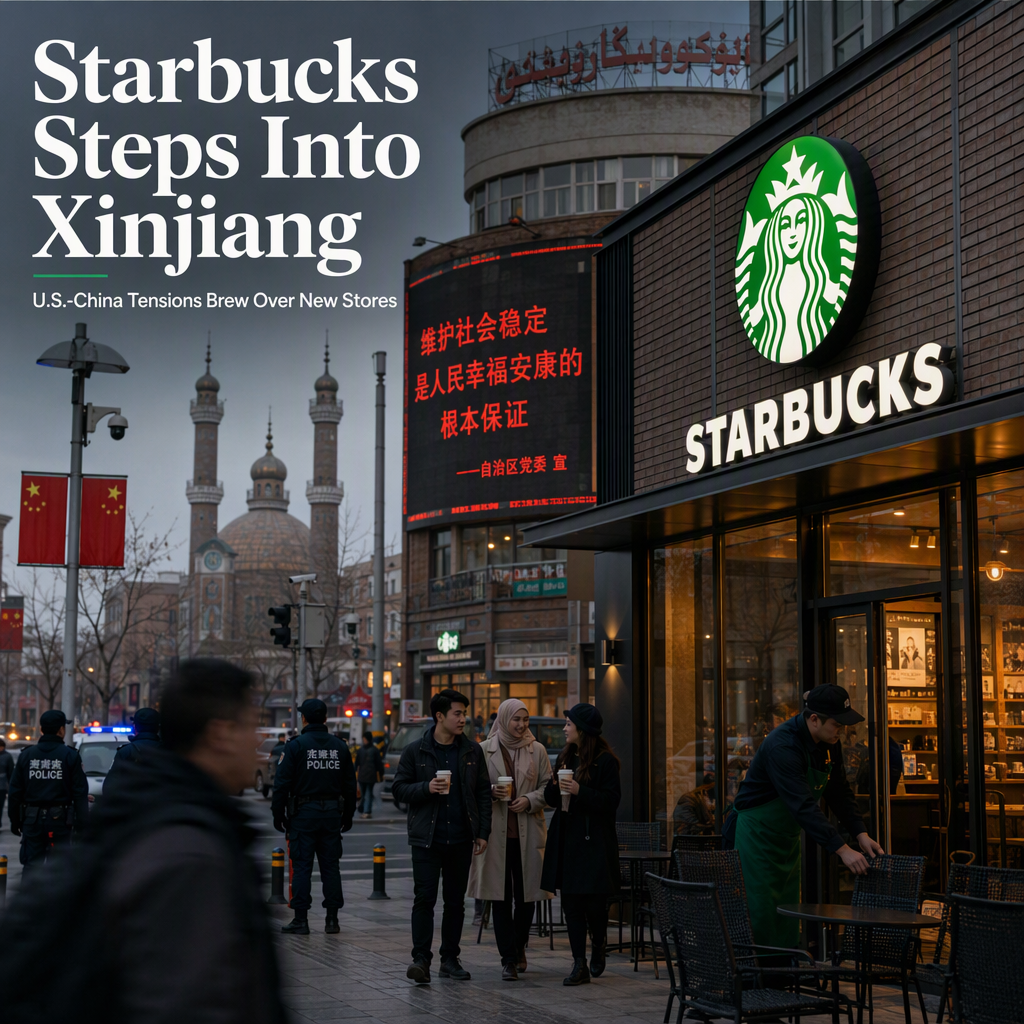
Starbucks has opened two stores in Urumqi, Xinjiang, marking a significant and controversial expansion into a region where Western governments, including the U.S., accuse Beijing of widespread human-rights abuses and where the U.S. restricts imports over forced-labor concerns [1]. This move comes after Starbucks sold a 60% controlling stake in its China operations to Boyu Capital, a Hong Kong-based private-equity firm with close ties to China's political elite, in April [1]. The venture aims to grow from roughly 8,000 stores to as many as 20,000, with Xinjiang as a bold initial step under the new ownership [1].
The decision has sparked strong criticism from U.S. lawmakers. The U.S. House Select Committee on China called Starbucks' entry into Xinjiang 'shocking and morally bankrupt' for a company that 'prides itself on social responsibility,' and demanded the stores close. The committee's chairman, Rep. John Moolenaar (R-Mich.), issued a statement titled 'Starbucks Serves Up Venti-Sized Genocide' [1]. In contrast, China's Foreign Ministry rejected the criticism, labeling U.S. claims of genocide as 'a blatant lie' and asserting that Xinjiang has achieved 'social stability, economic prosperity, ethnic unity and religious harmony' [1].
Industry analysts suggest that Boyu Capital, which now controls Starbucks' China business, is well aware of the political sensitivities and likely prioritized domestic commercial opportunities over potential backlash from Washington. Ivy Yang, founder of Wavelet Strategy, noted that Boyu 'understands the sensitivity of Xinjiang as well as anyone' and likely concluded that the market opportunity outweighed the risks [1]. Starbucks has been losing ground to local rivals on price and speed, and the new owner is under pressure to deliver growth by expanding into untapped regions [1].
Molly Liu, chief executive of Starbucks China, has pledged to continue investing in the region, signaling a commitment to the company's growth strategy in China despite geopolitical headwinds [1].
CONCLUSION
Starbucks' expansion into Xinjiang under new majority ownership by Boyu Capital has ignited political controversy in the U.S. but underscores the company's focus on growth in China. The move highlights the complex balance between commercial ambitions and geopolitical risks for American businesses operating in sensitive regions.