
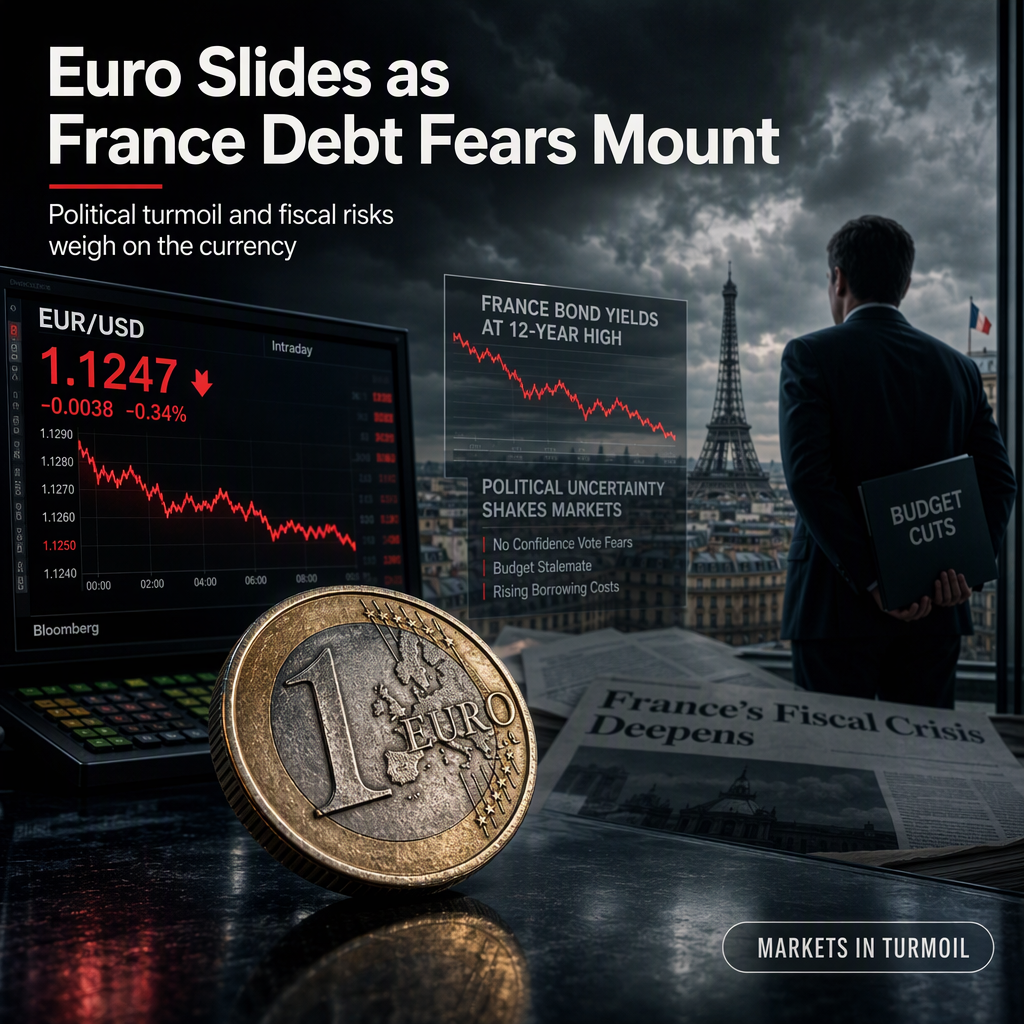
The Euro weakened against the US Dollar, with the EUR/USD pair trading defensively near 1.1250 during early Asian hours on Wednesday, as concerns over France's debt situation intensified [1]. Fears of a potential sovereign debt crisis in the Eurozone were heightened by a sharp bond market selloff last week and ongoing worries about France's ability to rein in its budget deficit [1]. France’s Finance Minister indicated that the government is prepared to use special constitutional powers to bypass Parliament and implement billions in spending cuts if negotiations over next year’s budget stall [1].
French Prime Minister Sébastien Lecornu's minority government previously announced a €54 billion savings plan to avoid a catastrophic downgrade or sovereign default, but mounting political challenges and the approach of a divisive 2027 election have increased pressure on French debt [1]. Additionally, the announcement of a snap election in Spain has contributed to the Euro’s downside, with Kathleen Brooks, research director at XTB, noting that 'Europe is taking the spotlight at the start of the week, as fiscal and political concerns hit the bloc,' and highlighting France as the epicenter of these worries [1].
Market positioning data from TD Securities shows that systematic traders remain materially short the Euro across various market scenarios, with exposure calibrated to different price paths and the potential for pronounced position adjustments if Euro strength accelerates [1]. On the US side, expectations for further Federal Reserve rate hikes have eased following softer US jobs data last week, with interest-rate swaps indicating traders are pricing in an almost 20% probability of a rate hike at the Fed's October meeting, according to the CME FedWatch tool [1]. However, a hawkish tone from Fed’s Schmid, who flagged AI-driven inflation and signaled the possibility of more short-rate tightening, has kept market participants attentive to US monetary policy developments [1].
Overall, the combination of fiscal and political uncertainty in the Eurozone, particularly in France and Spain, alongside shifting expectations for US monetary policy, has led to increased volatility and downside pressure on the Euro [1].
CONCLUSION
The Euro's decline below 1.1250 reflects heightened market anxiety over France's fiscal stability and broader Eurozone political risks. With systematic traders maintaining short positions and uncertainty surrounding both European and US policy outlooks, the market remains cautious and volatility is likely to persist in the near term.