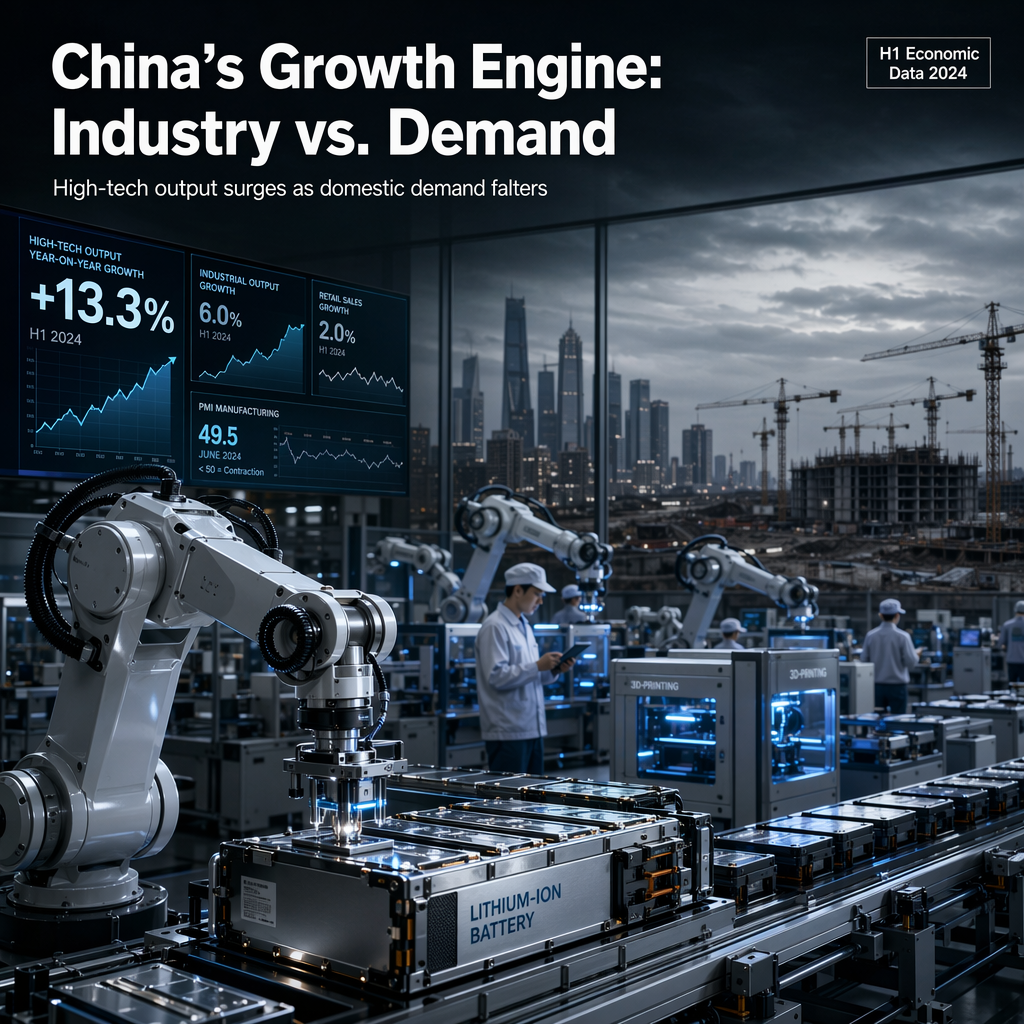
China's economic performance in the first half of the year was characterized by robust industrial and high-tech production, contrasted with weak domestic demand, according to BNY’s Geoff Yu and data from the National Bureau of Statistics [1]. The National Bureau of Statistics described the economy as operating 'within an appropriate range,' despite acknowledging an increasingly unstable external environment and insufficient domestic demand, which reinforces the case for stronger reflation efforts [1].
Key data points highlight the divergence in economic drivers: industrial value added rose 5.4% year-on-year (y/y) year-to-date (YTD), with manufacturing up 5.6% and high-tech manufacturing surging by 13.3%. In June, industrial output accelerated to 5.3% y/y from 4.5% in May. Notably, production of 3D printing devices, lithium-ion batteries, and industrial robots increased by 48.5%, 39.3%, and 28.0% y/y, respectively [1].
However, investment and property sectors remained weak. Fixed-asset investment excluding rural households declined 5.7% y/y in H1, with real estate development investment falling sharply by 18.0%. While primary industry investment edged up 0.9%, secondary and tertiary investments dropped by 1.1% and 8.4%, respectively. Infrastructure, manufacturing, and private investment all contracted, underscoring the drag from the property sector [1].
Labor and credit data were relatively stable but insufficient to offset weak domestic demand. The surveyed urban unemployment rate averaged 5.2% in H1 and improved to 5.0% in June, while the number of migrant workers rose 0.5% y/y by end-Q2. Total social financing grew by 7.4% y/y to ¥462.06 trillion, though incremental financing in H1 was ¥2.02 trillion lower than the previous year [1].
BNY’s Geoff Yu emphasized that while Beijing is not facing economic collapse, the current growth mix is overly dependent on exports and high-tech production, making it vulnerable to trade friction. The case for further reflation measures is considered stronger given the persistent weakness in domestic demand and property investment [1].
CONCLUSION
China's H1 economic data reveal a resilient industrial and high-tech sector but ongoing weakness in domestic demand and property investment. The current growth model's reliance on exports and high-tech production increases exposure to external risks, reinforcing calls for stronger policy support. Market participants are likely to watch for further reflation measures as authorities seek to address these imbalances.