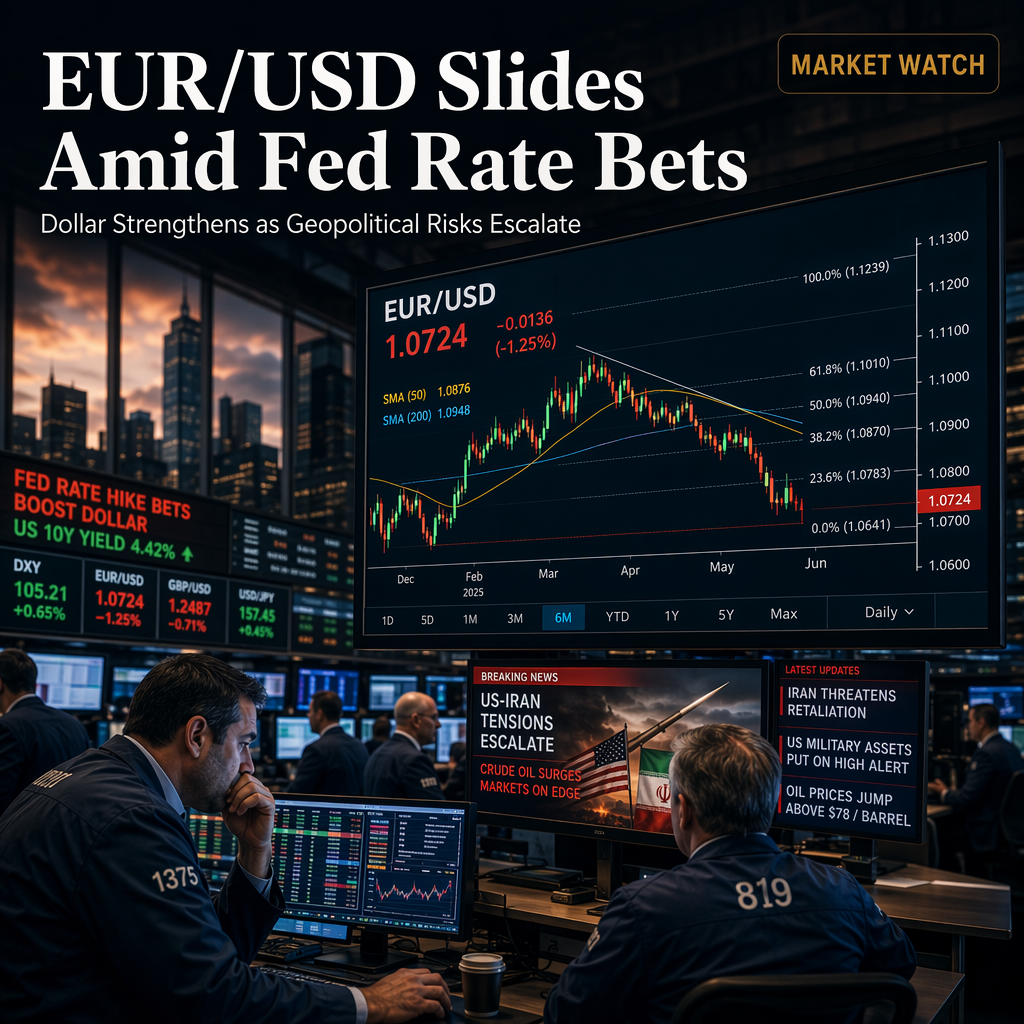
The EUR/USD currency pair declined for the second consecutive day on Friday, trading around the 1.1435 region, as revived energy-driven inflation fears boosted US Federal Reserve (Fed) rate hike expectations and strengthened the US Dollar. This move was further supported by escalating tensions between the US and Iran, which contributed to the risk-off sentiment and dollar demand [1].
Technically, the pair's recent breakout above the 23.6% Fibonacci retracement level of the April-June downturn lost momentum near the 200-period Simple Moving Average (SMA) on the 4-hour chart. Momentum indicators, including the Relative Strength Index (RSI) near a neutral 50 and a marginally negative Moving Average Convergence Divergence (MACD), suggest that bullish attempts may remain limited for now [1].
Key support for EUR/USD is identified at the Fibonacci anchor near 1.1330, which aligns with the latest swing low and could attract buyers if the pullback deepens. On the upside, immediate resistance is set at the 200-period SMA at 1.1477, followed by the 38.2% retracement at 1.1508. A sustained break above these levels could pave the way for further gains toward higher Fibonacci hurdles at 1.1563 and 1.1618, should bullish momentum return [1].
The lack of follow-through selling warrants caution before positioning for an extended pullback, indicating that traders are awaiting clearer signals before making further moves. No explicit forward-looking statements or analyst opinions were provided regarding future market direction [1].
CONCLUSION
EUR/USD remains under pressure due to revived Fed rate hike bets and geopolitical tensions, with technical indicators suggesting limited upside in the near term. Key support and resistance levels are closely watched by traders for potential market moves. The overall sentiment is cautious, with market participants awaiting further clarity before committing to new positions.