
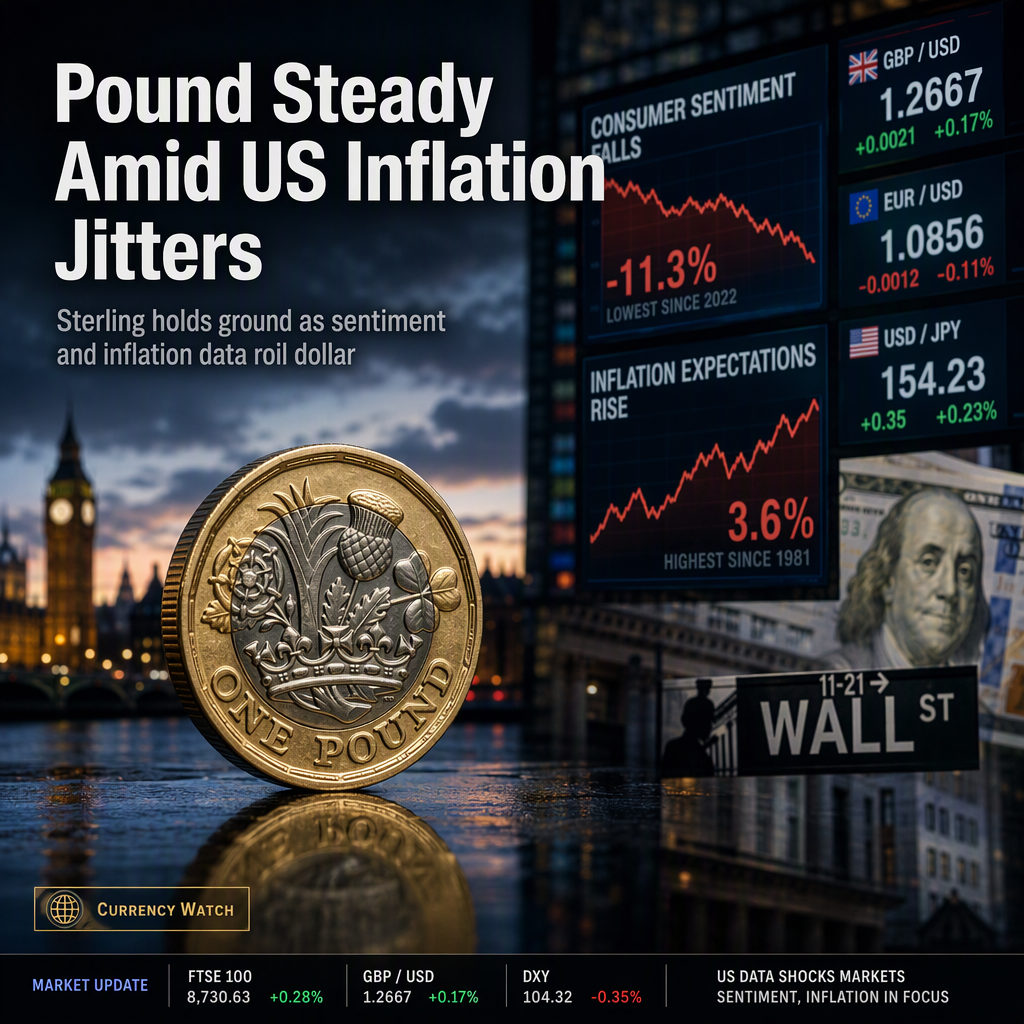
The British Pound (GBP) remained stable against the US Dollar (USD) on Friday, with GBP/USD trading at 1.3231, showing little change despite the US Dollar Index (DXY) posting a modest gain of 0.16% to 102.27 [1]. This stability comes as US consumer sentiment deteriorated, with the University of Michigan's Consumer Sentiment Index dropping from 48.1 in September to 46.3 in October, missing forecasts of 47.6. The report also highlighted that the economic outlook has weakened since the start of 2026 [1]. US households raised their one-year inflation expectations to 4.7% from 4.6%, and five-year expectations to 3.5% from 3.4% [1].
Despite high US Treasury yields, which reflect investor concerns about rising living costs, the Pound Sterling held its ground. Market participants are now focused on upcoming US consumer and producer inflation data, retail sales, further jobs data, and comments from Federal Reserve officials, all of which could influence the path of interest rates ahead of the October FOMC meeting [1]. Current market pricing indicates an 81% probability that the Fed will keep rates unchanged in October, while for December, investors expect 21 basis points of tightening, with an 87% chance of a rate increase, according to Prime Terminal [1].
In the UK, attention is turning to high energy prices and the forthcoming Autumn Budget from Chancellor John Healey. Investors are also watching for UK retail sales data, a speech by Bank of England Chief Economist Pill, and the release of GDP figures [1].
From a technical perspective, GBP/USD remains bearish in the near term, trading at 1.3229 and staying below key moving averages around 1.3439. The Relative Strength Index (14) is at 38.47, indicating ongoing downside pressure, with sellers maintaining control unless the price can reclaim structural resistance levels near 1.3360 and above [1].
CONCLUSION
The British Pound has shown resilience against the US Dollar despite weakening US consumer sentiment and rising inflation expectations. Market participants are awaiting key economic data and central bank signals, which could influence future interest rate decisions and currency movements.