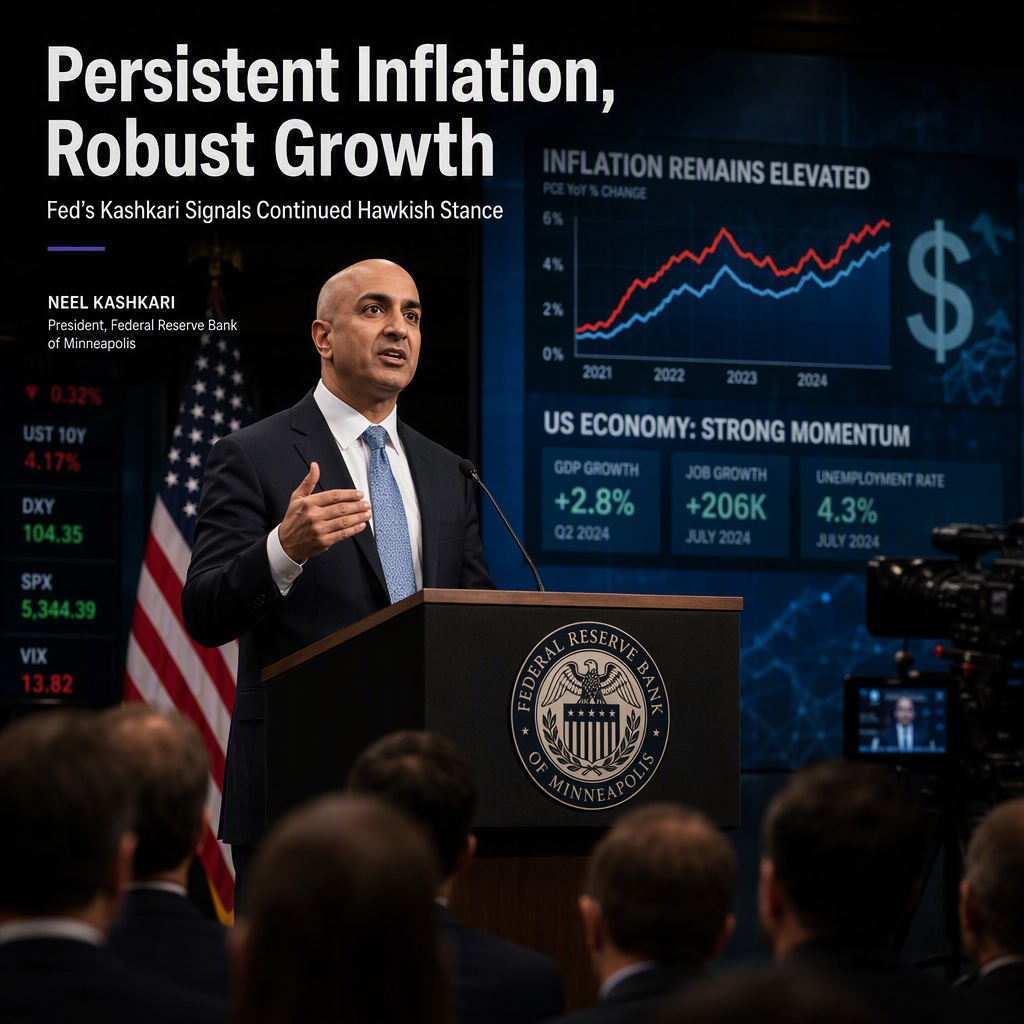
Minneapolis Federal Reserve President Neel Kashkari stated that inflation remains too high across all sectors of the US economy, not limited to rising oil prices, according to Reuters as reported by FXStreet [1]. Kashkari emphasized that inflation extends beyond energy, and expressed hope for support from other parts of government and the real economy to help address price pressures [1]. He noted that US economic growth has been fairly robust, with the American economy showing resilience despite ongoing wars, and productivity displaying some signs of improvement [1]. Kashkari also highlighted the strength of the labor market, reinforcing the Fed's ability to remain patient but vigilant regarding inflation [1].
At the time of writing, the US Dollar Index (DXY) was trading 0.07% higher at 100.30, reflecting a modest positive reaction in currency markets to Kashkari's comments [1]. The FXS Speechtracker score registered at 6.2/10, nearly matching the historical average of 6.3/10, indicating a steady, moderately hawkish tone in Fed communication [1]. Meanwhile, the FXS Fed Sentiment Index fell by 1.47 points to 150.61, signaling a slight pullback in perceived hawkishness, though the overall stance remains well above the neutral 100 mark [1].
Kashkari's remarks underscore persistent inflationary pressures cushioned by solid economic fundamentals, including resilient growth and a robust labor market. He clarified that the bond market is the responsibility of the Treasury, not the Fed, and expressed hope that continued growth could help reduce inflation over time [1]. Despite the modest decline in hawkish sentiment indices, Fed communication under Kashkari continues to lean toward tighter policy, with no indication of an imminent pivot [1].
CONCLUSION
Fed President Kashkari's comments reinforce a narrative of persistent inflation and resilient US growth, supporting a continued hawkish policy bias. Market reaction was modest, with the US Dollar Index ticking higher and sentiment indices showing only a slight pullback in hawkishness. The Fed remains patient but vigilant, with no immediate shift in policy signaled.