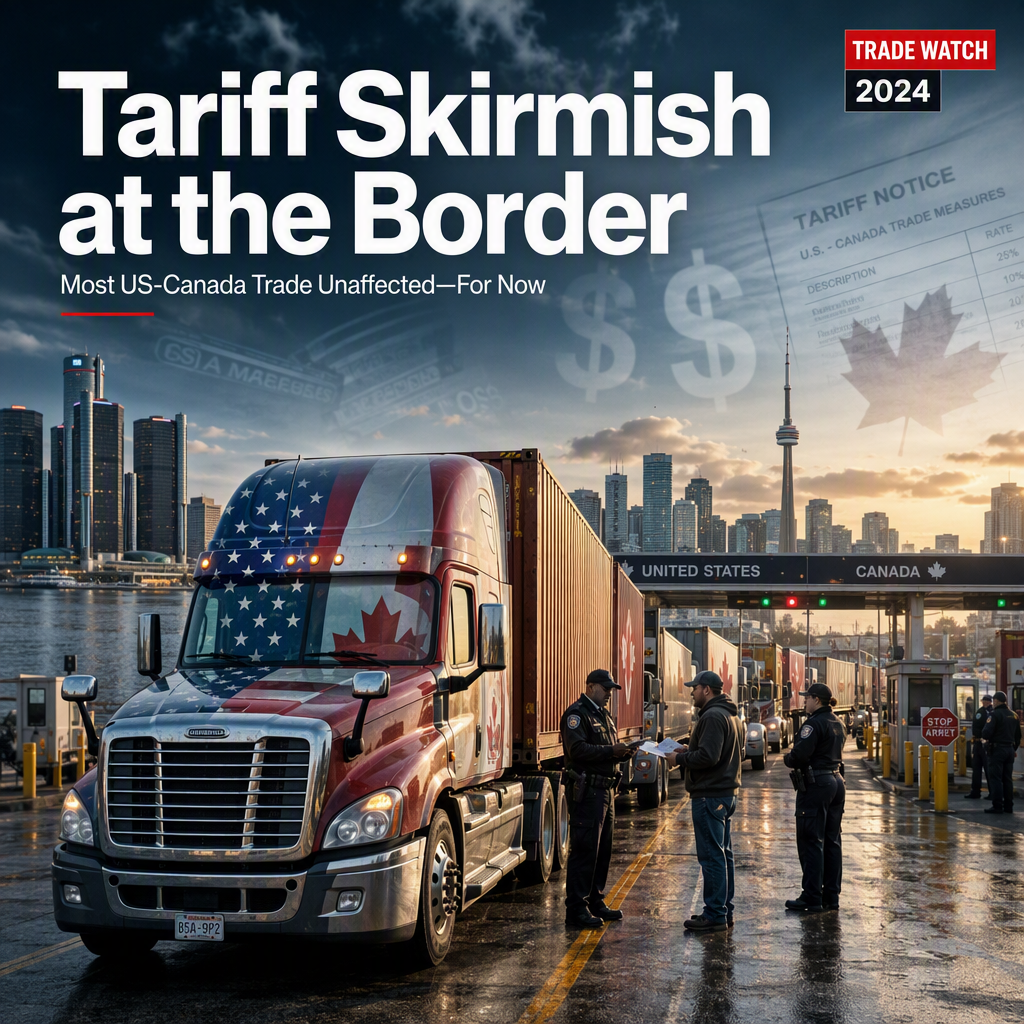
On August 22, the U.S. administration implemented Section 338 tariffs, imposing a 50% rate on approximately $20 billion worth of Canadian goods, which represents about 5% of Canada's exports to the U.S. [1]. In response, Canada announced its own tariffs, effective September 8, targeting roughly $20 billion of American exports to Canada, or about 6% of what Canada imports from the U.S. [1]. While these tariffs affect $40 billion in trade, this is a relatively small fraction of the nearly $900 billion in annual cross-border transactions between the two countries, with about 95% of trade continuing as usual [1].
The article notes that the real escalation may occur in January, when 50% tariffs are scheduled to hit a broader range of Canadian exports, including cars, trucks, and auto parts. This could lead to higher tariffs on well over $100 billion of trade if Canada retaliates further [1]. The current tariffs are notable because they apply regardless of USMCA compliance, breaking with previous practice where USMCA-compliant products were exempted. This change undermines businesses that invested heavily to align their supply chains with USMCA rules, with the share of imports claiming USMCA preference rising from about 45% in late 2024 to 86% by February [1]. Federal Reserve economists estimate the cost of regulatory compliance at $39 billion to $71 billion per year in manufacturing [1].
Some companies that moved production to Ontario to comply with USMCA now face higher effective tariff rates than firms that kept operations in China, which is contrary to the intended benefit for American production. For example, an American appliance manufacturer buying Canadian steel must pay a 50% tariff, potentially putting them at a disadvantage compared to foreign competitors [1].
Despite media and political rhetoric suggesting a full-blown trade war, the article characterizes the current situation as a 'skirmish,' with most trade unaffected and the major escalation yet to come. The author warns that the January tariff expansion could mark a shift from a skirmish to a trade war, especially if Canadian retaliation intensifies [1].
CONCLUSION
While reciprocal tariffs between the U.S. and Canada have raised concerns, the immediate impact is limited to a small portion of overall trade. The situation could escalate significantly in January if broader tariffs are implemented and Canada retaliates further. Businesses that invested in USMCA compliance are particularly affected, and market participants should monitor developments closely.