The International Energy Agency (IEA) has significantly revised its global oil demand outlook downward for 2026, citing the impact of higher prices and ongoing supply disruptions caused by the Iran war. According to the IEA's latest monthly oil market report, the agency cut its 2026 demand growth estimate to 1.1 million barrels per day year-over-year, a reduction of 700,000 barrels per day from the previous month's forecast. This adjustment follows a sharp decline in deliveries, which plunged by 5 million barrels per day in the second quarter of 2026 [1].
On the supply side, global oil output fell to 94.5 million barrels per day in May, representing a month-on-month decrease of 600,000 barrels per day. The IEA noted that this brought production to 13.6 million barrels per day, well below pre-war levels. The agency now expects global supply to drop by 3.9 million barrels per day year-on-year in 2026 to 102.4 million barrels per day, before rebounding strongly to 110.3 million barrels per day in 2027 [1].
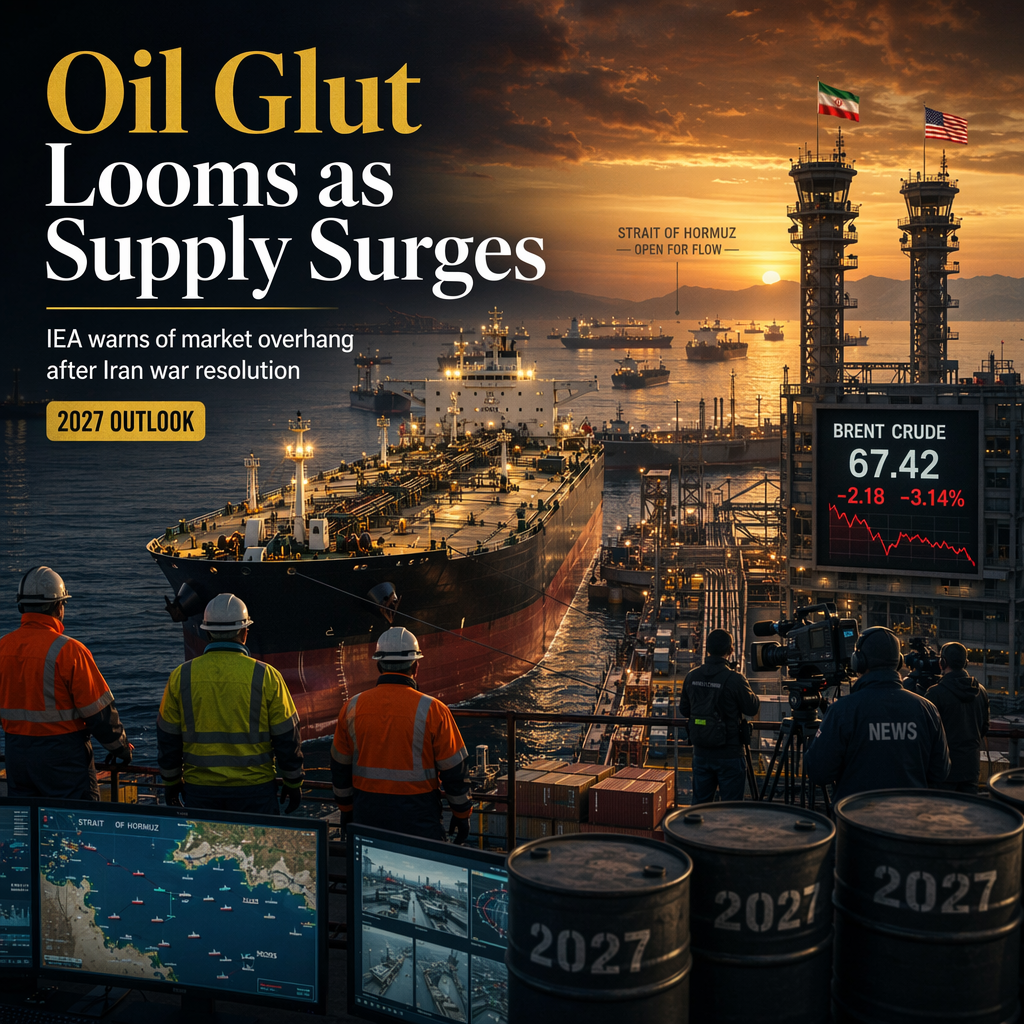
The IEA warned that a resolution to the Iran war and the reopening of the Strait of Hormuz could trigger a significant supply surge, potentially resulting in an oil glut next year. The agency projects that supply could increase by around 8 million barrels per day to roughly 110 million barrels per day in 2027, far outpacing the anticipated modest recovery in global oil demand to 105.3 million barrels per day. The IEA stated, "Our first look at 2027 balances shows a significant overhang emerging next year" [1].
Market reactions have been swift, with Brent crude prices falling 0.7% to $78.44 and U.S. West Texas Intermediate futures for July delivery dropping 1.1% to $75.18. The decline in prices comes as investors anticipate the signing of a U.S.-Iran deal in Geneva, which could allow Iranian oil exports to fully resume and further boost supply. The IEA cautioned that while exports and production from the Gulf are expected to gradually recover, normalization of supply could take several months, even as shipments through the Strait of Hormuz have already rebounded sharply due to ship-to-ship transfers in the Gulf of Oman [1].
CONCLUSION
The IEA's latest report signals a major shift in the oil market outlook, with the potential for a significant supply overhang in 2027 if the Iran war resolution holds. While oil prices have already declined in anticipation of increased supply, the agency warns that normalization will be gradual and inventories remain strained. Market participants are closely watching the U.S.-Iran deal and its impact on global energy flows.