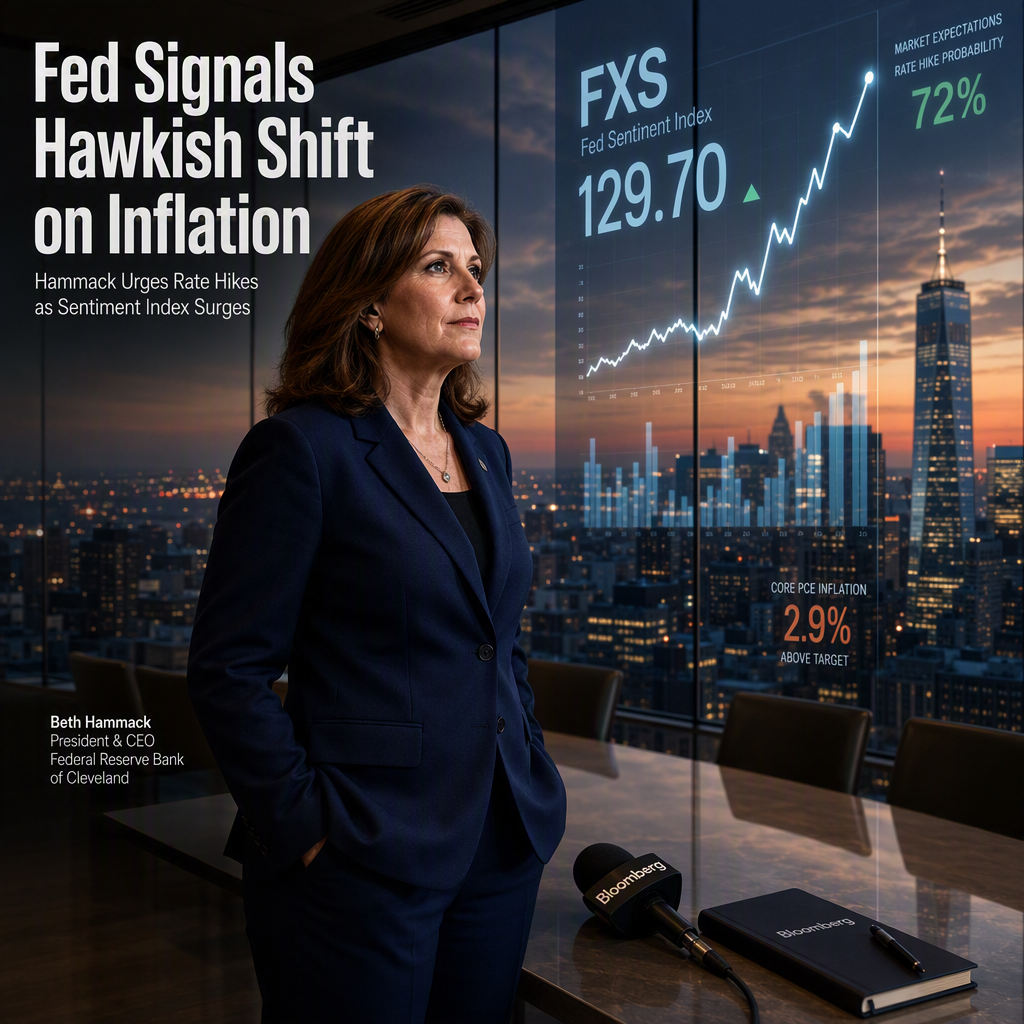
Cleveland Federal Reserve President Beth Hammack delivered a distinctly hawkish message in an interview with Bloomberg, stating that it is time for the Fed to act with rate hikes, warning that waiting could create pain for the economy [1]. Hammack emphasized that inflation is expected to end the year around 3%, which does not meet the Fed's target, and noted that there is not much restriction in the economy at present [1]. She asserted that financial conditions are not currently restrictive and highlighted the importance of Fed credibility in delivering on its dual mandate [1].
Hammack underscored that interest rates are the Fed's most easily understood tool and that markets can complement, but not substitute for, the Fed's policy actions [1]. She also mentioned that the era of low interest rates may have been unusual, suggesting a possible shift in the Fed's policy stance [1]. The FXS Speechtracker score for Hammack's remarks was 8.2/10, notably above the 7.5/10 historical average, reflecting a strong push for tighter policy [1].
The FXS Fed Sentiment Index rose by 0.59 points to 129.70, moving further into hawkish territory and reinforcing expectations for additional tightening [1]. With the index well above the neutral 100 mark, the speech is seen as strengthening the case for further rate hikes, a scenario that is typically supportive of the US Dollar and yields [1].
No specific market reactions or analyst opinions beyond the FXS Sentiment Index were provided in the article. There were no forward-looking statements regarding the timing or magnitude of potential rate hikes, but Hammack indicated she approaches all Fed meetings with an open mind [1].
CONCLUSION
Beth Hammack's comments signal a clear hawkish shift within the Federal Reserve, emphasizing the need for rate hikes due to persistent inflation and a lack of restrictive financial conditions. The rise in the FXS Fed Sentiment Index and above-average Speechtracker score suggest markets may anticipate further tightening, likely supporting the US Dollar. The Fed's credibility and commitment to its dual mandate remain central to policy decisions.