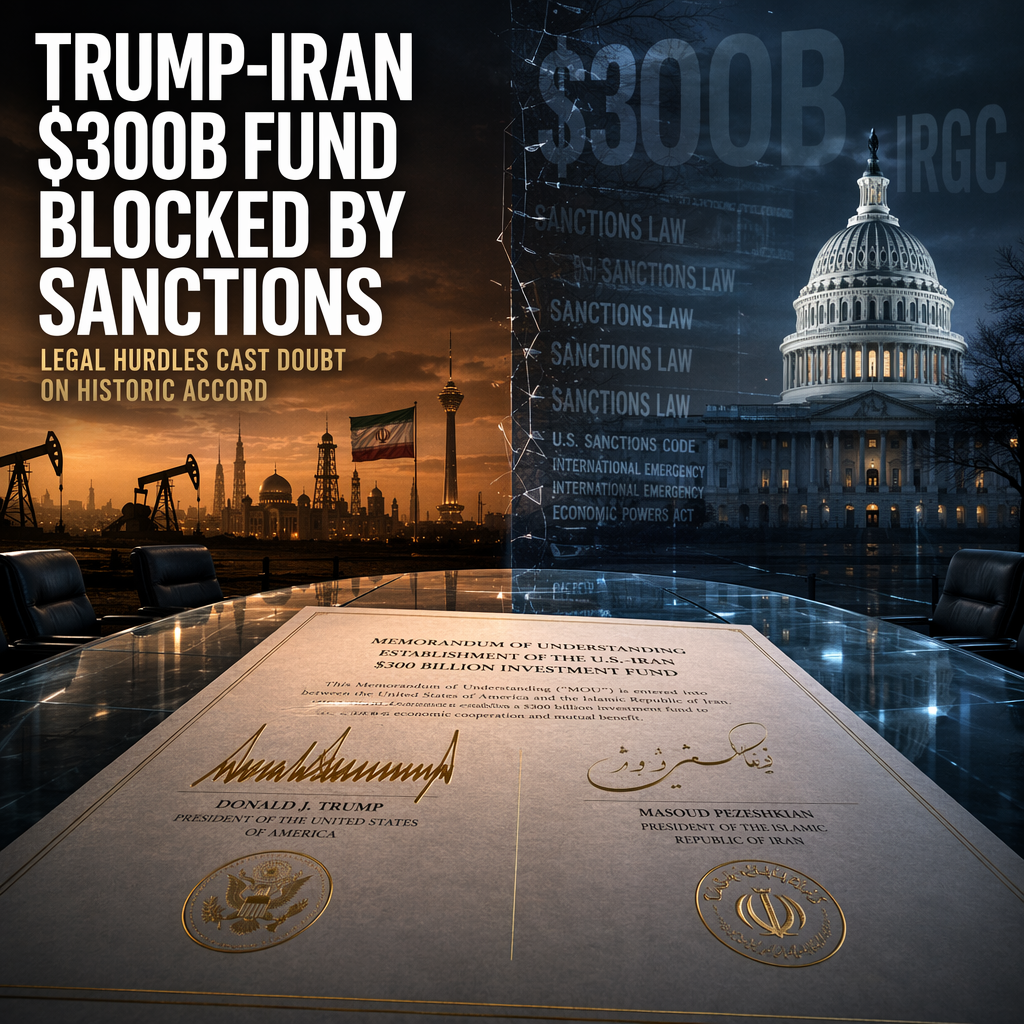
A proposed $300 billion investment fund for Iran, included in the U.S.–Iran memorandum of understanding, is facing significant legal obstacles due to existing U.S. sanctions law, according to experts cited in the article [1]. The memorandum, digitally signed on Wednesday by President Donald Trump and Iranian President Masoud Pezeshkian, is part of a 14-point plan aimed at ending the war and restoring traffic through the Strait of Hormuz. The plan includes lifting sanctions on Iran, allowing Tehran to increase oil revenue, and regaining access to parts of the international banking system [1].
One of the most ambitious elements of the agreement is the $300 billion private investment fund for Iran’s reconstruction and development. However, this initiative may be unworkable under current U.S. law, as the U.S. State Department has formally determined that Iran’s construction sector is controlled directly or indirectly by the Islamic Revolutionary Guard Corps (IRGC), most recently reaffirmed in May 2025 [1]. Under the Iran Freedom and Counter-Proliferation Act (IFCA), this finding creates sanctions risks for individuals or companies doing business in the sector [1].
Miad Maleki, a senior fellow at the Foundation for Defense of Democracies and former Treasury Office of Foreign Assets Control executive, stated that the legal and sanctions-related challenges are complex and go beyond the question of Congressional approval. Maleki noted that while the president has unilateral authority to begin easing restrictions—such as revoking executive orders, directing the Treasury Department to issue general licenses, and waiving some congressional sanctions laws—these measures may not be sufficient to make the fund durable or attractive to serious investors [1].
Maleki emphasized that Congress would likely be unavoidable for a durable version of the investment, and that reliance on temporary waivers or new licenses could make long-term investors wary and complicate any final deal [1].
CONCLUSION
The proposed $300 billion Iran investment fund, a centerpiece of the Trump-Iran memorandum, faces formidable legal and sanctions-related barriers under current U.S. law. Without Congressional involvement and more permanent legal solutions, the fund's viability and attractiveness to investors remain highly uncertain.