
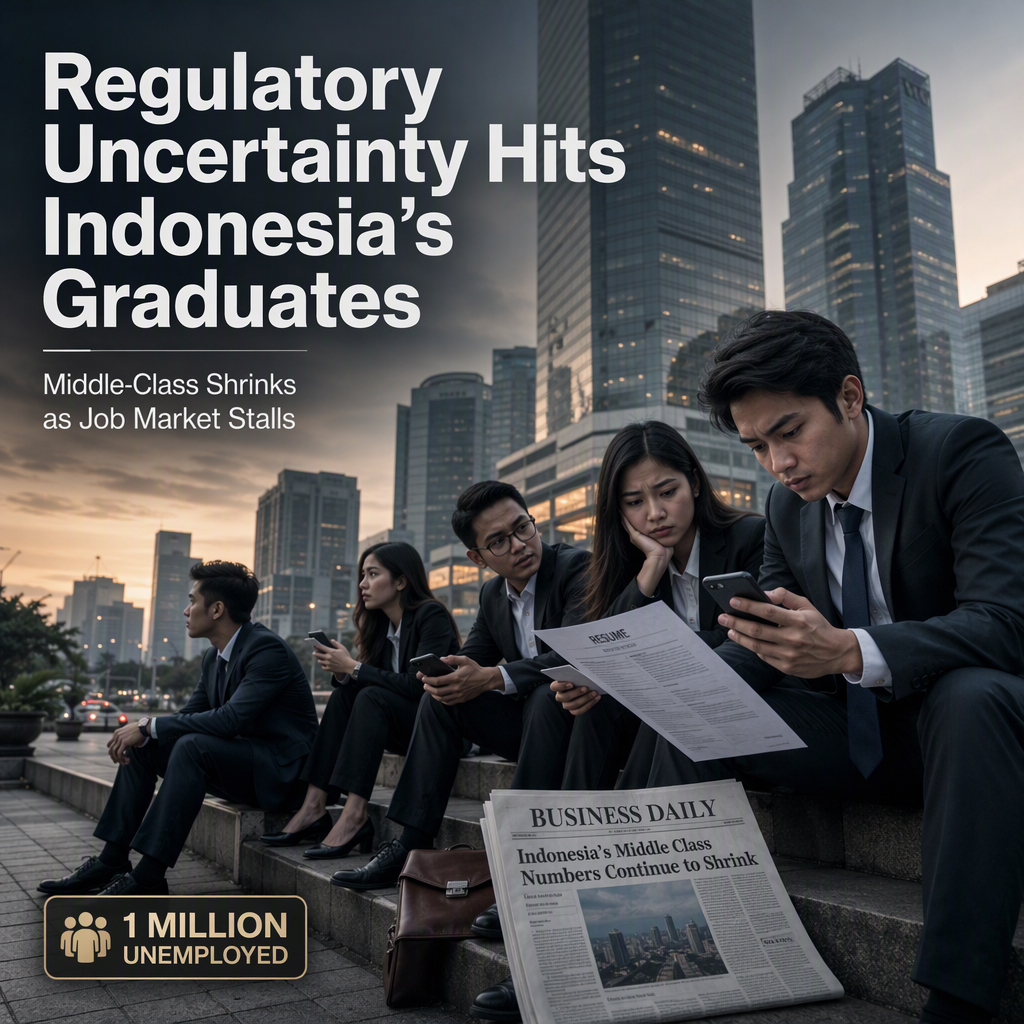
Indonesia is experiencing a significant downturn in its labor market, as companies postpone investment and expansion due to rising regulatory uncertainty, leading to a sharp increase in unemployment among university graduates. According to official statistics, the number of unemployed university graduates has reached 1 million, reflecting the severity of the current business doldrums [1]. The World Bank's recent analysis underscores this trend, noting a dramatic decline in the share of workers earning middle-class incomes—from 14.5% in 2018 to just 7.1% in 2025 [1].
Businesses are reportedly holding off on hiring and major investments as they await clearer policy signals, with a senior HR manager from a Jakarta-based manufacturing company stating, 'The uncertainty is making it difficult for us to plan for the future' [1]. This hesitancy has forced many graduates to accept positions below their qualifications or remain jobless, further exacerbating the labor market squeeze [1].
The shrinking middle class is seen as a key indicator of declining economic health and reduced upward mobility. Analysts warn that if regulatory challenges persist, Indonesia could face further contraction in its skilled labor force, which would have long-term negative implications for consumer spending, investment, and overall economic growth [1].
Market sentiment remains cautious, with both businesses and job seekers expressing concerns about the future. The ongoing regulatory uncertainty is directly cited as the primary reason for delayed investment and expansion plans, impacting the country's labor market and financial outlook [1].
CONCLUSION
Indonesia's labor market is under significant strain, with 1 million university graduates unemployed and the middle class shrinking sharply. Persistent regulatory uncertainty is dampening investment and hiring, raising concerns about long-term economic growth and stability.