
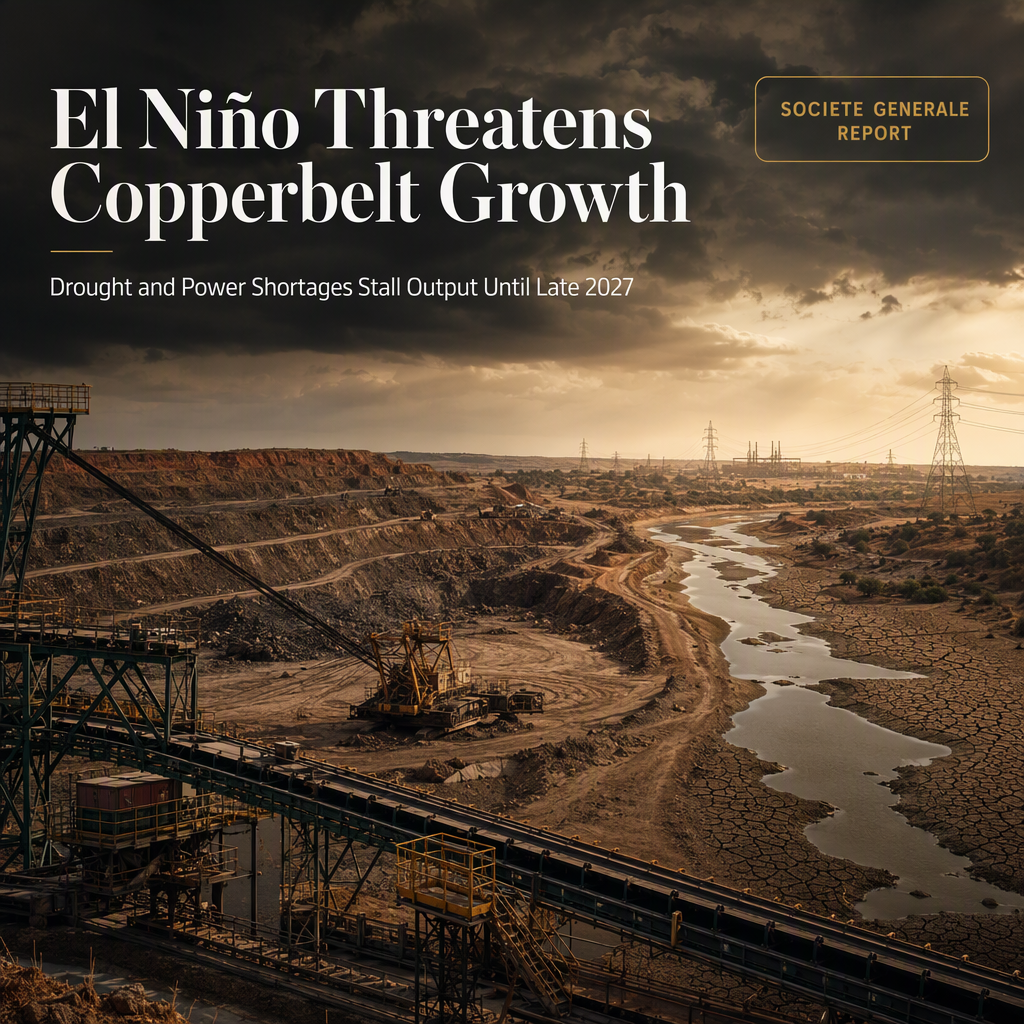
Societe Generale’s Commodity Compass, authored by Michael Haigh and Jeremy Sellem, highlights that the anticipated El Niño event in 2026-2027 poses significant risks to copper output in the African Copperbelt, particularly in the Democratic Republic of Congo (DRC) and Zambia [1]. The report notes that hydropower, which supplies most of the electricity in these regions, is vulnerable to drought-driven power shortages, and that mine growth is already slowing. As a result, Copperbelt production is expected to remain flat at best through the first half of 2027 before improving later in the year [1].
Historical data shows that major El Niño episodes have consistently coincided with weaker Copperbelt production, with output declines recorded in the DRC in 2016 and in Zambia in both 2019 and 2023, while growth stalled in 2015 [1]. The current RONI index is approaching levels seen in 1997-98, making this one of the strongest El Niño episodes on record. Societe Generale estimates that rainfall could fall 30cm below last year’s levels, while temperatures may rise by almost +1°C, further straining river levels and hydropower generation [1].
Despite consensus expectations for copper output growth of +200 kt in the DRC and +70 kt in Zambia this year, year-to-date trends indicate only +90 kt and +20 kt, respectively [1]. With the climate anomaly likely to persist through H1 2027, Societe Generale believes Copperbelt production growth could be flat at best before conditions begin to improve from Q3 2027 onward [1].
Looking ahead, the report expects the RONI anomaly to remain above +0.5°C in H1 2027, as observed in both 1998 and 2024, suggesting copper production will likely remain flat on a year-on-year basis until the climate anomaly fades later in 2027 [1].
CONCLUSION
Societe Generale warns that El Niño-related droughts and power shortages are likely to cap copper supply growth in the African Copperbelt through the first half of 2027. Market participants should anticipate flat production levels until conditions improve from Q3 2027 onward, potentially impacting global copper supply dynamics.