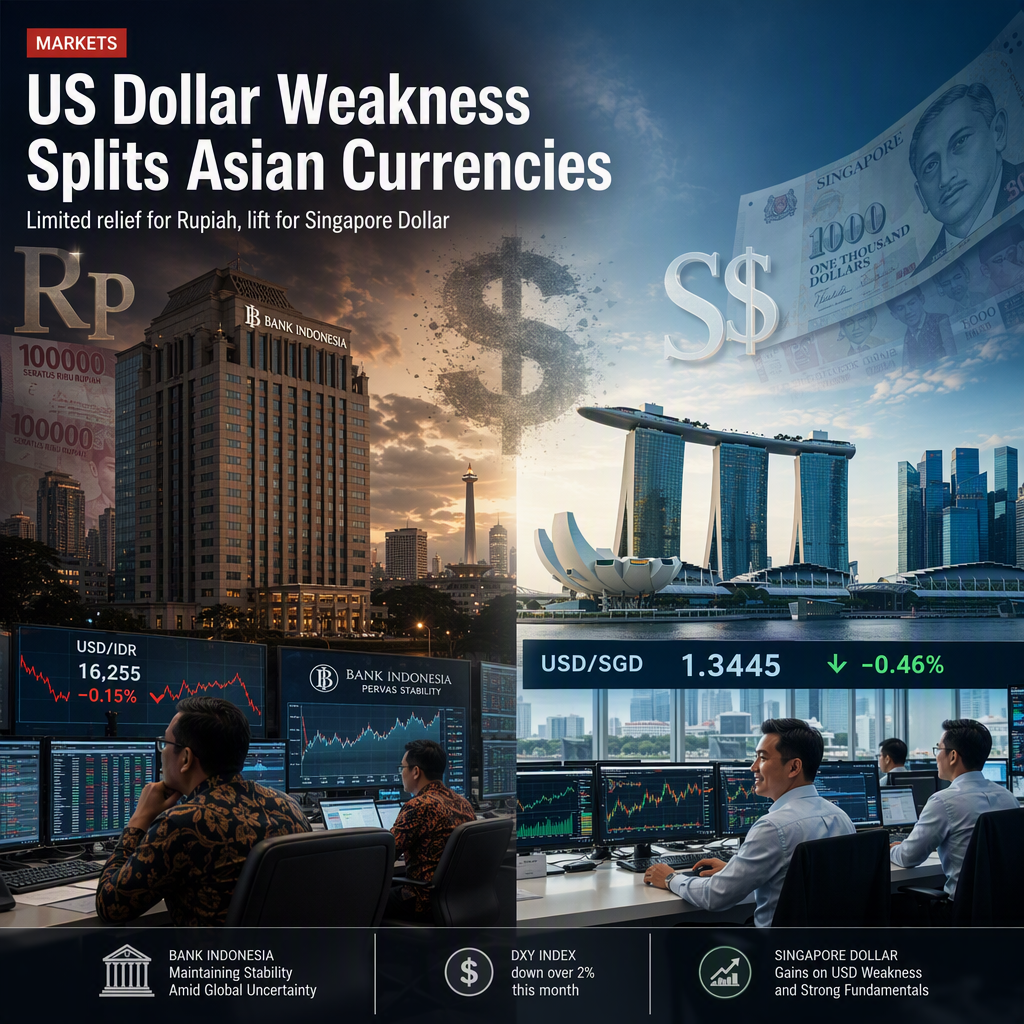
Recent market movements have seen the US Dollar (USD) weaken, impacting both the Indonesian Rupiah (IDR) and the Singapore Dollar (SGD) in distinct ways. According to OCBC strategists Sim Moh Siong and Christopher Wong, the IDR is expected to find some relief from the softer USD and a pullback in long-end US Treasury yields. Bank Indonesia (BI) has maintained its policy rate at 5.75% and is focusing on currency stability, increasingly relying on non-rate tools such as FX hedging incentives and SRBI to attract foreign inflows and deepen FX markets. The decision to hold rates also reinforces policy continuity under acting Governor Destry Damayanti. Despite these measures, elevated oil prices remain a constraint for Indonesia, and the USD/IDR pair last closed at 17,830, with bearish momentum intact and support at 17,760 and 16,630, and resistance at 17,940 [1].
Meanwhile, United Overseas Bank’s Quek Ser Leang and Lee Sue Ann report that the USD/SGD pair extended its overnight slide as the USD sell-off pushed the pair toward the 1.27 area. The pair reached a low of 1.2708 before closing 0.59% lower at 1.2709. Short-term signals remain oversold, but further weakness toward 1.2695 and potentially 1.2670 is possible, with resistance now marked at 1.2740 and 1.2770 in the coming days. The analysts note that while the sharp decline in USD/SGD appears excessive, there is no sign of stabilization yet, and the downside risk for USD remains as long as the 1.2810 resistance is not breached. However, oversold conditions could slow the pace of any further decline [2].
Both articles highlight the impact of the softer USD on Asian currencies, with the IDR finding limited relief due to domestic constraints and BI's policy stance, while the SGD continues to strengthen against the USD amid ongoing downside pressure. Market participants are advised to monitor key support and resistance levels for both currency pairs as the situation evolves [1][2].
CONCLUSION
The recent weakening of the US Dollar has provided some support to the Indonesian Rupiah and driven the Singapore Dollar higher, though domestic factors and oversold conditions may limit further moves. Central banks in the region are responding with a mix of policy tools and market participants should watch for further developments around key technical levels. Overall, the market impact is moderate, with continued attention on USD trends and regional policy responses.