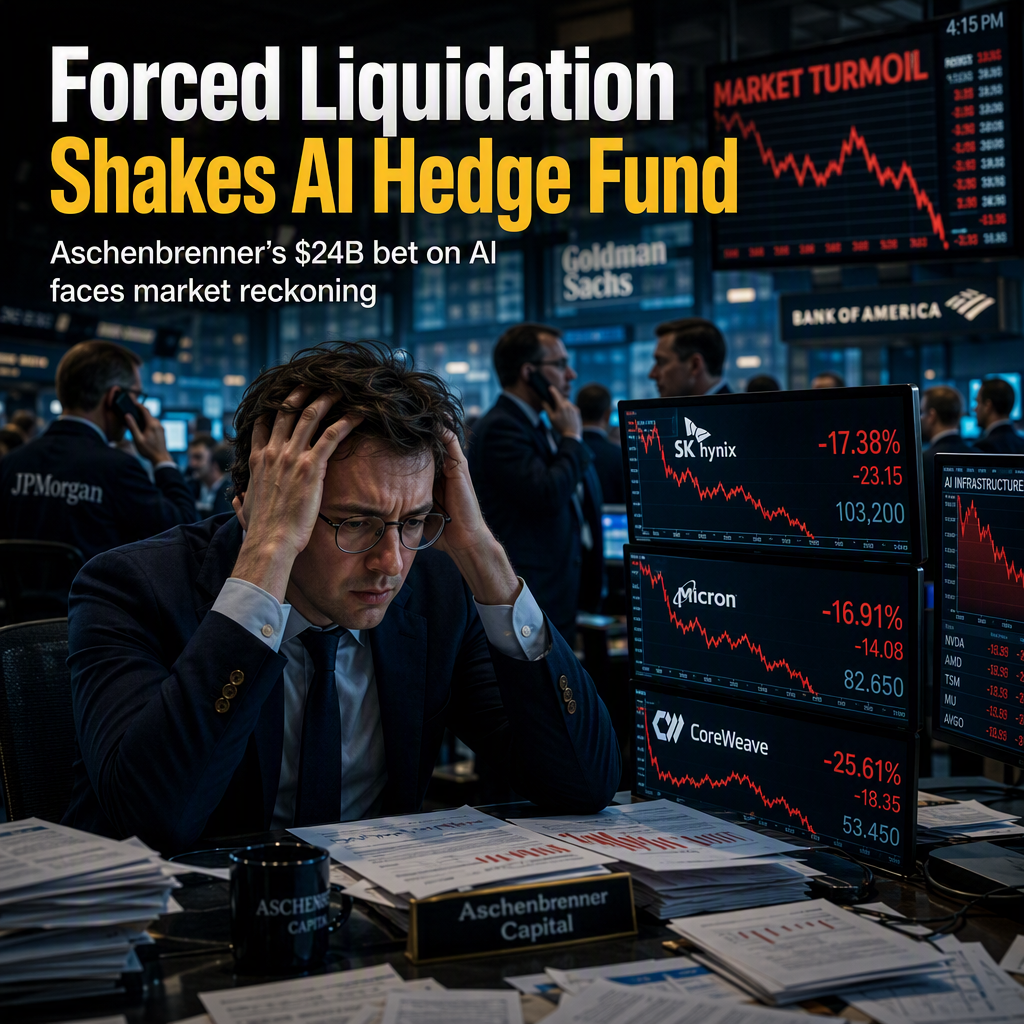
Leopold Aschenbrenner's hedge fund, Situational Awareness, has been compelled to sell all of its public stock holdings following substantial losses in artificial intelligence infrastructure investments, according to people familiar with the matter [1]. The fund, which manages $24 billion and was founded by the former OpenAI researcher, has faced significant declines in its portfolio, particularly in AI infrastructure stocks such as SK Hynix, and suffered from short positions in software companies like Adobe that moved sharply against it [1].
Prime brokers including Bank of America, Goldman Sachs, and JPMorgan Chase have been actively assisting the fund in raising cash to meet margin requirements and facilitating the orderly reduction of positions. These brokers have been marketing both long and short holdings for sale ahead of Thursday's trading session [1]. A large investment firm has reportedly reached a deal to acquire the fund's publicly traded assets, though the identity of the buyer remains unknown [1].
The fund's largest holdings at the end of the first quarter included Nebius Group, Sandisk, Micron, and CoreWeave, all of which have declined by more than 35% this month [1]. The situation is described as fluid, with uncertainty around whether margin calls are being satisfied through these asset sales. Negotiations to sell the fund's stake in Anthropic have taken place, but a spokesman for the firm denied reports that the stake was being marketed [1].
This turmoil represents an early and potentially significant test of Aschenbrenner's investment thesis, which was built on the belief that rapid advances in AI would necessitate a vast expansion of chips, memory, data centers, and electricity generation. The recent losses challenge the foundation of this thesis and have led to a scramble to raise liquidity and unwind positions [1].
CONCLUSION
Situational Awareness's forced liquidation of public stock holdings underscores the volatility and risks associated with AI infrastructure investments. The sharp declines in key holdings and the urgent need to meet margin requirements have had a high market impact, raising questions about the sustainability of Aschenbrenner's AI-driven investment thesis. The situation remains fluid, with ongoing asset sales and uncertainty about the fund's future direction.