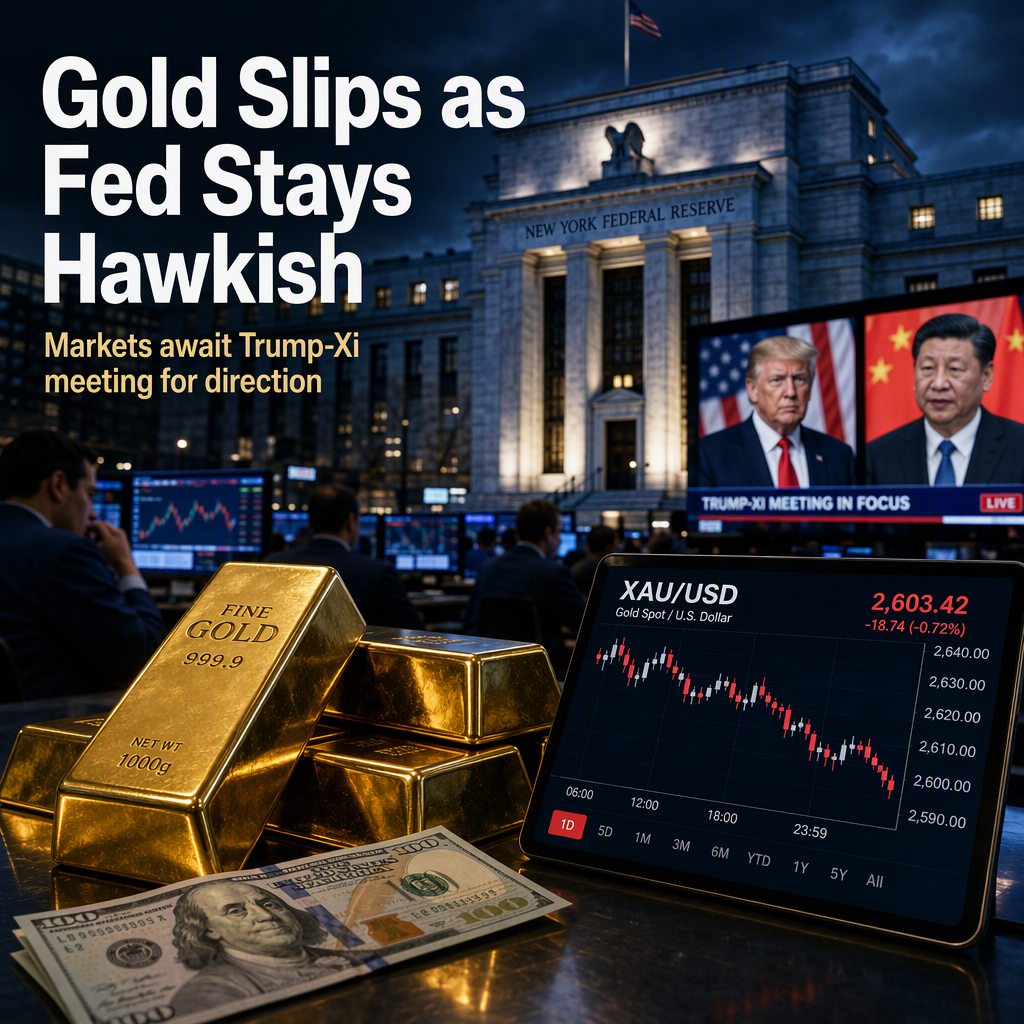
Gold (XAU/USD) edged lower during the Asian session on Wednesday, struggling to build on the previous day's rebound from sub-$4,300 levels and encountering renewed selling pressure. The decline in gold prices was primarily attributed to the US Dollar's continued strength, which reached its highest level since July 30 on Tuesday. This USD strength was driven by the Federal Reserve's hawkish outlook, as the US central bank raised interest rates for the first time in over three years at the September policy meeting and signaled the possibility of one more hike this year. St. Louis Fed President Alberto Musalem and Chicago Fed President Austan Goolsbee explicitly supported further policy tightening due to persistent inflation risks, while Boston Fed President Susan Collins and Richmond Fed President Tom Barkin left the door open for additional hikes. According to the CME Group's FedWatch Tool, traders are pricing in a 90% chance of a rate hike in December [1].
Geopolitical tensions also influenced market sentiment. US President Donald Trump addressed the United Nations General Assembly, stating he faces a significant decision on whether to make a deal with Iran or "annihilate" the Islamic Republic if the Middle East conflict remains unresolved. Additionally, tighter US sanctions targeting Iranian aviation took effect on Wednesday. Iranian Foreign Minister Abbas Araghchi met with US Special Envoy Steve Witkoff to reiterate Tehran's conditions for reopening the Strait of Hormuz, with Trump describing the discussions as having gone well but providing no further details. These developments maintained a geopolitical risk premium, supporting the USD and weighing on gold prices [1].
Despite these pressures, US bond yields remained below multi-year highs, as a recent decline in crude oil prices helped ease concerns about runaway inflation. This dynamic could potentially cap further USD gains and limit gold's downside. Market participants are now awaiting the release of flash global PMIs to assess the health of major developed economies, as well as speeches from influential FOMC members and ongoing geopolitical headlines, all of which are expected to drive short-term USD demand and influence gold prices. The market's primary focus remains on the upcoming meeting between US President Donald Trump and Chinese President Xi Jinping on Thursday, which is anticipated to provide significant direction for gold [1].
From a technical perspective, XAU/USD remains capped below the 100-period Exponential Moving Average (EMA) at $4,369, but is holding just above the 50.0% retracement of the $3,934.91–$4,694.41 move. Momentum indicators are mixed, with the Relative Strength Index (RSI) at 47.86, suggesting a lack of clear directional bias [1].
CONCLUSION
Gold prices are under pressure due to a strong US Dollar, bolstered by the Federal Reserve's hawkish stance and ongoing geopolitical tensions. However, subdued US bond yields and upcoming key events, such as the Trump-Xi meeting, could influence the next move for gold. Market participants remain cautious, awaiting further data and developments for clearer direction.