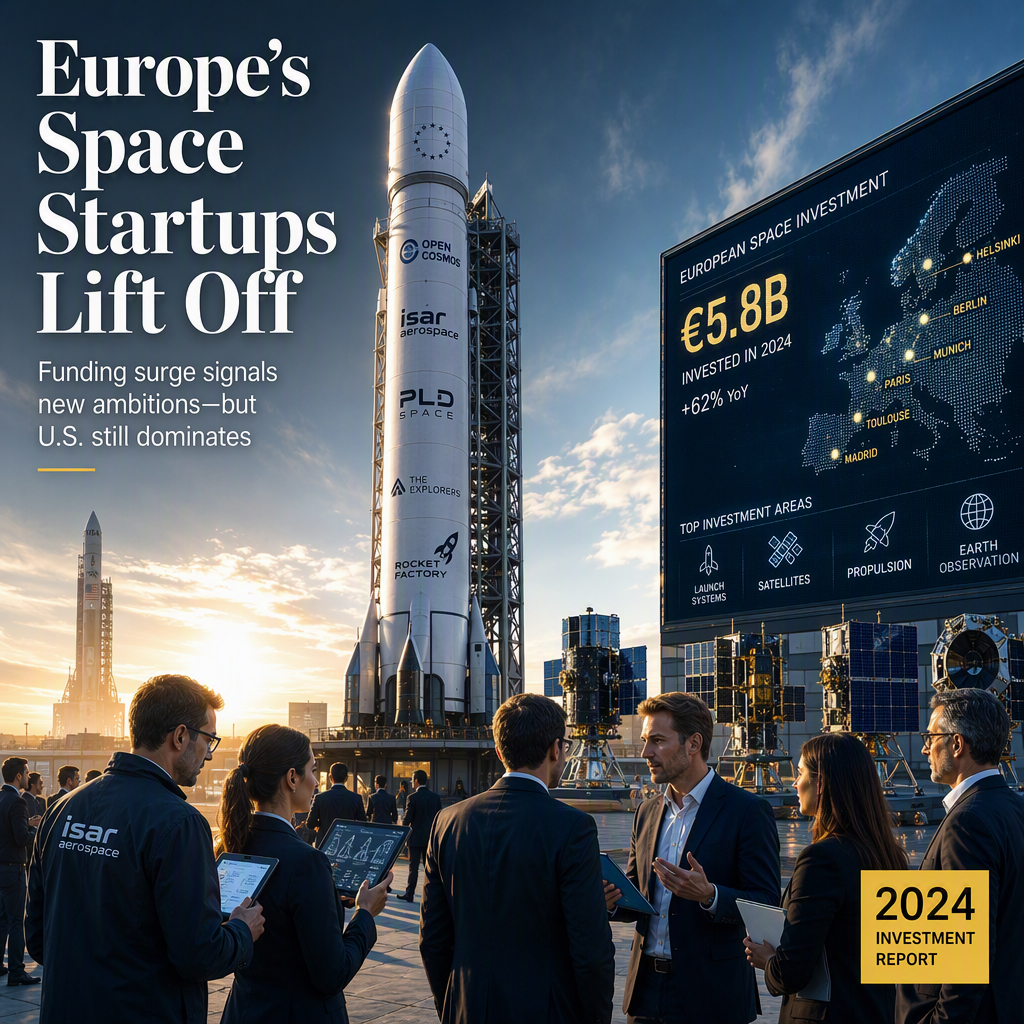
European space startups have announced a series of significant funding rounds, signaling a concerted effort to close the gap with U.S. space industry leaders such as SpaceX [1]. Open Cosmos, a satellite manufacturer, raised 300 million euros ($346 million) in an oversubscribed round that prioritized European investors, with CEO Rafel Jordà Siquier stating the funds will be used to build satellite infrastructure, connectivity, and real-time intelligence for Europe [1]. Despite being profitable for five consecutive years, Open Cosmos is raising more capital to seize growing opportunities in the space sector [1].
This funding blitz includes several other notable rounds: The Exploration Company announced a $450 million Series C, Spanish rocket company PLD Space added 108 million euros to its Series C (totaling 288 million euros), and German rocket startup HyImpulse raised over 50 million euros in new equity through a Series A extension [1]. Additionally, Marlan Space and Loft Orbital revealed a $1 billion program to build a 50-satellite AI-enabled constellation with partners such as French AI firm Mistral, and Amazon Leo ordered six more launches from Arianespace [1].
Europe's ambitions were further highlighted when German startup Isar Aerospace became the first commercial European company to put satellites into orbit earlier this month, following a 270 million euro raise in June to scale production and expand its launch network [1]. However, the surge in European investment occurs amid a significant funding gap compared to the U.S.: the OECD estimates that in 2025, 67% of private space investment recipients were U.S.-based, versus 12.8% in Europe [1]. U.S.-based Stoke Space alone raised $1 billion this month to accelerate its reusable Nova launch vehicle, underscoring the deeper capital pools available to American firms [1].
The U.S. public space budget was approximately $77 billion in 2024, further illustrating the disparity in resources between the U.S. and Europe [1].
CONCLUSION
A wave of major funding rounds is propelling European space startups forward, but the continent still faces a significant investment gap compared to the U.S. The influx of capital and recent milestones signal growing ambitions and competitiveness in Europe's commercial space sector, though American companies continue to benefit from larger funding pools and public budgets.