
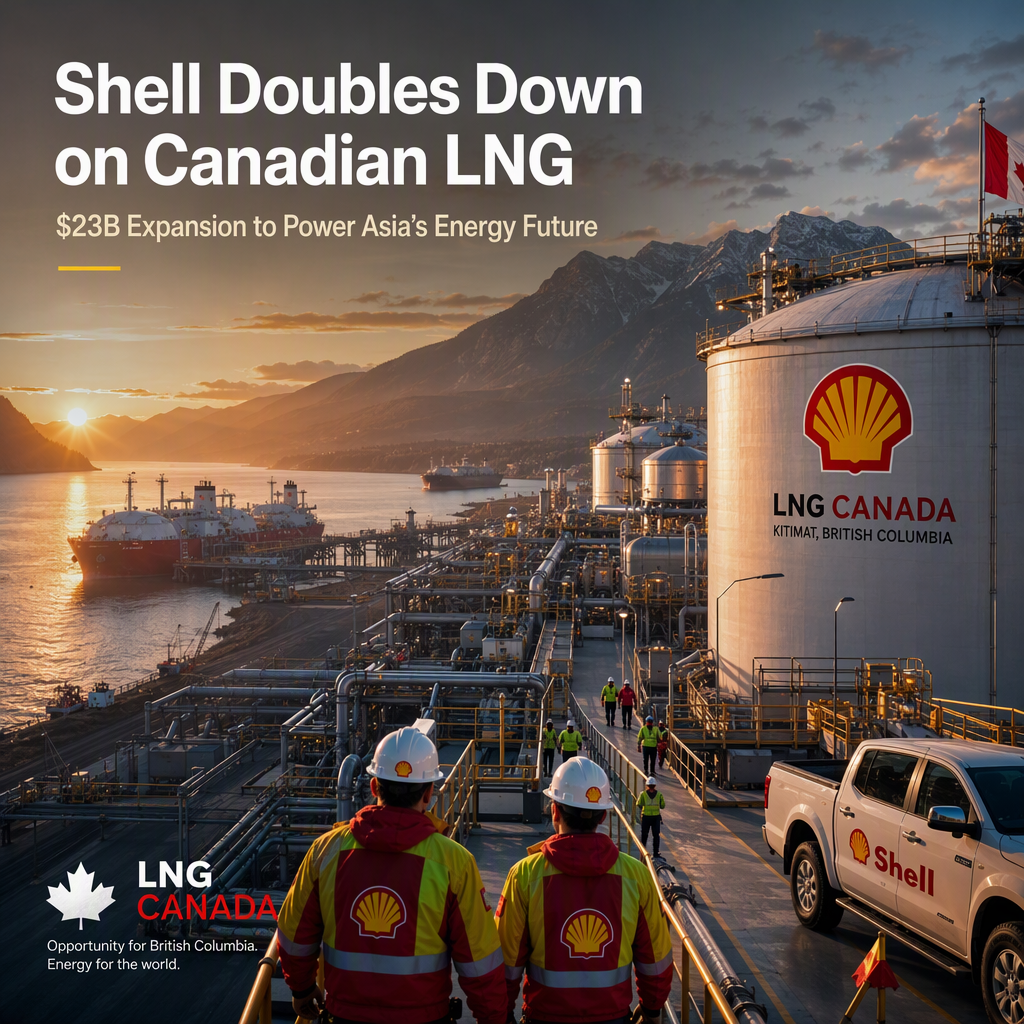
A consortium led by Shell has approved a final investment decision to expand the LNG Canada project in Kitimat, British Columbia, doubling its production capacity from 14 million metric tons per annum (mtpa) to approximately 28 mtpa [1]. Shell holds a 40% stake in the project, with other partners including Malaysia's Petronas, China's PetroChina, Japan's Mitsubishi Corp, and South Korea's state-owned Korea Gas Corp [1]. The expansion is valued at 33 billion Canadian dollars ($23.2 billion) in private sector capital, according to previous estimates by the Canadian government [1].
The investment is seen as a significant boost to Prime Minister Mark Carney's ambition to position Canada as an 'energy superpower,' especially as global LNG supplies face disruptions due to the U.S.-Iran war and as Western nations seek to reduce reliance on Russian gas [1]. The project is strategically located on Canada's Pacific coast, targeting LNG exports to key Asian markets, with commercial operations expected to commence in the early 2030s [1].
Cederic Cremers, Shell's integrated gas president, emphasized that 'LNG Canada is a core part of our Integrated Gas portfolio, helping to supply LNG to customers in Asia at a time when diversity of energy supplies and energy security are increasingly important' [1]. He further stated that the expansion supports Shell's strategic objective to be the world's leading integrated gas and LNG business [1]. LNG Canada described the move as a 'nation-building investment' that will strengthen Canada's role as a trusted energy partner [1].
The Canadian government anticipates the project will create thousands of jobs. The expansion comes amid ongoing trade tensions between Canada and the Trump administration, with Ottawa seeking to reduce its reliance on the U.S. as an energy partner [1]. On the day of the announcement, Shell's London-listed shares traded nearly 1% lower, though the stock remains up more than 32% year-to-date [1].
CONCLUSION
Shell's decision to double LNG Canada's capacity marks a transformative investment for Canada's energy sector, reinforcing its ambitions to become a leading global LNG exporter. The move is expected to have significant economic and geopolitical implications, despite a modest short-term dip in Shell's share price. The expansion positions Canada as a key energy supplier to Asia and supports Shell's strategic growth in the LNG market.