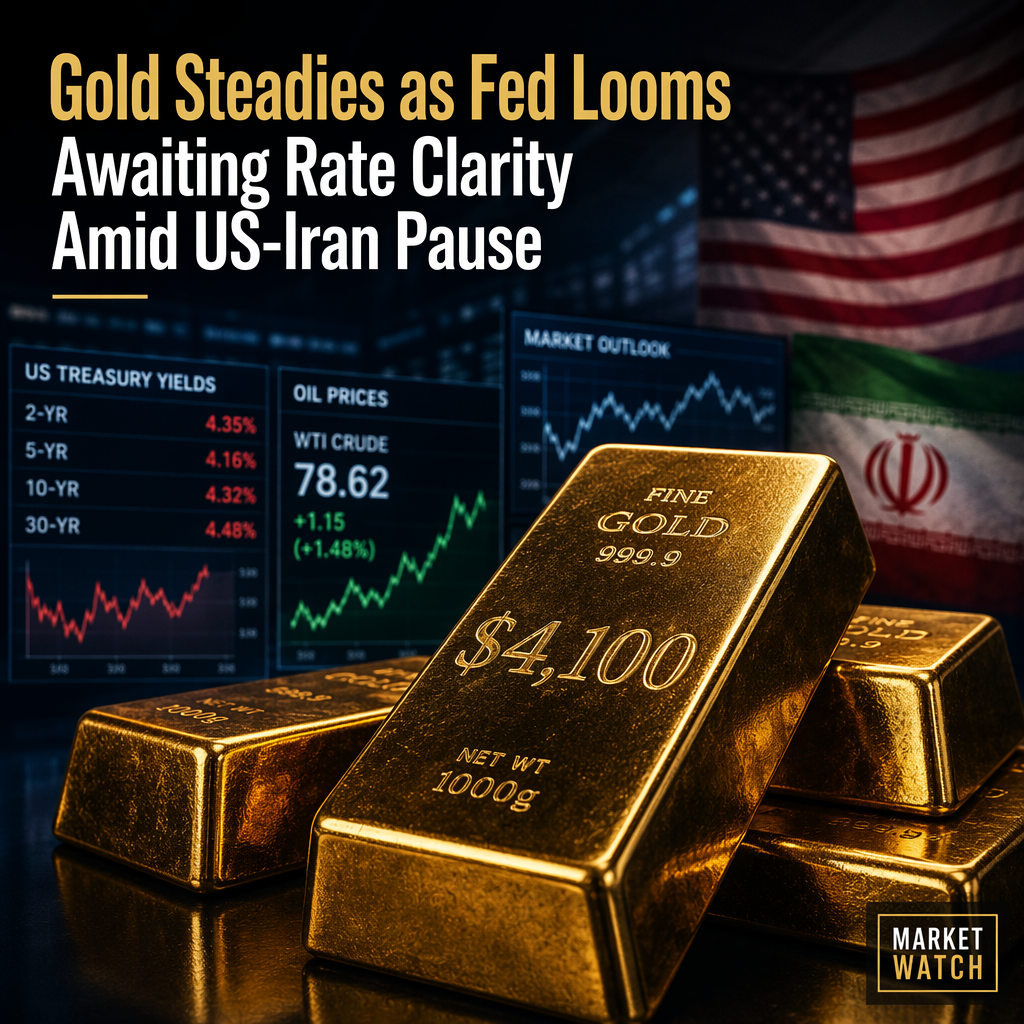
Gold (XAU/USD) has opened the week with a bullish gap, consolidating gains during the European trading session and trading around $4,101-$4,102, up 1.24% on the day [1][2]. This move follows a temporary pause in hostilities between the United States and Iran, which has improved risk sentiment and sent Oil prices sharply lower, with West Texas Intermediate (WTI) trading near $82.50 per barrel, down more than 7% on the day [2]. The pause has also pushed US Treasury yields lower and contributed to a moderate improvement in risk sentiment, hurting the safe-haven USD [1][2]. US Ambassador to the United Nations Mike Waltz stated that President Donald Trump is giving negotiations some space while keeping all military options on the table, and Tehran has indicated it would refrain from fresh attacks as long as Washington does the same [2]. However, Iranian Foreign Ministry spokesperson Esmaeil Baghaei noted that the situation in the Strait of Hormuz had not changed and the strategic waterway remained closed [2].
Despite the positive developments, buyers appear reluctant to chase Gold higher as the geopolitical situation remains fluid [2]. Gold’s reaction shows a decoupling from its traditional safe-haven role since the US-Iran war began, with positive developments lifting Gold by pushing Oil prices lower, easing inflation concerns, and reducing hawkish Federal Reserve (Fed) bets [2]. The Fed’s monetary policy meeting on Wednesday is a key risk event, with futures markets pricing a 33% chance of a rate hike, while the most likely scenario is a steady monetary policy [1][2]. The probability of a rate increase in September stands near 79% [2]. Strong growth data and above-target inflation might prompt the Fed’s Chairman to convey a hawkish message, skewing risk to the downside for gold [1]. The US Dollar Index (DXY) trades around 101.28, recovering from an intraday low of 101.12 [2].
Strategists at OCBC note that “a hold accompanied by hawkish guidance would likely push expected rate hikes further out the curve without materially altering the roughly 55bp of cumulative tightening priced in through mid-2027,” supporting the USD [2]. Conversely, “a decision to leave rates unchanged with little explanation could be interpreted as dovish and create confusion about the Fed's reaction function,” potentially lifting long-end inflation breakevens and negatively impacting the USD [2].
Technically, XAU/USD is forming a descending triangle and remains range-bound between $4,000 and $4,200, with prices fluctuating around the 21-day Simple Moving Average (SMA) at $4,070 [1][2]. Momentum indicators are in neutral-to-positive territory, hinting at consolidation rather than an impulsive bullish reversal [1]. Bulls would need a clear break above $4,160-$4,200 to confirm a trend shift, while supports are at $3,940-$3,960 and $3,885, with the triangle's measured target at $3,700 [1]. The near-term outlook is neutral, but the broader bias remains bearish [1][2].
CONCLUSION
Gold is consolidating near $4,100 as markets weigh the impact of a temporary US-Iran pause and await the Federal Reserve's rate decision. While technical and fundamental signals point to a neutral-to-bearish bias, the outcome of the Fed meeting and ongoing geopolitical developments will be crucial for gold's next move. Traders remain cautious, with the risk skewed to the downside if the Fed signals further tightening.