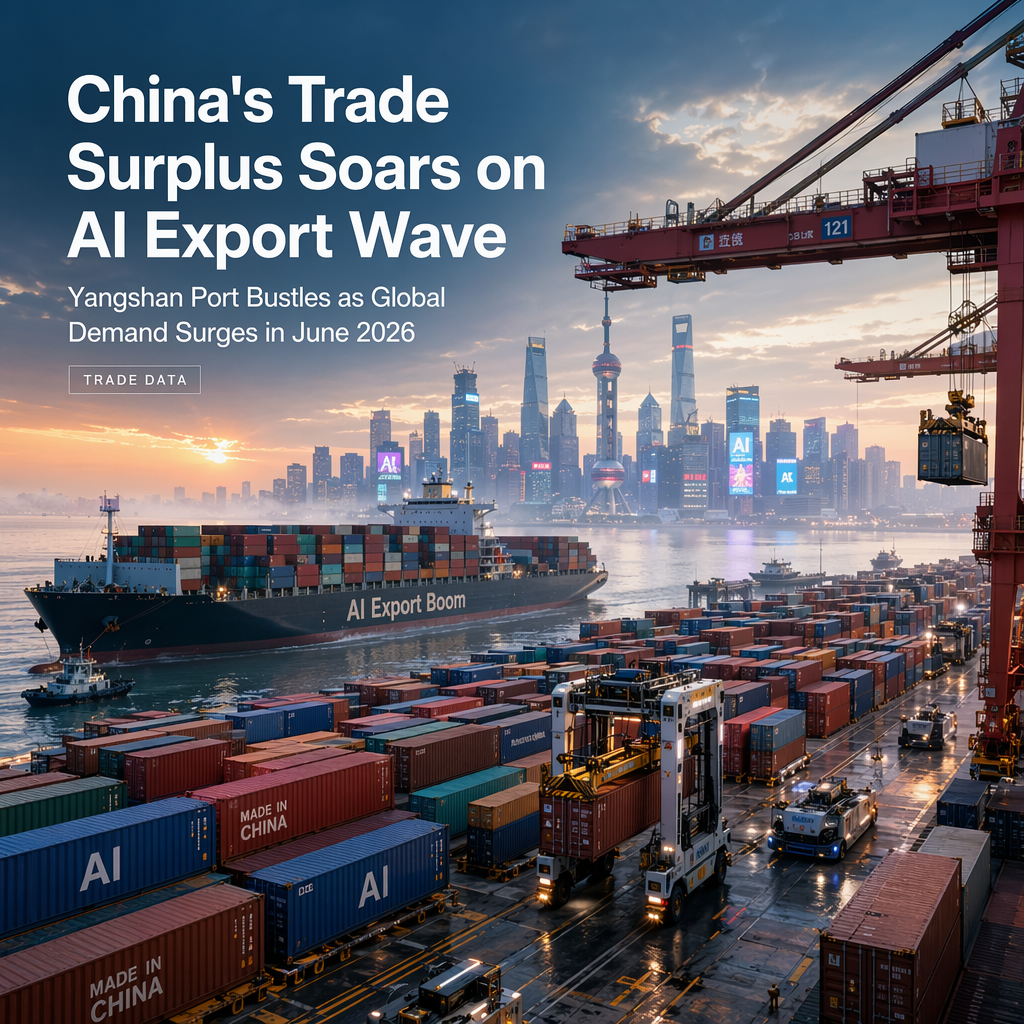
China's trade performance saw a significant boost in the first half of 2026, primarily driven by a global surge in investment in artificial intelligence (AI)-related industries. According to Nikkei Asia, China's exports rose by 27% in June, while imports jumped 36%, resulting in a 21% year-on-year increase in total trade for the first six months of 2026. This robust activity, exemplified by stacked shipping containers at Yangshan Port outside Shanghai, was attributed to heightened demand for Chinese goods and components linked to the AI boom, which helped offset weaknesses in other sectors such as domestic household consumption and ongoing geopolitical uncertainties [1].
FXStreet reports that China's June Trade Balance in Chinese Yuan (CNY) terms reached CNY859.05 billion, up from the previous CNY723.98 billion. In US Dollar (USD) terms, the trade surplus rose to $125.62 billion, surpassing both the expected $121 billion and the prior $105.43 billion. Exports surged 27% year-over-year in June, exceeding the 18.2% expected and 19.4% from the previous month, while imports climbed 36% year-over-year, also beating the 24% expected and 27.4% previously recorded [2].
The market reaction to the trade data was notable, with the Australian Dollar (AUD) experiencing slight selling pressure following the release. As of the report, AUD/USD was trading flat at around 0.6922, consolidating since the market opened [2]. The data release, which is closely watched due to China's influence on the global economy, generated some volatility for the CNY and had implications for the broader Forex market [2].
Despite challenges such as weak domestic consumption and geopolitical uncertainty, China's AI-related industries have demonstrated resilience, driving the country's trade expansion and helping to maintain robust export and import growth [1].
CONCLUSION
China's June 2026 trade data highlights a sharp expansion in both exports and imports, fueled by the global AI boom. The resulting trade surplus exceeded expectations and generated notable market reactions, particularly in currency markets. This performance underscores the resilience of China's trade sector amid broader economic challenges.