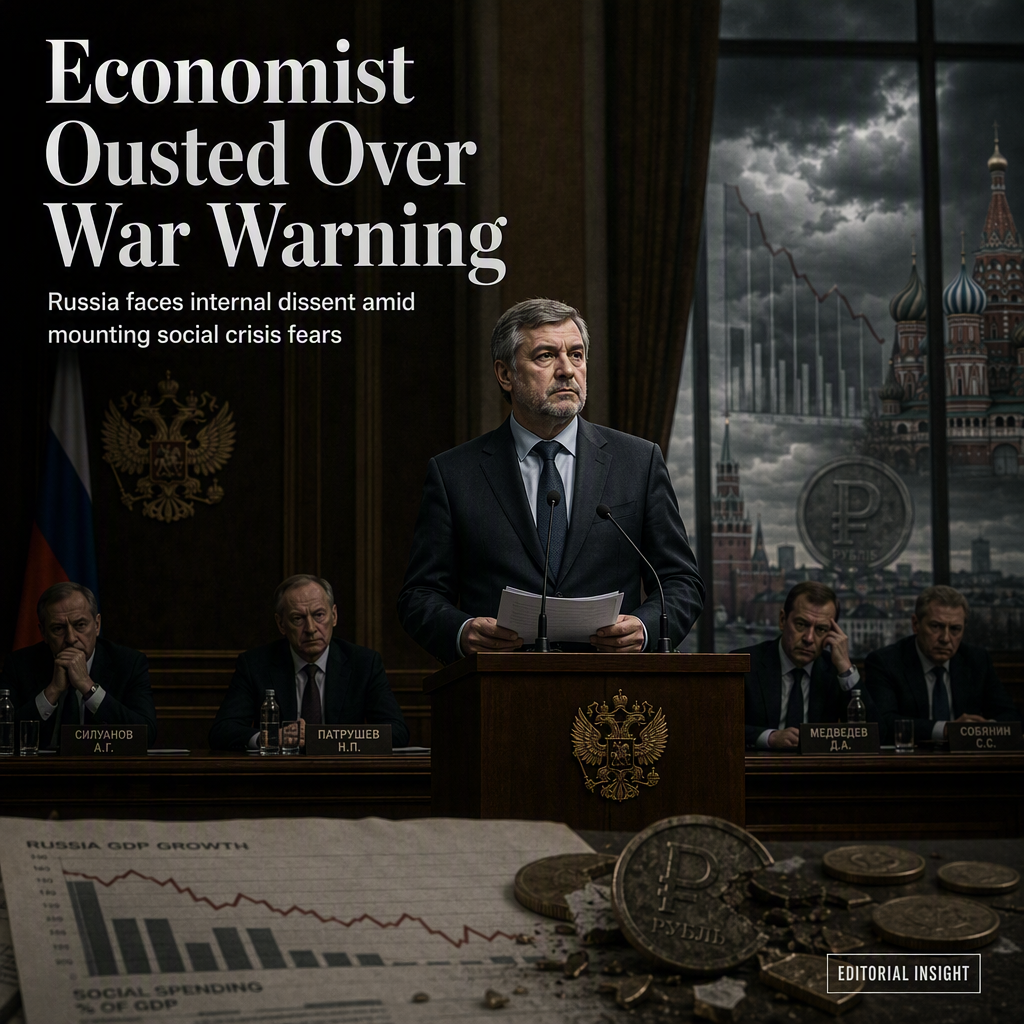
Russia has asserted that its economy remains resilient despite ongoing 'unprecedented foreign pressure' following its full-scale invasion of Ukraine in early 2022, according to government officials who spoke to CNBC [1]. However, this official stance is at odds with the views of Andrei Klepach, the former chief economist of Russia's state-controlled development bank VEB and a former deputy economy minister, who was reportedly dismissed after warning that the Ukraine war could trigger a major social crisis and that Russia could not win a prolonged war of attrition [1]. Klepach's dismissal was directly linked to his critical economic assessment, as reported by independent Russian outlet The Bell and cited by CNBC, though CNBC could not independently verify the report [1].
In a speech presented to fellow economists on May 21, Klepach stated, 'In this war of attrition, we will not win the competition. We're under the illusion that everything will collapse. It hasn't, and it won't. Our costs are mounting,' and further predicted, 'I believe Russia won't collapse, but I'm almost certain that we'll end up in a social crisis. We won't collapse economically, but our lag will widen, with all the ensuing consequences' [1]. His comments highlighted concerns about mounting costs and widening economic lag, despite official claims of resilience.
The Kremlin's move to dismiss Klepach underscores its zero-tolerance approach to public criticism and opposition to its military campaign in Ukraine after nearly four-and-a-half years of war [1]. Meanwhile, Russian officials remain defiant regarding the country's fiscal position. The Russian embassy to the U.K. told CNBC that Russia's foreign public debt is around $57 billion, which they claim is 'considerably less' than the amounts spent by the U.S., U.K., Italy, or France on debt servicing alone [1]. The embassy spokesperson emphasized, 'The Russian economy remains resilient, as does the will of our people,' and argued that attempts to undermine Russia through economic pressure have not produced the expected results, suggesting that Western countries are themselves paying a substantial price for their actions [1].
Ukraine's attacks on Russia's energy infrastructure are adding pressure to a wartime economy already reliant on military spending, higher taxes, and subsidized lending [1]. No forward-looking analyst opinions or market reactions were explicitly discussed in the article.
CONCLUSION
Russia's dismissal of a top economist who warned of a looming social crisis highlights internal tensions over the country's economic outlook amid the prolonged Ukraine war. While officials maintain a narrative of resilience and fiscal strength, mounting costs and infrastructure pressures suggest underlying vulnerabilities. The market impact is medium, as the event signals potential instability but lacks immediate financial market reaction.