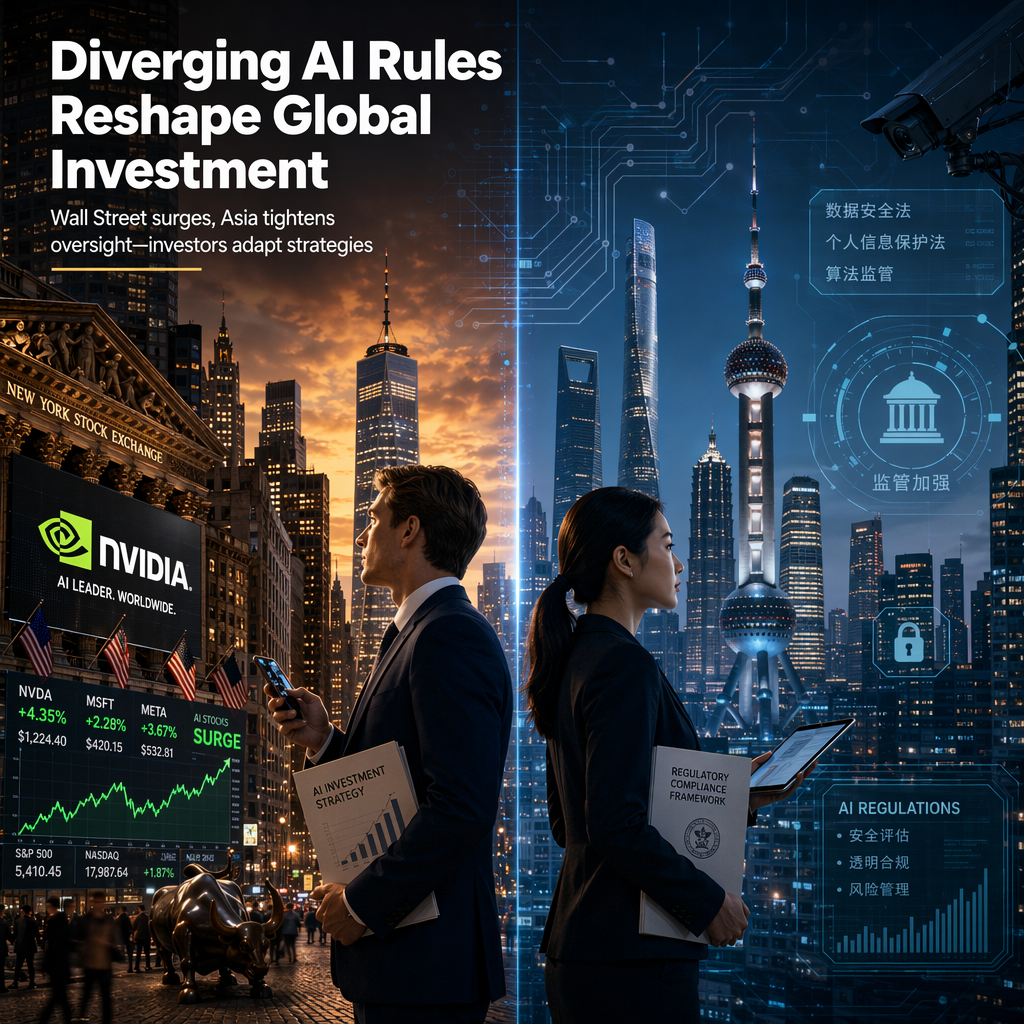
Regulators in the United States and Asia are adopting contrasting approaches to governing the rapidly expanding artificial intelligence (AI) sector, significantly impacting the investment landscape for those seeking to capitalize on AI opportunities [1]. In the U.S., regulators and policymakers have largely embraced a hands-off strategy, relying on market forces and the innovation ecosystem centered around Silicon Valley. This approach has contributed to soaring valuations for AI-focused companies listed on the New York Stock Exchange and Nasdaq, with Nvidia recently surpassing a $3 trillion market capitalization [1].
In contrast, Asian regulators—particularly in China and increasingly in Japan—are taking a more interventionist stance. Their focus is on balancing innovation with concerns about data privacy, national security, and social stability. In China, this has resulted in heightened scrutiny of tech giants and AI platforms, tighter rules on data flows, and efforts to align technology companies more closely with government priorities [1].
These regulatory differences are influencing capital flows and investor sentiment. On Wall Street, the rally in AI stocks has sparked fears of a bubble, with some analysts drawing parallels to the late 1990s dot-com boom and warning of stretched valuations. In Asian markets, uncertainty over regulatory tightening has made investors more cautious, despite governments promoting ambitious growth targets and offering substantial incentives for AI startups [1].
The article argues that investors should not view the U.S. and Asian approaches as mutually exclusive. Given the global nature of AI development, supply chains, and talent pools, opportunities exist on both sides of the Pacific. Diversification across regions, regulatory regimes, and stages of AI commercialization is recommended to mitigate risks and capture upside from multiple waves of innovation. The evolving regulatory frameworks in both regions will play a critical role in determining the sustainability of AI-driven growth and shaping the winners and losers in this era of technological competition [1].
CONCLUSION
The divergence in AI regulation between the U.S. and Asia is creating distinct investment climates, with Wall Street seeing rapid growth and Asian markets facing regulatory caution. Investors are advised to diversify across regions and monitor regulatory developments closely, as these will be key to long-term success in the AI sector.