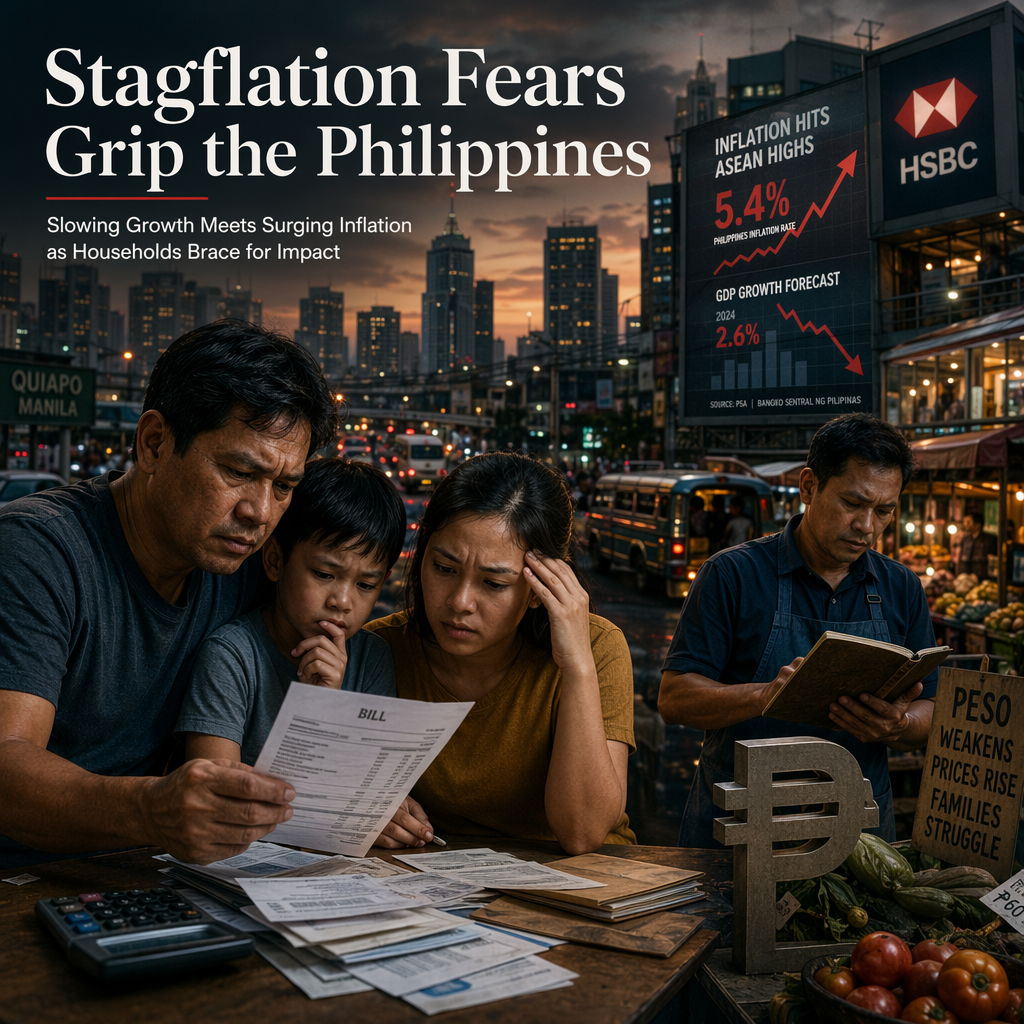
HSBC strategists have raised concerns about the Philippines facing stagflation, characterized by slowing GDP growth and surging inflation rates. According to HSBC, the country's GDP growth in the first quarter of 2026 was 2.8% year-on-year, marking its slowest pace since 2009, excluding the COVID-19 pandemic period [1]. The slowdown is attributed to declining public capital disbursements and uncertainty around government spending, which has led households and businesses to reduce their expenditures. This has resulted in increased savings and decreased investment [1].
The labor market has also been affected, with the unemployment rate rising above 5% [1]. HSBC notes that households and small businesses may soon need to tap into their accumulated savings due to persistent price increases. Headline inflation currently stands at 6.8% year-on-year, the highest in the ASEAN region [1].
Despite these challenges, HSBC sees potential for a relatively quick market recovery once the energy shock subsides. The fiscal response has been described as prudent, with officials implementing targeted welfare measures rather than broad-based stimulus [1]. HSBC expects growth to remain below potential through 2026–2027 but maintains optimism for financial market recovery post-energy normalization [1].
CONCLUSION
HSBC's analysis highlights significant stagflation risks in the Philippines, with slow growth and high inflation impacting both demand and the labor market. However, the prudent fiscal response and the expectation of a quick market recovery once energy prices stabilize offer some optimism for investors and policymakers.