
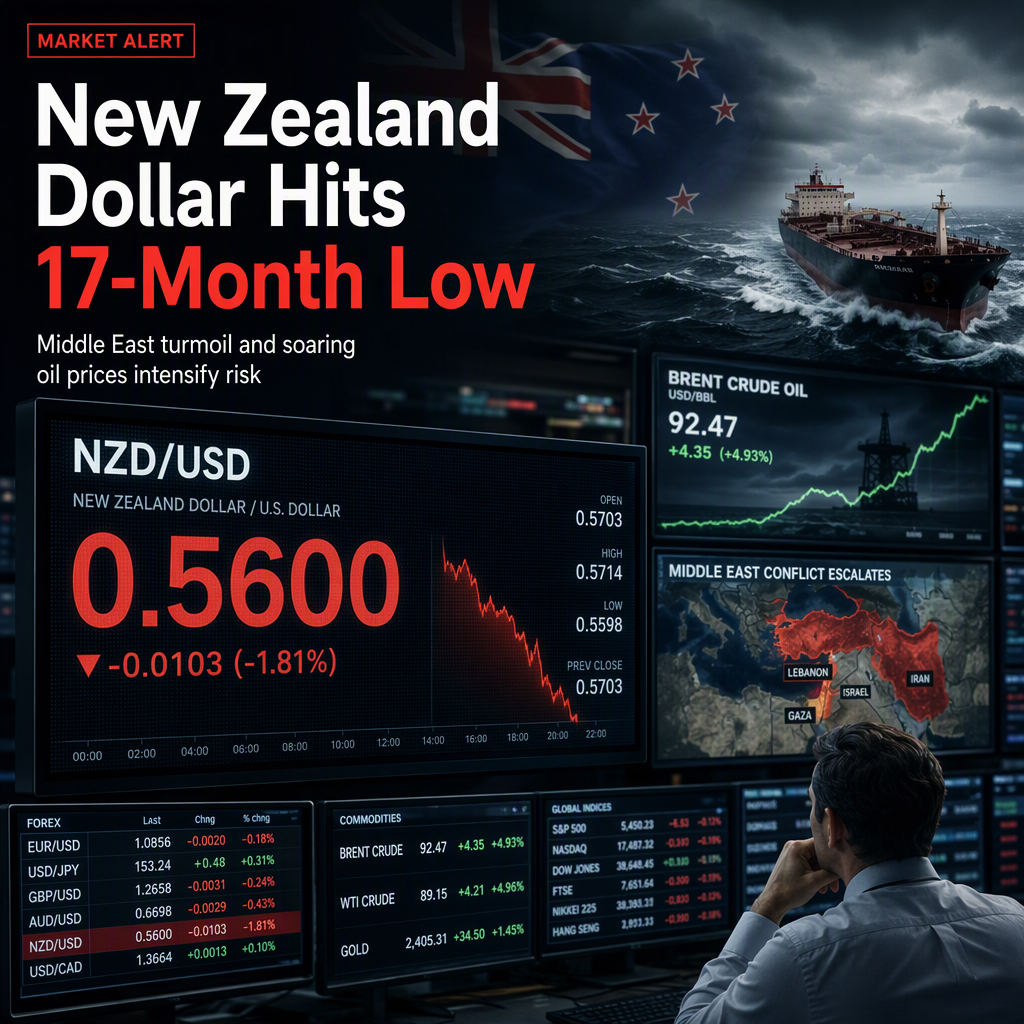
The New Zealand Dollar (NZD) has retreated sharply against the US Dollar (USD), with the NZD/USD pair trading around 0.5600 and approaching its lowest level in 17 months near 0.5580 on Monday [1][2]. This decline comes amid heightened geopolitical tensions in the Middle East and persistently high Oil prices, which have fueled risk aversion across global financial markets [1][2]. Both sources report that a new attack by Iran-backed Houthi rebels on Saudi Arabia’s King Khalid International Airport resulted in one death and 11 injuries, following a Saudi strike on Sanaa Airport in Yemen. This tit-for-tat escalation has raised fears of a broader regional conflict, further pressuring sentiment-linked currencies like the Kiwi [1][2].
Elevated Oil prices, with Brent crude rebounding to the $102.70 area during the European morning session after dipping to $100.65 in Asia, are particularly problematic for New Zealand, a net Oil importer [1]. Higher energy costs pose additional risks to New Zealand’s economic activity and household purchasing power, exacerbating the NZD’s weakness [2].
On the US side, the Greenback started the week on a soft note, weighed down by disappointing University of Michigan (UoM) Consumer Sentiment Index data, which fell to 46.3 in October from 48.1 in September—below economists’ expectations of 47.6 [1][2]. This reading reflects deteriorating household confidence amid rising living costs and economic uncertainty linked to the Middle East conflict [2]. However, the US Dollar regained some ground later in the session [2].
Market participants are closely watching upcoming inflation reports in the US for further insight into the Federal Reserve’s tightening calendar. According to the CME FedWatch tool, the probability of a 25-basis-point rate hike at the Fed’s October meeting has dropped to 17% from 24% a week earlier, while the chance of a December hike stands at 84% [2]. In New Zealand, attention is turning to upcoming economic releases, including food inflation figures and the Manufacturing Purchasing Managers Index (PMI) for September, as well as a speech by Reserve Bank of New Zealand Governor Anna Breman on Thursday [1][2]. These events could influence monetary policy expectations and the NZD’s near-term direction [1][2].
CONCLUSION
The New Zealand Dollar is under significant pressure, nearing a 17-month low against the US Dollar as geopolitical tensions and high Oil prices drive risk aversion. With key economic data and central bank commentary on the horizon, markets remain cautious, and the NZD’s outlook will depend on both global developments and domestic economic signals.