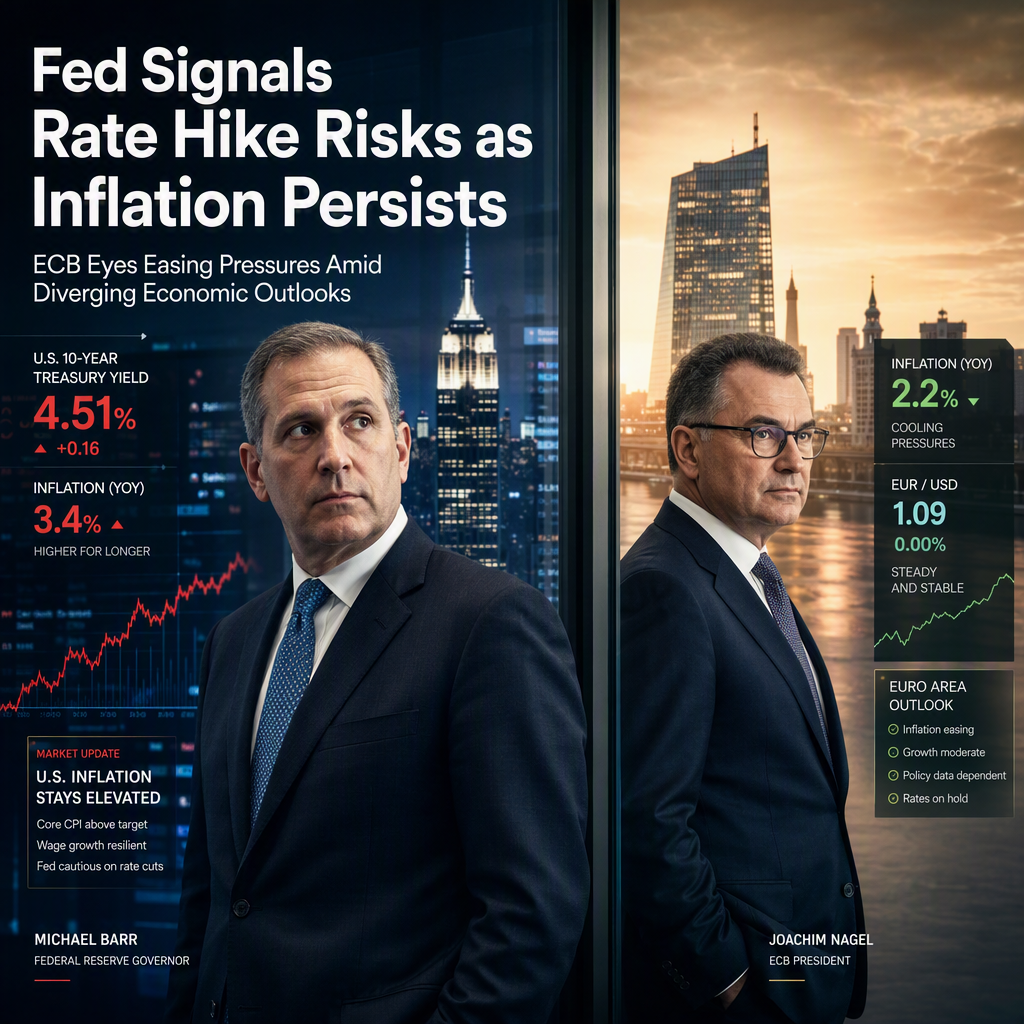
Federal Reserve Governor Michael Barr stated that he would support an interest rate hike if inflation does not ease, emphasizing that inflation has remained above the Fed's 2% target for nearly 5½ years [3]. Barr noted that if data shows inflation moderating toward 2%, the Fed could take more time to assess its policy stance, but if inflation fails to moderate, decisive action to raise rates would be necessary [1][3]. He highlighted that consumer spending has been resilient and the economy is growing solidly, with a stable labor market and low unemployment, but persistent inflation remains a significant policy risk [1][3]. The most recent inflation readings showed headline prices up 3.7% over the past year, or 3.3% excluding food and energy [3]. Barr supported the July decision to keep the benchmark funds rate targeted between 3.5%-3.75%, but markets were pricing in about a 66% chance of an increase this month, according to CME Group's FedWatch tool [3]. Treasury yields jumped Tuesday, with the benchmark 10-year note at a level not seen since mid-January 2025, amid worries over the Middle East situation [3].
Meanwhile, Joachim Nagel, ECB Governing Council member and Bundesbank President, expressed confidence in the global economic outlook despite geopolitical tensions in the Middle East [2]. Nagel welcomed the easing in core and services inflation in Europe and stated that he is not seeing second-round effects on inflation [2]. He also commented on recent foreign exchange interventions involving the Japanese Yen, noting that coordination would have been welcomed and that the use of the Euro in US and Japanese interventions was discussed at the G20 meeting [2]. The Euro showed little reaction to Nagel’s comments, with EUR/USD trading around 1.1590, down 0.24% on the day [2].
According to Barr, investment in artificial intelligence is boosting US economic growth [1]. Both Barr and Nagel highlighted the importance of monitoring inflation trends closely, with Barr warning that persistent inflation above target creates risks and Nagel noting positive developments in European inflation [1][2].
Forward-looking, Barr indicated the Fed will get another look at inflation data when the consumer and producer price indexes are released next week [3]. Markets are anticipating potential policy action at the next Fed meeting in two weeks, with elevated odds of a rate hike [3]. Nagel’s remarks suggest the ECB is less concerned about inflationary pressures at present, focusing instead on maintaining growth amid geopolitical uncertainties [2].
CONCLUSION
Fed Governor Barr’s comments signal a heightened risk of a US rate hike if inflation fails to moderate, with markets already pricing in a significant chance of an increase. In contrast, ECB’s Nagel sees positive inflation trends in Europe and little immediate risk, resulting in muted market reaction for the Euro. The divergence in central bank outlooks underscores persistent inflation concerns in the US versus easing pressures in Europe.