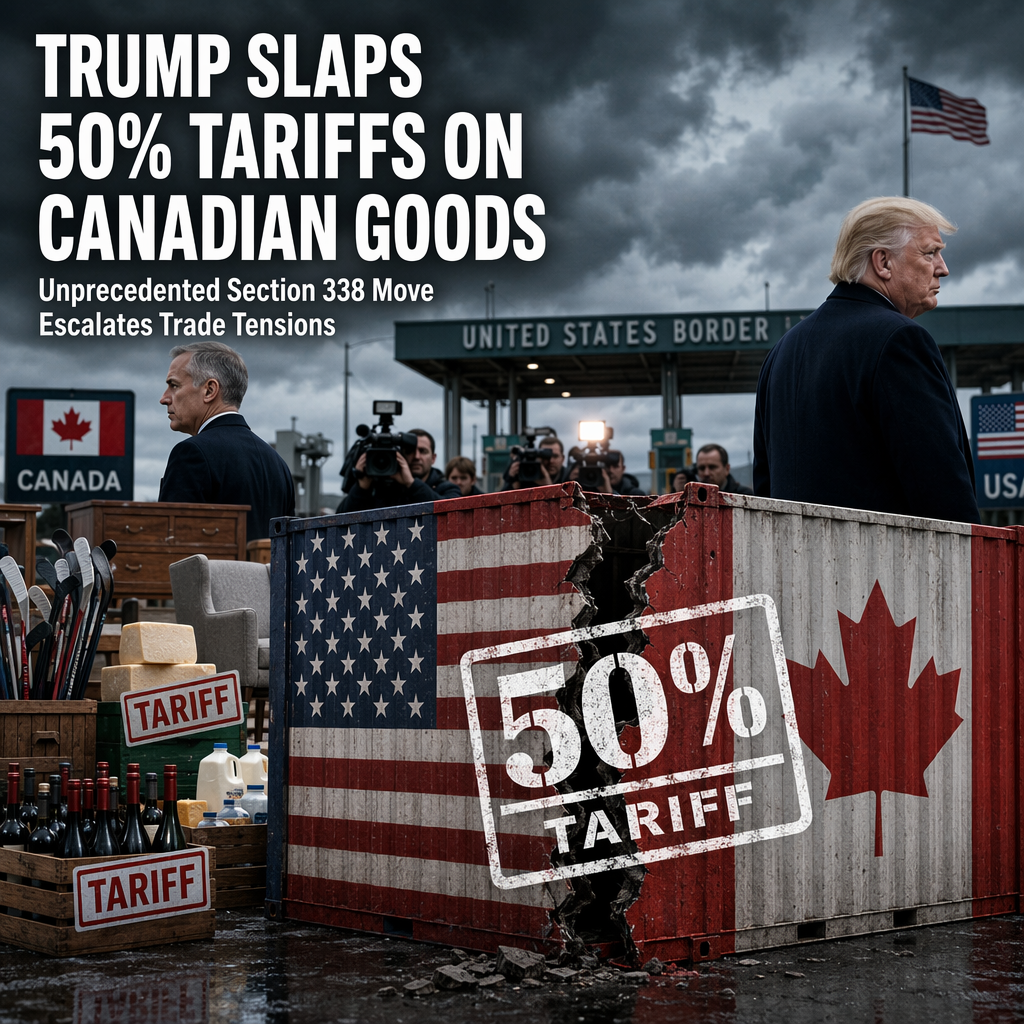
President Donald Trump has invoked Section 338 of the 1930 Tariff Act, a provision never before used by a U.S. president, to impose 50% tariffs on a range of Canadian goods, including wine, hockey sticks, cement, dairy products, and furniture [1]. This action targets Canada, one of America's top trading partners, and is expected to take effect within the next 30 days [1]. The move adds further tension to the already strained trade relationship between Trump and Canadian Prime Minister Mark Carney [1].
Canadian Prime Minister Mark Carney criticized the tariffs, stating they violate the U.S.-Mexico-Canada Agreement, but reaffirmed Canada's commitment to negotiations [1]. The tariffs are described as a significant escalation, with Scott Lincicome of the Cato Institute noting that Section 338 grants the president broad authority and introduces new uncertainty into the multitrillion-dollar trading environment [1]. Lincicome also highlighted that the law's use follows a Supreme Court ruling against the administration's previous use of emergency powers for tariffs, suggesting Section 338 could become a new legal avenue for future trade actions [1].
The tariffs are expected to impact U.S. importers, who typically pay such duties upfront and may pass the costs on to wholesalers, retailers, and consumers through higher prices [1]. Lincicome suggested the limited scope of the tariffs may be influenced by upcoming midterm elections, as Americans generally associate tariffs with affordability issues [1]. David Clement of the Consumer Choice Center argued that the move appears designed to preserve Trump's broader tariff agenda despite recent legal setbacks [1].
CONCLUSION
Trump's unprecedented use of Section 338 to impose steep tariffs on Canadian goods marks a significant escalation in U.S.-Canada trade tensions and introduces new legal uncertainty for future trade policy. The move has drawn criticism from Canada and raises concerns about higher costs for U.S. businesses and consumers. Market participants are likely to view this as a high-impact development with potential ripple effects across North American trade.