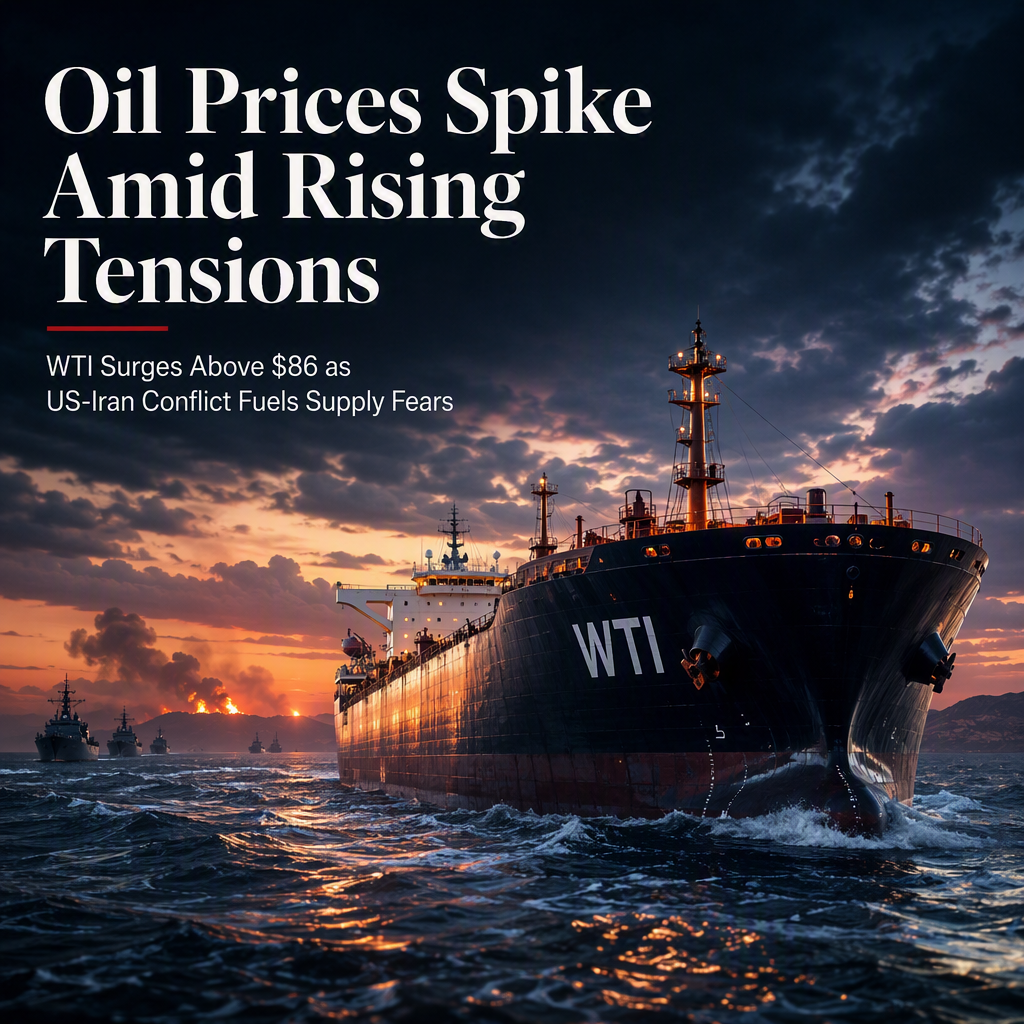
West Texas Intermediate (WTI), the benchmark US crude oil price, climbed above $86.00 on Tuesday, marking its second consecutive day of gains as escalating tensions between the US and Iran, particularly around the Strait of Hormuz, fueled supply concerns [1]. The recent US military action involved strikes on two rocket launchers on Iran’s Larak Island in the Strait of Hormuz on Sunday, which was the first such strike since late July. This prompted an Iranian counterattack on American air bases in Jordan. US President Donald Trump subsequently warned that further military action was possible and threatened to hit Iran 'hard,' maintaining a heightened geopolitical risk premium in the oil market [1].
From a technical perspective, WTI is trading comfortably above the 100-day Simple Moving Average (SMA) at $85.07 and the 38.2% Fibonacci retracement at $82.60, with the Moving Average Convergence Divergence (MACD) indicator remaining marginally positive and the Relative Strength Index (RSI) near 58, indicating ongoing buying interest [1]. Immediate resistance is identified at the 50.0% retracement level of $87.30, with a more significant barrier at the 61.8% retracement at $92.01. A daily close above $87.30 could pave the way for tests of higher retracement hurdles at $98.71 and $107.25. On the downside, support levels are seen at the 100-day SMA ($85.07), the 38.2% retracement ($82.60), and deeper at $76.77 and $67.36 if a broader correction occurs [1].
The current market environment is characterized by strong buying momentum, underpinned by geopolitical risks and technical factors, suggesting that buyers maintain control of the broader trend despite recent consolidation below higher retracement levels [1]. No specific analyst opinions or forward-looking statements beyond the technical outlook and geopolitical context were provided in the article [1].
CONCLUSION
WTI crude oil prices have surged above $86.00, driven by renewed US-Iran tensions and supply concerns in the Strait of Hormuz. Technical indicators point to sustained buying interest, with key resistance and support levels in focus. The market remains sensitive to further geopolitical developments, which could continue to influence oil prices in the near term.