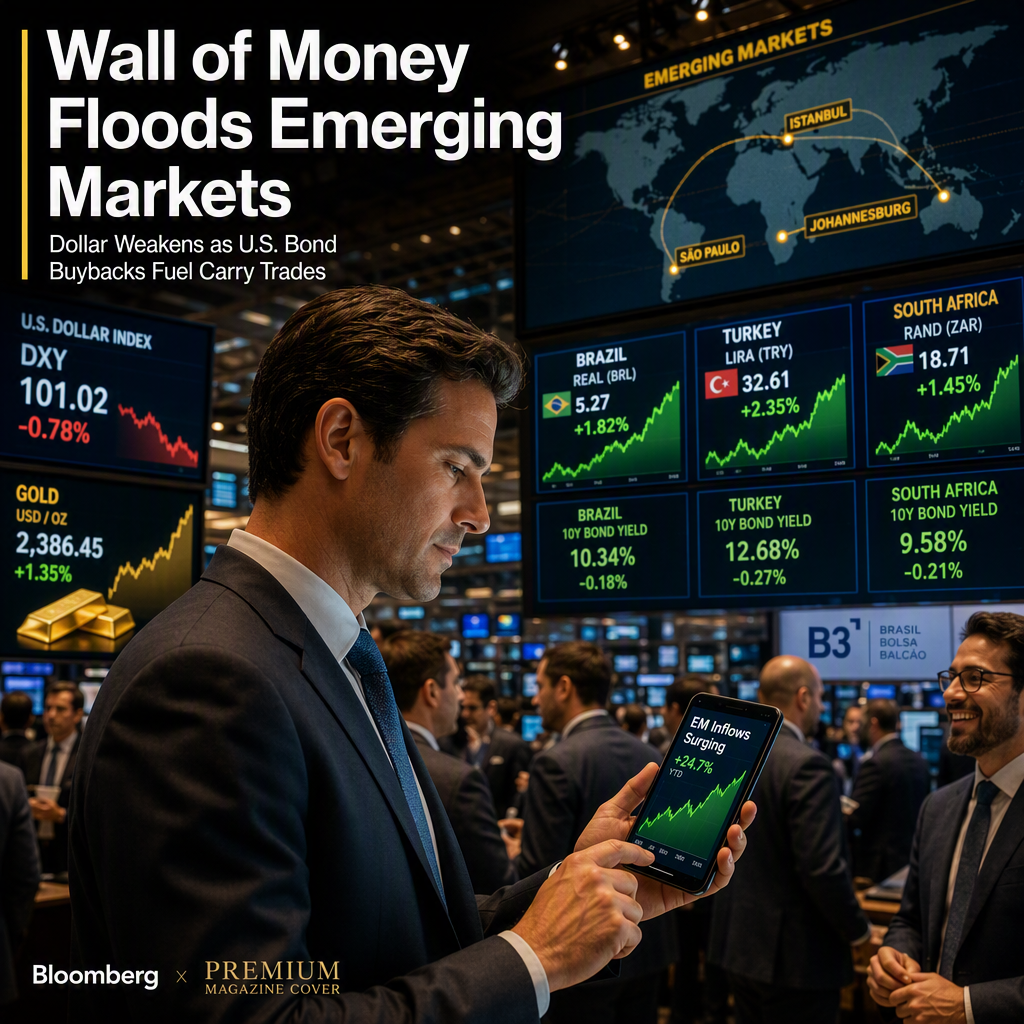
Emerging markets are expected to receive a significant influx of investor capital, described as a 'wall of money,' following the U.S. Treasury's recent bond buyback plans, according to analysts from the Brookings Institution and other financial experts [1]. The U.S. Treasury Secretary, Scott Bessent, doubled planned buybacks of longer-dated U.S. government debt last month to ease pressure on long-term yields, which had surged due to inflation and debt concerns [1]. This intervention has weakened the U.S. dollar, prompting investors to seek higher-yielding assets in emerging markets such as Brazil, Turkey, and Colombia [1].
Robin Brooks, a senior fellow at the Brookings Institution, stated that the efforts by developed economies to lower longer-dated government bond yields are supporting the carry trade, where investors borrow in a low-yielding currency to invest in higher-yielding assets [1]. The greatest risk to carry trades—a sudden spike in borrowing costs—has been reduced due to the U.S. government's actions, according to Brooks [1].
Data from TD Securities shows that global emerging market bond funds recorded inflows of $967 million in the week to Wednesday, an increase of about 15% from the previous week, even as overall bond fund inflows slowed [1]. The South Korean won strengthened 2.83% against the dollar since the bond buyback announcement, while the Brazilian real and South African rand gained 0.64% and 0.59%, respectively, according to LSEG data [1].
Peter Kinsella, global head of FX strategy at Union Bancaire Privee, noted that the Treasury's announcement signaled potential U.S. policies akin to financial repression, resulting in a weaker USD and benefiting high-yielding G10 and emerging market currencies [1]. Kinsella added that the environment for carry trade outperformance remains strong, with low volatility and broadly falling inflation [1]. Brazil and Turkey are particularly favored due to their high nominal and inflation-adjusted yields, with Brazil's benchmark interest rate at 14% and 12-month inflation at 4.2% as of mid-August [1]. Gold prices have also surged as investors seek safe havens, with support from Deutsche Bank and Bridgewater Associates founder Ray Dalio [1].
CONCLUSION
The U.S. Treasury's bond buyback program has weakened the dollar and fueled a surge of capital into emerging markets, particularly those with high yields like Brazil and Turkey. Analysts expect this trend to continue, supported by favorable conditions for carry trades and ongoing investor demand for higher returns and safe havens.