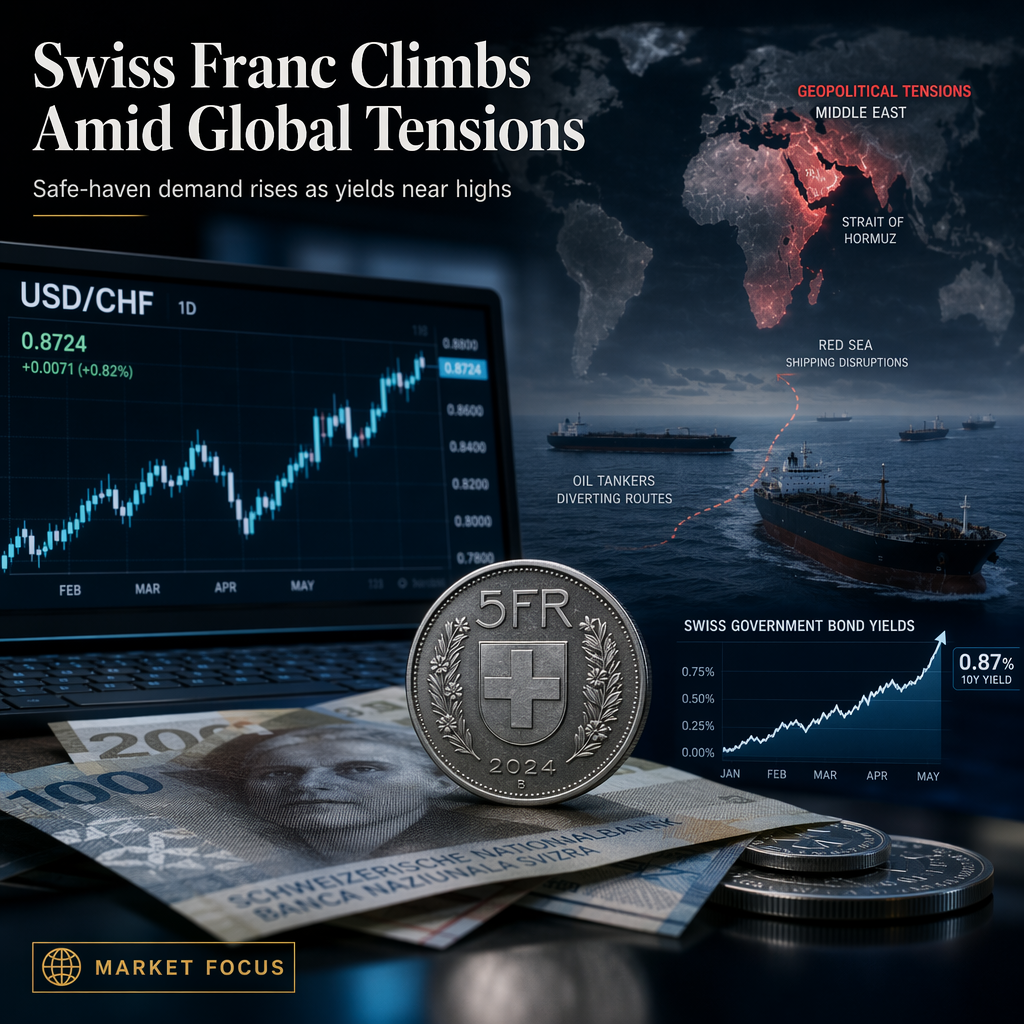
The Swiss Franc edged higher as geopolitical tensions between the United States and Iran entered their eleventh consecutive day, with USD/CHF trading around 0.8120, down 0.09% on the day as of Wednesday morning. The ongoing conflict has led US President Donald Trump to dismiss immediate negotiations with Tehran after a series of military strikes, and he threatened to target Picaxe Mountain, a site believed to house nuclear facilities. In response, Tehran warned that any attack on these facilities would escalate the conflict regionally. The situation has also affected global shipping, with Houthi rebels announcing a blockade of the Bab el-Mandeb Strait, causing three Saudi oil tankers to turn back in the Red Sea and renewing concerns about disruptions to global energy supplies. This has underpinned demand for safe-haven assets such as the Swiss Franc and the US Dollar [1].
In Switzerland, the 10-year government bond yield is around 0.45%, near its highest level in two months. Rising energy costs, driven by the geopolitical tensions, are prompting markets to reassess inflation and monetary policy outlooks. Despite these pressures, the Swiss National Bank (SNB) kept its policy rate unchanged at 0% at its latest meeting, maintaining that inflation is expected to remain broadly stable over the medium term [1].
Analysts at ING suggest that USD/CHF could become an increasingly popular vehicle in the coming months, noting that the SNB is unlikely to intervene in the foreign exchange market as aggressively as the Bank of Japan did earlier in the year. ING believes the SNB likely welcomes a weaker Swiss Franc and is expected to be one of the last central banks to hike rates, especially as higher energy prices and global rates widen interest rate differentials against Swiss rates. ING has discussed the potential for a higher USD/CHF, stating that if energy prices rise further, USD/CHF could see significant gains if it breaks the 0.8150/70 resistance level [1].
Rabobank strategists note that CHF net shorts have fallen for a third consecutive week, as the safe-haven rally driven by the Iran conflict has faded and SNB intervention warnings have limited speculative demand. Rabobank expects EUR/CHF to consolidate around 0.92 over the next three months and USD/CHF to remain near 0.81 in the second half of the year, suggesting a period of range trading rather than renewed aggressive safe-haven inflows into the Franc [1].
CONCLUSION
The Swiss Franc has seen modest gains amid ongoing US-Iran tensions and rising Swiss yields, but analysts expect range-bound trading ahead. While safe-haven demand has faded, the SNB's policy stance and global energy developments remain key factors for the currency's outlook.